Credible Theories Sign in

The record

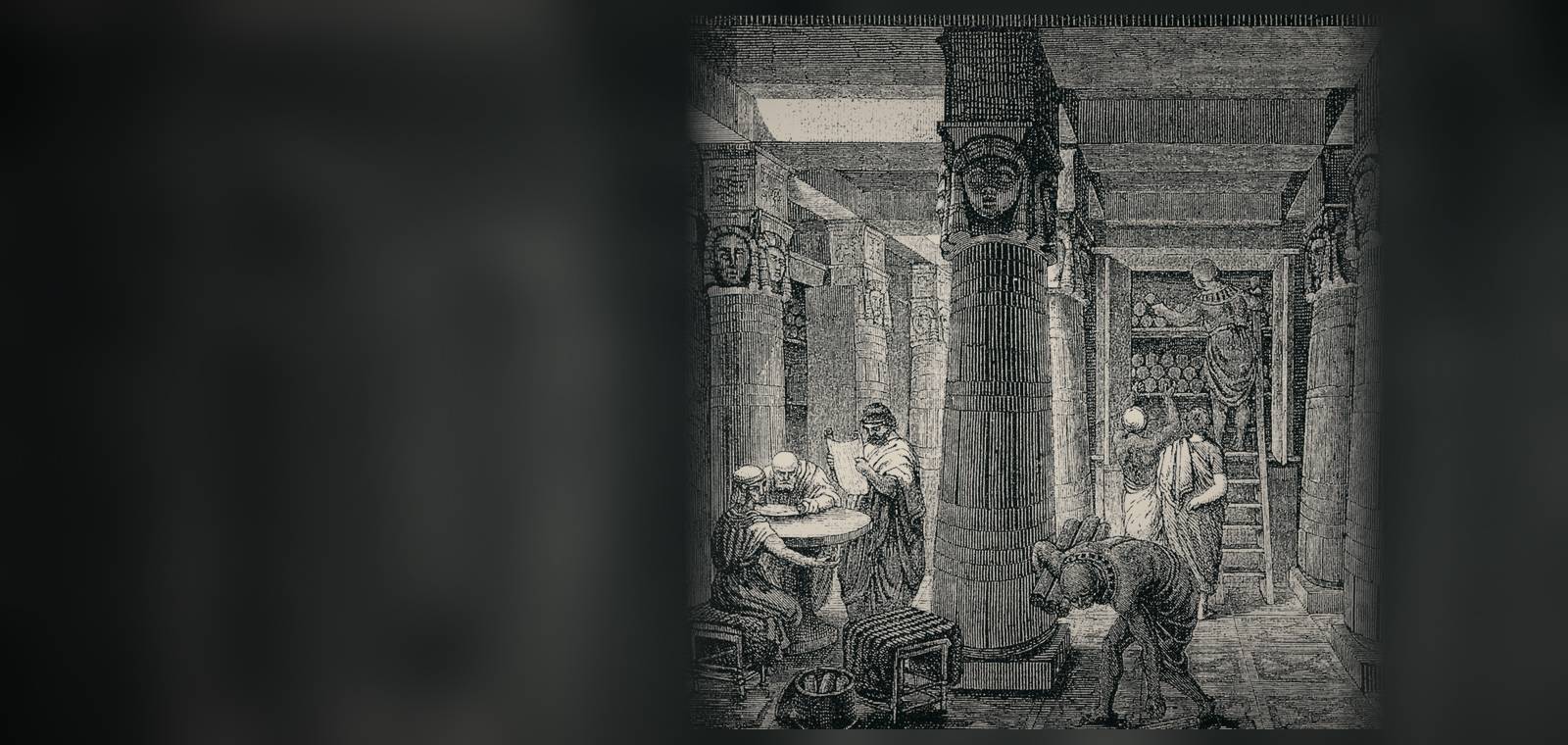
The Library of Alexandria was the great book collection of Egypt's Greek kings, the Ptolemies, in their capital on the Mediterranean coast. It belonged to the Museum, a royal house of learning. No one today can point to its walls, so what is known comes from writers of the Roman age.

Writing about 150 years after Caesar, the Greek author Plutarch said that during Julius Caesar's war in Alexandria, in 48 BCE, Caesar used fire to stop the enemy from cutting off his fleet, and this spread from the dockyards and destroyed the great library. In the 100s CE the Roman writer Aulus Gellius gave a number: nearly seven hundred thousand volumes, which, he said, were all burned during the sack of the city in our first war with Alexandria, not intentionally or by anyone's order, but accidentally by the auxiliary soldiers.

The puzzle is that the scholars do not seem to have left. The geographer Strabo, who lived in Egypt a generation after the fire, described the Museum as still part of the royal palaces, with a public walk, an Exedra with seats, and a large house, in which is the common mess-hall of the men of learning who share the Museum. Its priest, he wrote, was once chosen by the kings but is now appointed by Caesar. Strabo does not say how many books it still held. How much burned in 48 BCE, and when the last of the collection was lost, are questions the old writers leave open.
Questions people ask about The Library of Alexandria

Was Alexandria the first public library?

Not according to Aulus Gellius. He says the tyrant Pisistratus first set up a public library at Athens, that Xerxes carried its books off to Persia, and that King Seleucus Nicator later sent them back.

How did Caesar escape in Alexandria?

Plutarch says that in a fight near the Pharos he jumped from the harbor wall into a small boat, then, when the boat was sunk, swam to safety with many papers held above the water in one hand while missiles flew at him.

What else stood in Alexandria's royal quarter?

Strabo describes the Sema, an enclosure holding the tombs of the Ptolemies and of Alexander the Great, as part of the same royal palaces as the Museum. He says Ptolemy, son of Lagus, took Alexander's body from Perdiccas, who was bringing it down from Babylon.

The open question

Still strange: The library that burned and kept working.

Yet Strabo, a generation later, described the Museum's scholars still sharing their common dining hall.

Emerald Tablet: Where Does "As Above, So Below" Come From? →
  1. Step 1 of 4 · This fileThe Library of Alexandria
  2. Step 2 of 4 · Next fileEmerald Tablet: Where Does "As Above, So Below" Come From?
  3. Step 3 of 4 · Next fileHermes Trismegistus: Who Wrote the Hermetic Books?
  4. Step 4 of 4 · Next fileManetho: Why Did Egypt's First Historian Begin With Gods?
About these videos

Found by a YouTube search for this topic, not checked by us. The player loads from YouTube only when you press play.

Where this comes from

EvidenceDocumented

Comes from Plutarch, Life of Caesar 49, trans. Bernadotte Perrin (Loeb, 1919), LacusCurtius. Plutarch's Lives: Life stories of famous Greeks and Romans written by Plutarch, a Greek writer and priest at Delphi, around AD 100 to 120. They are full of personal detail and anecdotes, not all of them checked.

What this means

Records exist and are linked below. This page says what the records say.

For The Library of Alexandria, the original record exists and is linked: Plutarch, Life of Caesar 49, trans. Bernadotte Perrin (Loeb, 1919), LacusCurtius. That tells you the record is real and what it says. It does not mean every claim in it is true.

Primary records exist: an original document, a published text, an official file or a dated report. We link to them. This level says the record exists and what it says, not that every claim in it is true.

See all five labels

Sources

  1. Plutarch's LivesLife stories of famous Greeks and Romans written by Plutarch, a Greek writer and priest at Delphi, around AD 100 to 120. They are full of personal detail and anecdotes, not all of them checked. Bernadotte Perrin's English version came out from 1914.Plutarch, Life of Caesar 49, trans. Bernadotte Perrin (Loeb, 1919), LacusCurtiusPrimary text
  2. LacusCurtiusLacusCurtius, a website of Greek and Roman texts and translations, many from the Loeb Classical Library, put online and carefully proofread by Bill Thayer and hosted on a University of Chicago server.Aulus Gellius, Attic Nights 7.17, trans. J. C. Rolfe (Loeb, 1927), LacusCurtiusPrimary text
  3. Geography, by StraboA 17-book description of the lands and peoples of the known world by Strabo, a Greek geographer, finished around AD 20 to 25. It includes an account of the city of Helike sinking in 373 BC.Strabo, Geography 17.1.8, trans. H. L. Jones (Loeb, 1932), LacusCurtiusPrimary text

Quotations come from public-domain translations. A book in our Library links to its Library page; other links open the free online copy or the reference page.

Updated

Credible or not?

Tap one to see how other readers voted.

Discussion