












The Meaning of the Glorious Koran, Pickthall, 1930
A complete English Quran by Marmaduke Pickthall, an English convert to Islam. It includes the passages about the jinn, Gog and Magog, and the youths who slept in the cave, all in a single, readable translation.
Public domain copy
Read The Meaning of the Glorious Koran, Pickthall, 1930 online
Theology Library
SCHOOL OF THEOLOGY AT CLAREMONT California
From the library of Wilson ie Hume
apy a
THE MEANING OF iReols, GLORIOUS KORAN
Koran. E nq lish: WA
; THE MEANING OF a” I = ae Clorious orn
AN EXPLANATORY TRANSLATION
BY
MARMADUKE PICKTHALL
NEW YORK ALFRED * A ° KNOPF 1930
PRINTED IN ENGLAND FOR
ALFRED A.KNOPEF INC.
BY RICHARD CLAY @” SONS LTD. BUNGAY SUFFOLK
TO HIS EXALTED HIGHNESS THE NIZAM
the translator expresses his
gratitude for the most gen- erous grant of leave which enabled him to complete this work while in His Exalted Highness’s
service.
TRANSLATOR’S FOREWORD
THE aim of this work is to present to English readers what Muslims the world over hold to be the meaning of the words of the Koran, and the nature of that Book, in not unworthy language and concisely, with a view to the requirements of English Muslims, It may be reasonably claimed that no Holy Scripture can be fairly presented by one who disbelieves its inspiration and its message; and this is the first English translation of the Koran by an Englishman who is a Muslim. Some of the translations include commentation offensive to Muslims, and almost all employ a style of language which Muslims at once recognise as unworthy. The Koran cannot be translated. That is the belief of old-fashionedSheykhs and theview of the present writer. The Book is here rendered almost literally and every effort has been made to choose befitting language. But the result is not the Glorious Koran, that inimitable symphony, the very sounds of which move men to tears and ecstasy. It is only an attempt to present the meaning of the Koran—and peradventure something of the charm—in English. It can never take the place of the Koran in Arabic, nor is it meant to do so.
Before publication the work has been scrutinised word by word and thoroughly revised in Egypt with the help of one whose mother- tongue is Arabic, who has studied the Koran and who knows English; and when difficulties were encountered the translator had recourse to perhaps the greatest living authority on the subject. Every care has thus been taken to avoid unwarrantable renderings. On the one or two occasions where there is departure from the traditional inter- pretation, the traditional rendering will be found in a footnote.
The translator’s thanks are due to Lord Lloyd for an introduction of great use in Egypt; to Dr. F. Krenkow for supplying him with old meanings of Arabic words not to be found in dictionaries; to Muhammad Ahmad Al-Ghamrawi Bey of the Cairo College of Medicine for his invaluable and patient help with the revision of the manuscript, a work which occupied three months; tothe Sheykh Mustafa
vii
Vill TRANSLATOR’S FOREWORD
Al-Maraghi, former Rector of Al-Azhar University, for his advice and guidance in the revision; and to His Excellency Fuad Bey Salim Al-Hig4zi, by whose efforts such revision was made possible.
The mushaf (copy of the Koran) which has been used throughout 1s a lithograph copy of that written by Al-Hajj Muhammad Shakar- _ zadeh at the command of Sultan Mahmiid of Turkey in 1246 A.H. In the Introduction and the notes to individual strahs, Ibn Hishdm (Balaq ed. 1295 A.H.) has been followed, with occasional reference to the much later, much abbreviated, but more critical Life of the Prophet by Ibn Khaldiéin (published as an appendix to his Térikh, Bulag ed.). Other Strabs, like that of Ab&’l-Fida, late in date and uncritical, have been read but not followed. Of commentators AlI- Beydawi and Zamakhshari must be mentioned, while for reference during the work of revision, the brief commentary of Al-Jalaleyn was kept at hand. WAbhidi’s Asbabu ’n-Nuziil has been largely consulted, and for the authenticity of Traditions the translator has relied upon
Bukhari.
INTRODUCTION
PART I
At Mecca
MuHAMMapD, son of Abdullah, son of Abdul Mutallib, of the tribe of Qureysh, was born at Mecca fifty-three years before the Hijrah.
The Prophet’ s
His father died before he was born, and he was protected first by his birth
grandfather, Abdul Mutallib, and, after his grandfather’s death, by his uncle, Abi Talib. As a young boy he travelled with his uncle in the merchants’ caravan to Syria, and some years afterwards made the same journey in the service of a wealthy widow named Khadijah. So faithfully did he transact the widow’s business, and so excellent was the report of his behaviour which she received from her old servant who had accompanied him, that she soon afterwards married her young agent; and the marriage proved a very happy one, though she was fifteen years older than he was. Throughout the twenty-six years of their life together he remained devoted to her; and after her death, when he took other wives he always mentioned her with the greatest love and reverence. This marriage gave him rank among the notables of Mecca, while his conduct earned for him the surname Al-Amin, the “‘trustworthy.”’
The Meccans claimed descent from Abraham through Ishmael, and tradition stated that their temple, the Ka‘bah, had been built by Abraham for the worship of the One God. It was still called the House of Allah, but the chief objects of worship there were a number of idols which were called daughters of Allah and intercessors. The few who felt disgust at this idolatry, which had prevailed for cen- turies, longed for the religion of Abraham and tried to find out what had been its teaching. Such seekers of the truth were known as HTunafa (sing. Hanif), a word originally meaning “those who turn away’ (from the existing idol-worship), but coming in the end to
His mar- riage
The Hunafa
The first revela- tion
The vision of Mt. Hira
2 THE GLORIOUS -RORAN
Read the story behind it
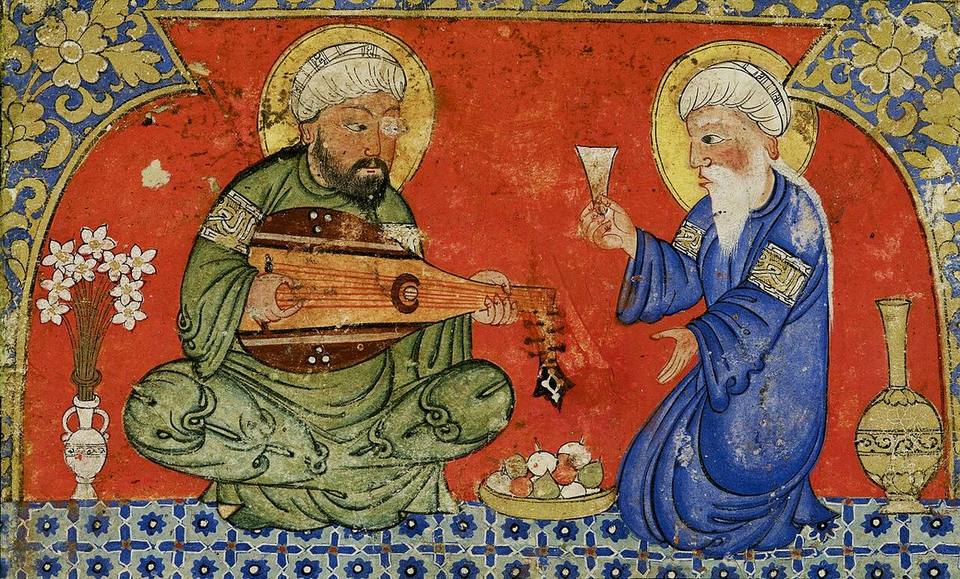 BeingJinnMyth or legendA second species, made of smokeless fire and hidden from sight, shares the world with us, the Quran says. They eat, marry, die and choose whether to believe; one chapter claims they once sat in listening posts in heaven, until meteors drove them off. What were they trying to overhear?
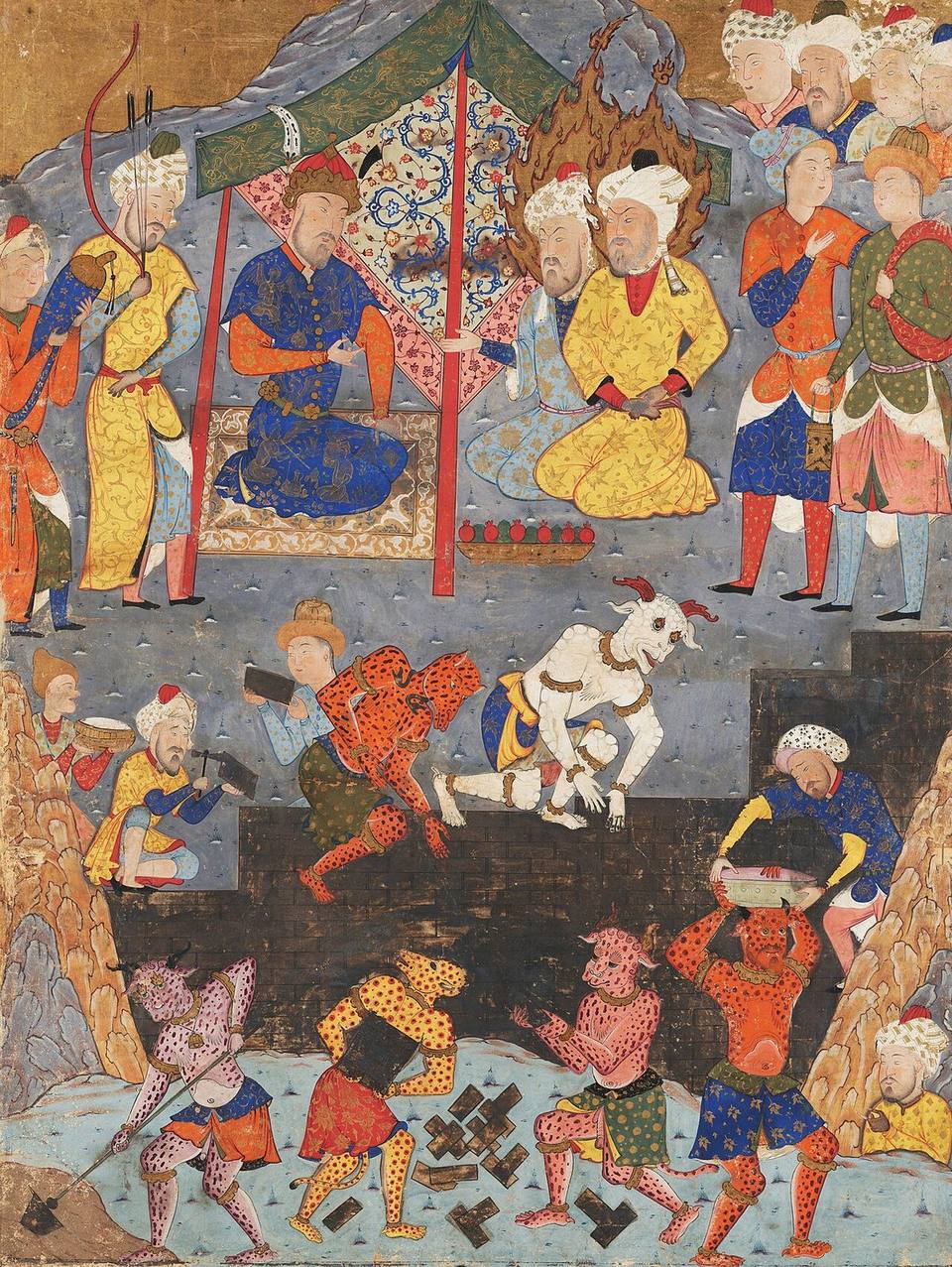 BeingGog and MagogMyth or legendAccording to the Bible and the Quran, a people is penned behind a wall at the edge of the world and will break loose at the end of time. In the 9th century a caliph sent a real expedition to inspect that wall, and its report survives. What did the travelers report?
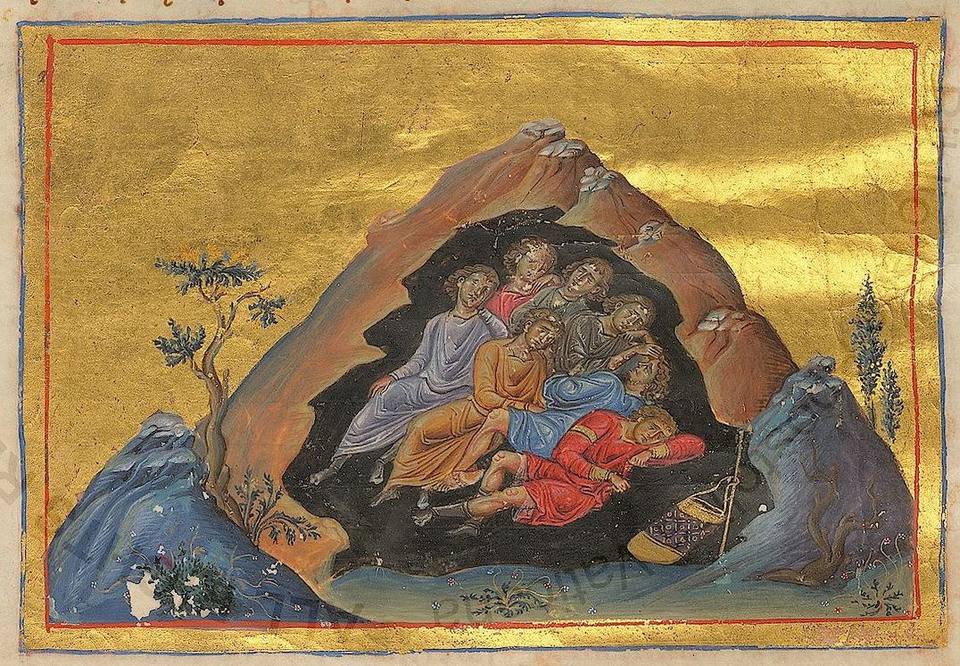 PersonPeople of the Cave (Seven Sleepers)Myth or legendYoung believers hide in a cave, and the Quran says they slept "three hundred years and add nine," their dog stretched at the entrance. That odd extra nine matches the gap between 300 solar years and 309 lunar years almost exactly; then one of them walks into town with an old silver coin. What happens next?
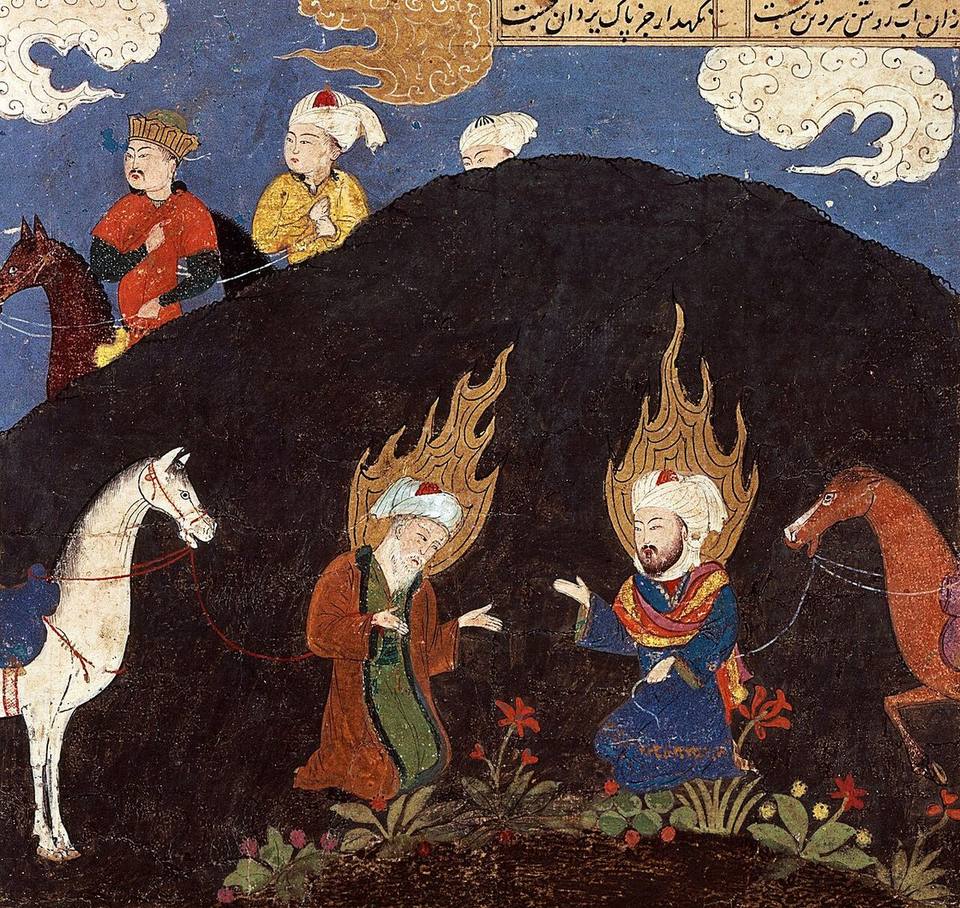 PersonDhul-QarnaynMyth or legendThe Quran describes a ruler who found the sun setting in a muddy spring, then sealed a people behind a wall. It even gives the recipe: iron heated with bellows until it glows, then covered with poured molten copper. Who was the Two-Horned One, and what was he locking away?
The same story, told elsewhere
Shared story · Death and return
Taken Up to Heaven: Ascension Stories Compared
Enoch, Elijah, Romulus, Heracles, Krishna and Jesus all leave the earth by going up: in a whirlwind, a cloud, a storm or a blaze of light. The stories quoted side by side.
Quran 17:1 (the Night Journey) is one telling. The same story is told 6 more times, in 3 parts of the world. Follow it:
- Hebrew BibleJudah · c. 600-400 BCE · Ancient text
- Hebrew BibleNear the Jordan River, Israel · c. 600-550 BCE · Ancient text
- HinduDvaraka, western India · c. 400 BCE · Ancient text
- GreekMount Oeta, central Greece · c. 1st-2nd century CE · Ancient text
- ChristianMount of Olives, Jerusalem · c. 80-90 CE · Ancient text
- RomanRome, near the Goat's Marsh · c. 100 CE · Ancient text
- IslamicMecca to Jerusalem · c. 620 CE · Medieval textTied to this page
The open question: Why do so many stories end with a great figure leaving the earth alive instead of dying like everyone else? Join the debate
Shared story · Heroes and trials
A Child Offered Up: Abraham, Jephthah, Agamemnon and Harishchandra
A father is told, or promises, that he must give up his own child. Sometimes an animal is found in time and sometimes no one stops the knife, and the story is told in the Bible, the Quran, Greece, India and Viking-age Sweden.
Quran, Surah 37, As-Saffat (Abraham's son) is one telling. The same story is told 8 more times, in 4 parts of the world. Follow it:
- Hebrew Bible (about Moab)Kir-hareseth, Moab · c. 850 BCE · Ancient text
- Vedic IndiaNorthern India · c. 800-600 BCE · Ancient text
- Hebrew BibleGilead, east of the Jordan · c. 7th-6th century BCE · Ancient text
- Hebrew BibleJudah / Israel · 1st millennium BCE · Ancient text
- GreekAthens, Greece · 458 BCE · Ancient text
- Phoenician (in Greek)Byblos, Lebanon · c. 100 CE · Ancient text
- IslamArabia · 7th century CE · Medieval textTied to this page
- Norse (Swedish legend)Uppsala, Sweden · c. 1225 CE · Medieval text
- French (Greek legend)France · 1699 · Recorded folklore
The open question: Do these stories remember a time when people really gave up their children, or were they told to teach that it must never happen? Join the debate
Shared story · Beginnings
People Made From Clay: Adam, Nuwa, Prometheus and the Potter Gods
A god kneels in the mud, shapes a body with his hands and breathes it into life. That scene is told in Iraq, Israel, Egypt, Greece, China, Arabia, Guatemala, Sudan and New Zealand.
Quran, Surah al-Hijr is one telling. The same story is told 8 more times, in 6 parts of the world. Follow it:
- Babylonian (Akkadian)Mesopotamia · c. 1700 BCE · Ancient text
- Ancient EgyptianEgypt · c. 1215 BCE · Ancient text
- Hebrew BibleJudah · c. 900-450 BCE · Ancient text
- GreekGreece · 1st or 2nd century CE · Ancient text
- ChineseChina · c. 195 CE · Retold in English
- IslamArabia · 7th century CE · Medieval textTied to this page
- K'iche' MayaHighland Guatemala · c. 1554-1558 · Retold in English
- Maori (New Zealand)Aotearoa · 19th century · Retold in English
- Shilluk (South Sudan)White Nile, South Sudan · 1911 · Retold in English
The open question: Did one old story about a potter god travel from people to people, or does anyone who works with clay end up imagining that we were made from it? Join the debate
Shared story · Death and return
Sleepers Who Wake Years Later: Epimenides, Honi, the Seven Sleepers and Rip Van Winkle
A man lies down for a nap and wakes to find his brother old, his village gone and his coins worth nothing. The same story is told in Crete, Judea, Ephesus, Arabia, India, Japan, Ireland and New York.
Quran, Surah al-Kahf (the People of the Cave) and Quran, Surah al-Baqarah (the man who slept a hundred years) are two tellings. The same story is told 7 more times, in 6 parts of the world. Follow it:
- GreekCrete · c. 200-250 CE · Ancient text
- Hindu (Puranic)India · c. 300-500 CE · Ancient text
- Jewish (Babylonian Talmud)Judea · c. 500-600 CE · Medieval text
- Christian (Seven Sleepers of Ephesus)Ephesus · c. 500 CE · Medieval text
- IslamArabia · 7th century CE · Medieval textTied to this page
- IslamArabia · 7th century CE · Medieval textTied to this page
- JapaneseJapan · c. 759 CE · Medieval text
- IrishIreland · c. 1750 · Early modern text
- AmericanCatskill Mountains, New York · 1819 · Recorded folklore
The open question: Is the long sleep a story people passed along from Crete to Ephesus to New York, or does every culture invent it because everyone fears coming home to a world that has moved on? Join the debate
Where this comes from
Comes from The Quran, the copy of The Meaning of the Glorious Koran, Pickthall, 1930 we host here. The Meaning of the Glorious Koran: an explanatory translation by Marmaduke Pickthall, New York: A. A. Knopf, 1930 (viii, 693 pages).
What this means
A primary record or a faithful public-domain copy of one. This page says what the file is and where it comes from; it does not say every claim in it is true.
Primary records exist: an original document, a published text, an official file or a dated report. We link to them. This level says the record exists and what it says, not that every claim in it is true.
Where and when was it found?
- Written
- 610 to 632 CE, during the life of Muhammad; a standard written version was set under the caliph Uthman (ruled 644 to 656)
- Where it was found
- Early Quran manuscripts survive in many collections; two early leaves are in the Cadbury Research Library, University of Birmingham, England
- When it was found
- Never lost; recited and copied from the start. The Birmingham leaves were collected by Alphonse Mingana in the 1920s and radiocarbon dated in 2015
- Oldest copy
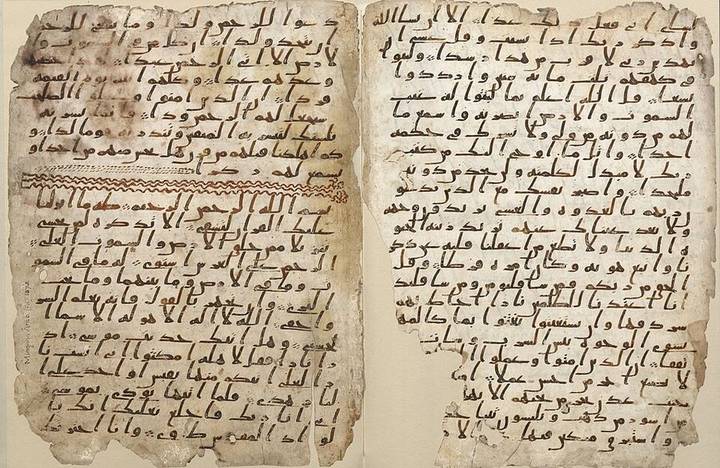
- The Birmingham Quran manuscript, two parchment leaves radiocarbon dated to between 568 and 645 CE, part of the Mingana Collection at the University of Birmingham
- Original language
- Arabic
About this copy
This is a public-domain copy. The line below says where the file comes from and why we may host it.
Why we can share it: Reasoning: the work was published in 1930 (archive.org metadata date 1930, publisher New York: A.A. Knopf); under 17 USC 304 US works published in 1930 entered the public domain on 1 January 2026; translator Pickthall died 1936. The archive.org item itself carries no public-domain statement or license field.
Updated