How the rabbit hole works. Start with anything that grabs you, say UFOs. Every person, place and document a page mentions links to its own page, so a UFO file leads to a witness, the witness leads to the people who investigated the case, and it keeps going.
The path you take shows in the bar under the top menu on every page, so you can step back any time or climb out and start again.
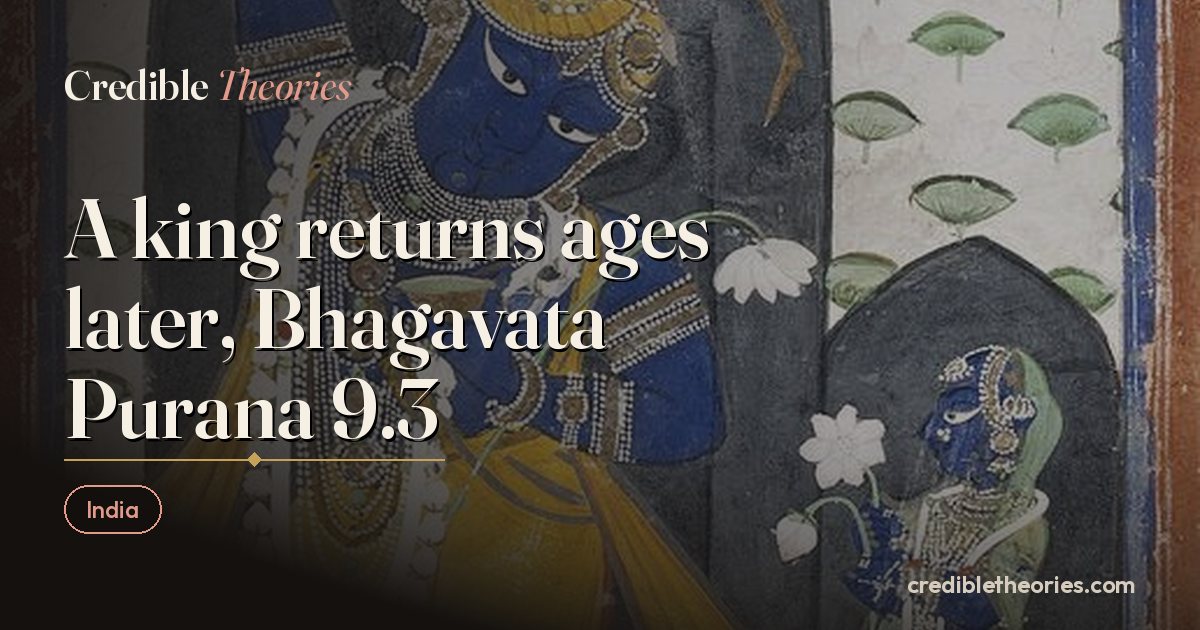
This is a summary from the Bhagavata Purana, a Sanskrit book of Hindu stories usually dated to about 800 to 1000 CE. King Kakudmi takes his daughter Revati to the realm of the god Brahma to ask about a husband for her. Brahma laughs and tells them that while they waited, 27 cycles of ages passed on earth.
ReferenceBhagavata Purana 9.3 (Kakudmi and Revati)
Writtenc. 800–1000 CE
SetSatya Yuga
King Kakudmi takes his daughter Revati to Brahma's realm to ask for a husband. Brahma laughs: while they waited, 27 cycles of ages passed on earth, and everyone they knew is long gone.
Documented · Retold in English, c. 800–1000 CE Summary by the editors. Translation: Summary in my own words
AdvertisementAd space
Read it literally
Clear time dilation, told as a joke by a god.
What scholars say
Puranic literature.
Themes Strange time Taken up alive
Questions people ask about Bhagavata Purana 9.3
Where can I read Bhagavata Purana 9.3?
The tale is in the ninth of the Bhagavata Purana's twelve books, which together contain about 18,000 verses. A full English translation with commentary by A. C. Bhaktivedanta Swami Prabhupada, founder of the Hare Krishna movement, can be read free on the Vedabase website. Shorter versions of the same story also appears in the Vishnu Purana.
When was Bhagavata Purana 9.3 written?
Most scholars date the Bhagavata Purana to roughly 800 to 1000 CE, and many think it was composed in South India, in the Tamil region, because of its strong links to the devotional poetry of the Alvars. Hindu tradition instead credits the sage Vyasa and sees it as far older.
What do scholars say about Bhagavata Purana 9.3?
They read it against Puranic ideas of time, in which one day of the creator Brahma lasts 4.32 billion human years, so a short wait in his hall equals ages on earth. In the story Revati then marries Balarama, Krishna's brother. Later retellings add that she was so tall from the earlier age that Balarama shortened her with his plough.
Used on these files
Kakudmi and Revati: The Short Visit That Lasted AgesMyth or legendA king and his daughter visit the creator god, wait politely through one musical performance, and return to find twenty-seven cycles of four ages have passed on earth. Scholars explain it through Puranic cosmology and note similar tales in Irish and Japanese folklore. What does a man find when his whole world is gone?
Where this comes from
EvidenceDocumented
Comes fromThe Bhagavata Purana, Bhagavata Purana 9.3 (Kakudmi and Revati). A Sanskrit book of Hindu stories, mainly about the god Vishnu and his form as Krishna. Scholars usually date it to about AD 800 to 1000.
What this means
The text exists and is quoted from a published translation. What it describes is a separate question.
Primary records exist: an original document, a published text, an official file or a dated report. We link to them. This level says the record exists and what it says, not that every claim in it is true.
The Bhagavata PuranaA Sanskrit book of Hindu stories, mainly about the god Vishnu and his form as Krishna. Scholars usually date it to about AD 800 to 1000. It tells of King Kakudmi, who visits the god Brahma for a short while and returns to find that ages have passed on earth.Bhagavata Purana 9.3 (Kakudmi and Revati), Bhaktivedanta VedaBasePrimary textArchived copy, 2026-10-03
Scholarly dates are rounded. The wording follows the named public-domain translation.
More from India
Two more stories, and what each shares with A king returns ages later.