Credible Theories Sign in
Greece and Rome · Liudprand of Cremona, Antapodosis 4.25

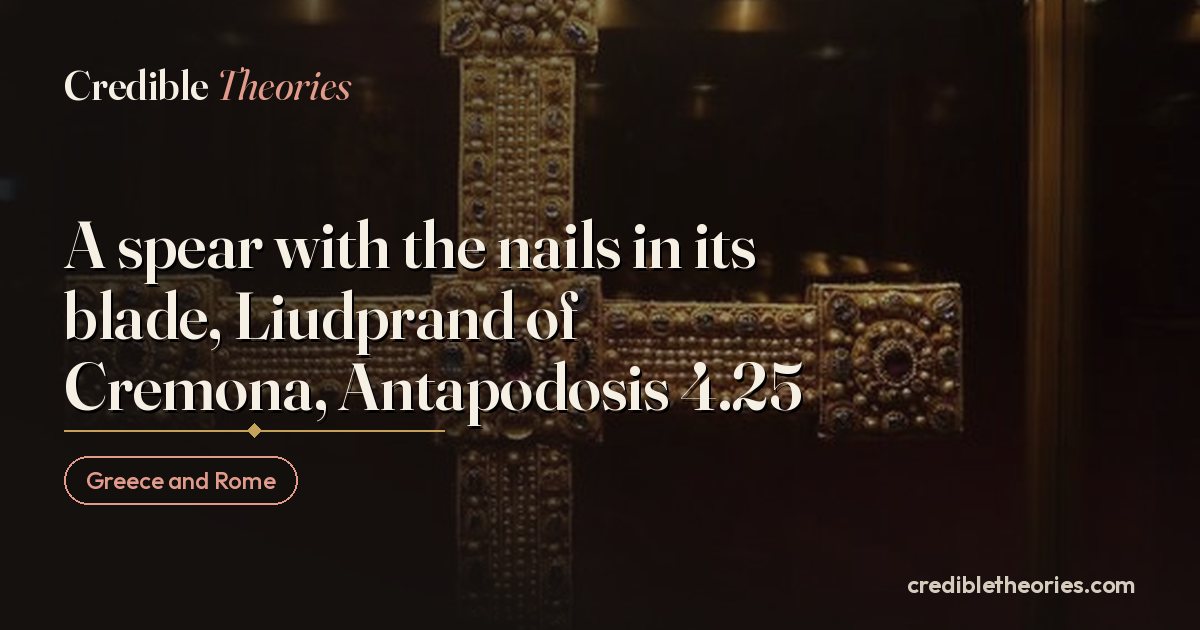
A spear with the nails in its blade, Liudprand of Cremona, Antapodosis 4.25

Share

In plain words

Liudprand describes a spear unlike any other, with openings on both sides of its middle and two sharp edges sloping down toward the center. People said it had belonged to the emperor Constantine, son of Saint Helena, who found the cross.

ReferenceLiudprand of Cremona, Antapodosis 4.25
WrittenWritten by Liudprand of Cremona, an Italian bishop, in his history Antapodosis in the 900s
SetThe court of King Henry, who forced Rodulf of Burgundy to hand over the sacred spear
It was of a different appearance from ordinary spears, of a novel shape and constructed in a novel fashion, with apertures on either side of its waist. In front of the thumb pieces two fine cutting edges extend sloping down to the middle of the spear. It is said that it once belonged to Constantine the Great, son of Saint Helena who found the life-giving cross.

Documented · Medieval text, 900 Translation: F. A. Wright, 1930

Read it literally

The oldest detailed description of the lance now in Vienna treats it as Constantine's spear with Christ's nails set in it, not yet the spear of Longinus. The Spear of Destiny file follows how its story changed.

What scholars say

Liudprand wrote during the reign of Henry's son Otto, who held the spear.

Themes Looks like technology
Questions people ask about Liudprand of Cremona, Antapodosis 4.25

How did King Henry get the spear?

Liudprand says Rodulf at first refused, so Henry threatened to lay his kingdom waste with fire and sword. Rodulf gave in, and Henry rewarded him with gold, silver and a large district of Swabia.

Where were the nails?

At the raised part in the middle, which Liudprand calls the waist, there were crosses made from the nails that pierced the hands and feet of Christ.

Used on these files

Where this comes from

EvidenceDocumented

Comes from F. A. Wright, Liudprand of Cremona, Antapodosis 4.25. Internet Archive: A nonprofit digital library in San Francisco, founded in 1996, that holds millions of scanned books, papers and recordings. A scan there shows the pages of a real printed book or document.

What this means

The text exists and is quoted from a published translation. What it describes is a separate question.

Primary records exist: an original document, a published text, an official file or a dated report. We link to them. This level says the record exists and what it says, not that every claim in it is true.

See all five labels

Sources

  1. Internet ArchiveA nonprofit digital library in San Francisco, founded in 1996, that holds millions of scanned books, papers and recordings. A scan there shows the pages of a real printed book or document.F. A. Wright, The Works of Liudprand of Cremona (London: Routledge, 1930)Primary text
  2. The Gospel of JohnOne of the four Gospels about the life of Jesus, usually dated by scholars to about AD 90 to 110, the last of the four to be written.John 19:34, King James Version (1611), Project GutenbergPrimary text Archived copy, 2026-10-03

Scholarly dates are rounded. The wording follows the named public-domain translation.

More from Greece and Rome

Two more stories, and what each shares with A spear with the nails in its blade.

Photo credits
RelatedHephaestus' golden robotsIliad 18.373–377, 417–420

It describes the god Hephaestus at work.

Same theme: Looks like technology
Photo credits
RelatedTalos, the bronze giantApollonius, Argonautica 4.1638–1688

It describes Talos, a giant man made of bronze who guarded the island of Crete.

Same theme: Looks like technology

Updated

Discussion