How the rabbit hole works. Start with anything that grabs you, say UFOs. Every person, place and document a page mentions links to its own page, so a UFO file leads to a witness, the witness leads to the people who investigated the case, and it keeps going.
The path you take shows in the bar under the top menu on every page, so you can step back any time or climb out and start again.
This is a short passage from the Argonautica, a Greek poem written around 250 BCE about Jason and the Argonauts and their quest for the Golden Fleece. It describes Talos, a giant man made of bronze who guarded the island of Crete. The text says he was the last of a bronze race, and he had one weak spot: a blood-red vein by his ankle.
ReferenceApollonius, Argonautica 4.1638–1688
Writtenc. 250 BCE
SetVoyage of the Argo
Talos, the man of bronze… he was of the stock of bronze, of the men sprung from ash-trees, the last left among the sons of the gods… but beneath the sinew by his ankle was a blood-red vein.
Genesis has the Nephilim, Greece has the Giants, the North has the frost giants, Arabia has the tall people of 'Ad and the Maya have Zipacna, who piled up mountains. Why does almost everyone remember giants?
Apollodorus, The Library (the Gigantomachy) is one telling. The same story is told 7 more times, in 4 parts of the world. Follow it:
The open question: Real bones dug up and explained, a memory of older peoples, or something else that made giants a story almost everywhere? Join the debate
Questions people ask about Apollonius, Argonautica 4.1638–1688
Who was Apollonius of Rhodes?
Apollonius was a Greek poet and scholar of the third century BCE who worked in Alexandria, Egypt. Ancient sources say he served as head of the famous Library there under the Ptolemy kings. His Argonautica tells the voyage of Jason and the Argonauts to win the Golden Fleece in four books, and it is the main Greek epic to survive from the Hellenistic age.
How does Medea defeat Talos in the Argonautica?
In Apollonius, Medea stands on the ship and uses spells, calling up spirits of death and casting an evil eye on Talos. As he lifts heavy rocks, he scrapes his ankle on a sharp stone. The ichor, the fluid of gods, pours out like melted lead and he crashes down. Other writers tell it differently, such as Medea pulling out the nail.
Who made Talos?
Ancient writers disagree. Apollonius says Zeus gave Talos to Europa to guard Crete. Apollodorus says some called Talos the last of the bronze race of men, while others said Hephaestus made him and gave him to King Minos. Ancient coins from Phaistos on Crete show a winged figure of Talos.
Used on these files
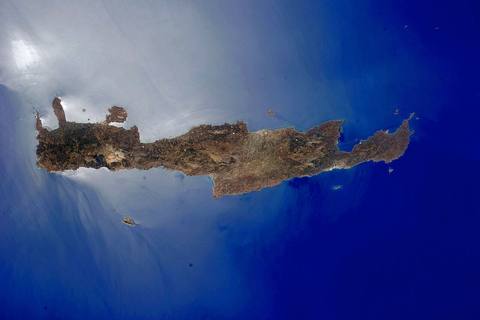
Talos: The Bronze Giant Who Guarded CreteMyth or legendA giant of bronze circled Crete three times a day hurling rocks at ships. His whole body was armored except one blood-red vein running neck to ankle, sealed by a single nail. Ancient tales say Medea brought him down. Was Talos a monster, or one of the first imagined robots? Historians disagree.
Where this comes from
EvidenceDocumented
Comes fromThe Argonautica, by Apollonius of Rhodes, Apollonius, Argonautica 4.1638–1688, read here in the R. C. Seaton. A Greek epic poem written in the 200s BC by Apollonius, a scholar at the great library of Alexandria in Egypt. It tells of Jason and the Argonauts and their quest for the Golden Fleece, including the bronze giant Talos who guarded Crete.
What this means
The text exists and is quoted from a published translation. What it describes is a separate question.
Primary records exist: an original document, a published text, an official file or a dated report. We link to them. This level says the record exists and what it says, not that every claim in it is true.
The Argonautica, by Apollonius of RhodesA Greek epic poem written in the 200s BC by Apollonius, a scholar at the great library of Alexandria in Egypt. It tells of Jason and the Argonauts and their quest for the Golden Fleece, including the bronze giant Talos who guarded Crete. R. C. Seaton's English version came out in 1912.R. C. Seaton, Apollonius Rhodius, The Argonautica (Loeb, 1912)Primary textArchived copy, 2026-07-17