The record
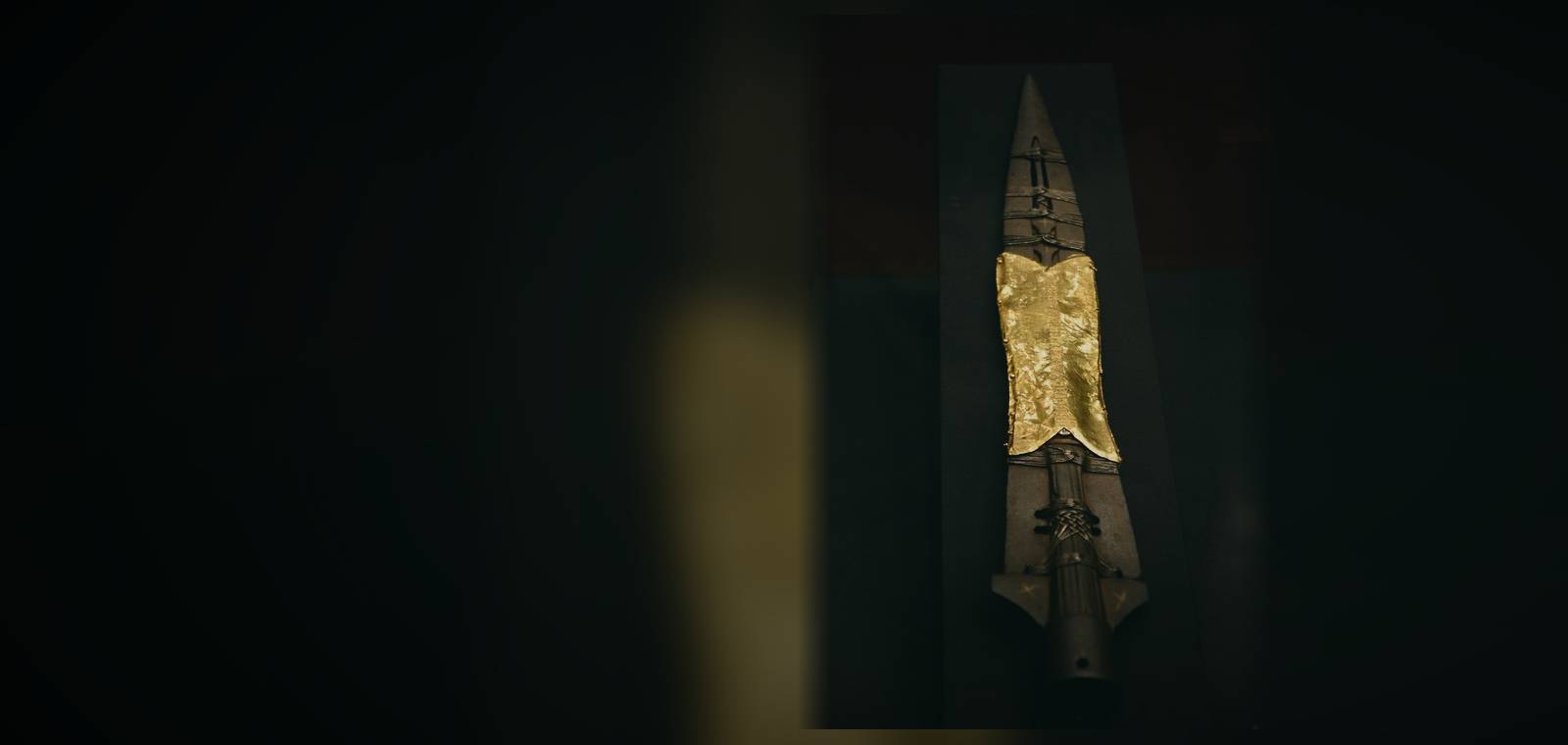
It was of a different appearance from ordinary spears, of a novel shape and constructed in a novel fashion, with apertures on either side of its waist. In front of the thumb pieces two fine cutting edges extend sloping down to the middle of the spear. It is said that it once belonged to Constantine the Great, son of Saint Helena who found the life-giving cross.
Liudprand of Cremona, Antapodosis 4.25 · Greece and Rome
Translation: F. A. Wright, The Works of Liudprand of Cremona (London: Routledge, 1930) · Public domain
The Gospel of John gives one line to the weapon: But one of the soldiers with a spear pierced his side, and forthwith came there out blood and water.
The soldier has no name in the gospel. The name Longinus and the idea that his spear survived came later.
The lance now called the Spear of Destiny lies in the Imperial Treasury in Vienna. The Kunsthistorisches Museum describes it as a Carolingian winged lance, made in the 8th century, with an oval opening cut in the blade to hold an iron pin. People came to see the pin as one of the nails of the Crucifixion. The museum says the lance was seen in turn as Constantine's lance, then as the spear of Saint Maurice, and only over the 13th century as the lance of Longinus.
Liudprand of Cremona, writing in the 900s, already called it the sacred spear. He tells how King Henry threatened to lay waste the kingdom of Rodulf of Burgundy to get it, and how Henry's son Otto knelt before the nails on his spear while his men won a battle. In 1938, after Germany annexed Austria, the imperial treasures went to Nuremberg, and they came back to Vienna after the Second World War. In 1973 the British writer Trevor Ravenscroft published a book claiming that the young Hitler had been captivated by the spear's legend.