Credible Theories Sign in

The record

From the text
And the Lord said to Michael: 'Go and take Enoch from out his earthly garments, and anoint him with my sweet ointment, and put him into the garments of My glory.'… and I looked at myself, and was like one of his glorious ones.
Documented · Ancient text, c. 1st century CE
2 Enoch 22:8–10 · Enoch, Jubilees and others
Translation: W. R. Morfill and R. H. Charles, The Book of the Secrets of Enoch (1896) · Public domain

3 Enoch is a Hebrew work of the Hekhalot, or "palaces," literature, framed as the account of Rabbi Ishmael, a second-century sage. Ishmael ascends through the heavenly palaces and is protected by Metatron, the Prince of the Presence. Metatron then tells his story: he was Enoch son of Jared, taken up from the corrupt generation of the Flood to serve as a witness.

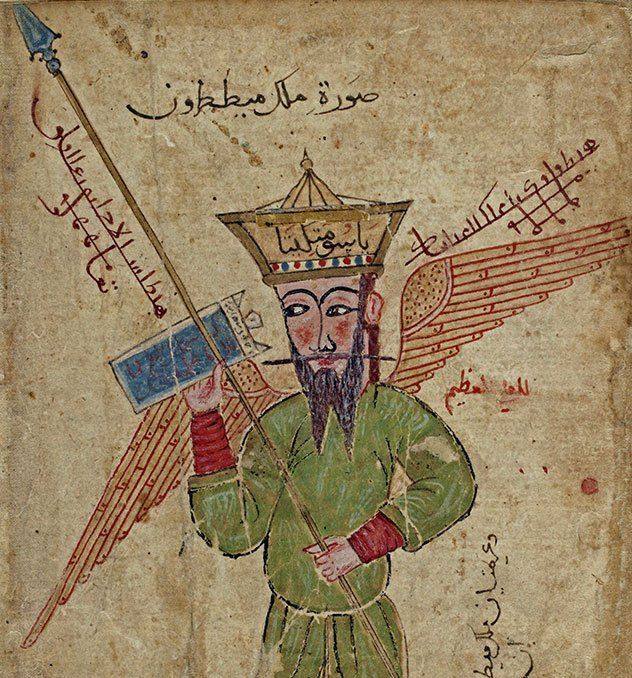
His transformation is described in physical detail. He is enlarged to the length and breadth of the world, given seventy-two wings, and his flesh is changed into flame, his sinews into fire, his bones into burning coals and the light of his eyelids into lightning. God gives him a crown and a throne and calls him the lesser YHWH.

The book also contains a detailed angelology: princes over the elements, the stars and the days, the heavenly court of justice, the storehouses of souls, and the curtain before God on which all history is printed. A notorious episode has the heretic Aher see Metatron seated on his throne and think there are two powers in heaven, after which Metatron is punished with sixty lashes of fire. Hugo Odeberg published the first critical edition and English translation in 1928. Scholars such as Philip Alexander see it as a compilation from Babylonia, with the Enoch material added to earlier Metatron traditions.
Questions people ask about 3 Enoch (Sefer Hekhalot)

What is 3 Enoch about?

Its Hebrew title is Sefer Hekhalot, the Book of Palaces, and it is also called the Book of Rabbi Ishmael the High Priest. It belongs to a body of Jewish mystical writing about rising through the heavens to God's throne. Metatron himself is older than the book: the Babylonian Talmud already mentions him in Hagigah 15a and Sanhedrin 38b.

Who was Rabbi Ishmael?

Rabbi Ishmael ben Elisha was a Jewish sage of the early 2nd century CE, active in the generation after the Temple's destruction. He is remembered for thirteen rules for interpreting the Torah, still recited in the daily morning prayers. Later legend counts him among the Ten Martyrs killed by the Romans and makes him a high priest who traveled to heaven.

When was 3 Enoch written?

The book claims a 2nd-century setting, but scholars think it was shaped in or near Babylonia and reached its final form around the 5th or 6th century CE. Hugo Odeberg, who edited it in 1928, also coined the name 3 Enoch to set it beside 1 and 2 Enoch. The oldest printed text dates only to about 1650.

The open question

Still strange: The text says Enoch was given seventy-two wings, and his bones were turned into burning coals.

Metatron: Who Is the Angel Called the Lesser YHWH? →
  1. Step 1 of 4 · This file3 Enoch
  2. Step 2 of 4 · The passageEnoch becomes one of them, 2 Enoch 22:8–10
  3. Step 3 of 4 · Next fileMetatron: Who Is the Angel Called the Lesser YHWH?
  4. Step 4 of 4 · Next fileEnoch: The Man Who Walked With God and Was Not
About these videos

Found by a YouTube search for this topic, not checked by us. The player loads from YouTube only when you press play.

Where it turns up

Where this comes from

EvidenceDocumented

Comes from 3 Enoch, trans. Hugo Odeberg, 3 Enoch or the Hebrew Book of Enoch (1928). 3 Enoch (the Hebrew Book of Enoch): A Hebrew book in which Rabbi Ishmael rises through the heavens and meets Metatron, a great angel who says he was once the man Enoch. Scholars disagree on its date; most place it in the AD 400s or later.

What this means

The text exists and is quoted from a published translation. What it describes is a separate question.

For 3 Enoch, the original record exists and is linked: 3 Enoch, trans. Hugo Odeberg, 3 Enoch or the Hebrew Book of Enoch (1928). That tells you the record is real and what it says. It does not mean every claim in it is true.

Primary records exist: an original document, a published text, an official file or a dated report. We link to them. This level says the record exists and what it says, not that every claim in it is true.

See all five labels

Sources

  1. 3 Enoch (the Hebrew Book of Enoch)A Hebrew book in which Rabbi Ishmael rises through the heavens and meets Metatron, a great angel who says he was once the man Enoch. Scholars disagree on its date; most place it in the AD 400s or later. It was kept among Jewish mystical writings, and Hugo Odeberg published the first English version in 1928.3 Enoch, trans. Hugo Odeberg, 3 Enoch or the Hebrew Book of Enoch (1928)Primary text
  2. The Jewish Encyclopedia (1901 to 1906)A 12-volume encyclopedia of Jewish history, religion and writings by leading scholars, published in New York from 1901 to 1906. It is still respected, but it is over 100 years old, so it misses later finds such as the Dead Sea Scrolls.Jewish Encyclopedia (1906), "Apocalyptic Literature, Neo-Hebraic"Reference Archived copy, 2026-10-03
  3. WikipediaA free online encyclopedia written and edited by volunteers. It is a good starting point and usually lists its own sources, but anyone can change it, so we treat it as a guide to better sources, not the final word.Wikipedia, "3 Enoch"Reference Archived copy, 2026-09-23

Quotations come from public-domain translations. A book in our Library links to its Library page; other links open the free online copy or the reference page.

Updated

Credible or not?

Tap one to see how other readers voted.

Discussion