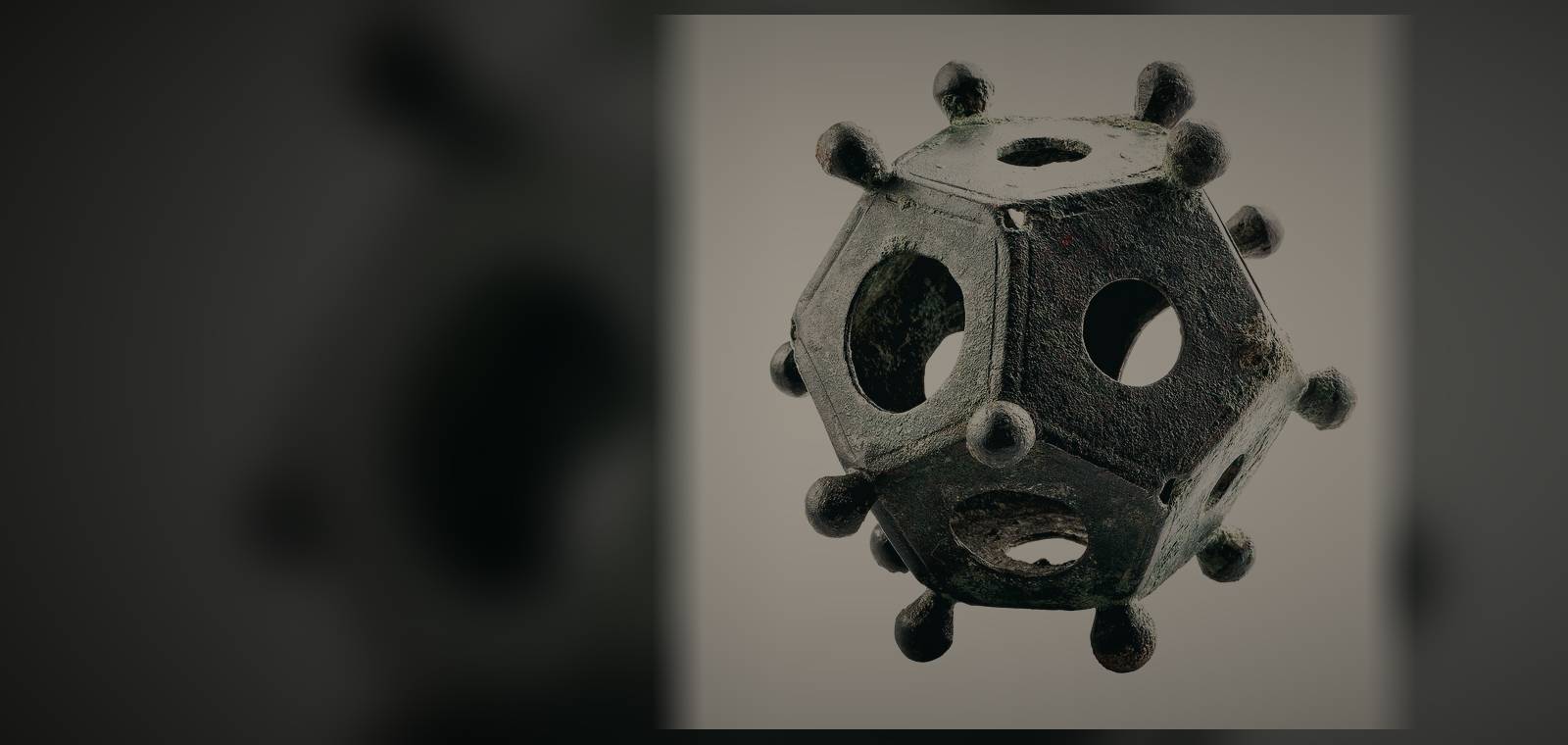
The record
The object is a hollow bronze ball with twelve flat five-sided faces. Each face has a round hole, the holes are of different sizes, and knobs sit on the corners. Samantha Tipper of the Norton Disney Archaeology Group sums up the puzzle: Roman dodecahedra are something of an enigma: there is no known mention of these 12-sided, hollow objects in ancient Roman texts or images.
She adds that around 130 dodecahedra have been found across the Roman Empire,
most of them in northern Europe and Britain, and none have been found in Italy.
They were not cheap trinkets. They are made out of a copper alloy and would have been quite expensive,
Tipper writes, because of the time and metal each one took. Yet they do not match each other: There is no uniformity in the size or shape of the dodecahedra found so far, nor in their metal composition or even in the level of craftsmanship.
That alone makes a single standard use, such as a measuring tool, harder to argue.
In June 2023 the group ran a community dig in a field near the village of Norton Disney in Lincolnshire. In the last of four trenches, in what appeared to be a large pit,
they found one whole. It's the 33rd to be found in England and the first to be found in the Midlands.
It measures around 8cm across and weighs 245 grams,
and a handheld X-ray reading gave a copper alloy with tin and a large share of lead. The group's secretary, Richard Parker, noted what makes it stranger still: It is completely undamaged and there is no evidence of any wear at all.
Guesses have piled up since the first ones turned up in the 18th century. Tipper lists religious objects, knitting tools, measuring instruments or stress toys.
In 2012 the physicist Amelia Carolina Sparavigna built a model of one found at Jublains in France to test an idea: a possible use of a Roman Dodecahedron, a bronze artifact of gallo-roman origin, for measuring distance,
by looking through it. In 2025 Michael Guggenberger and Stephen Leach looked to philosophy instead. They agree there is no contemporaneous description of the Gallo-Roman dodecahedron,
but argue that several ancient texts, including an overlooked passage in Iamblichus' On the Pythagorean Life,
point to where the idea came from, and they connect the finds in Gaul and Britain with the Druids' reported interest in Pythagoras.
Each idea explains some of the objects and not others. Tipper points to the missing clue that would settle it: If they were important objects, we would expect to also discover contextual evidence in the archaeological record, such as depictions in paintings or mosaics.
None has been found. The Norton Disney group planned to return in 2024 to finish digging the pit where theirs lay, hoping the ground around it would say what the Romans never did.