The record
As they lay, surrounded by the enemy, the Greeks began to fling their fire all around; and the Rusi seeing the flames threw themselves in haste from their ships, preferring to be drowned in the water rather than burned alive in the fire. Some sank to the bottom under the weight of their cuirasses and helmets which they were never to see again; some caught fire even as they swam among the billows; not a man that day escaped save those who managed to reach the shore.
Liudprand of Cremona, Antapodosis 5.15 · Greece and Rome
Translation: F. A. Wright, The Works of Liudprand of Cremona (London: Routledge, 1930) · Public domain
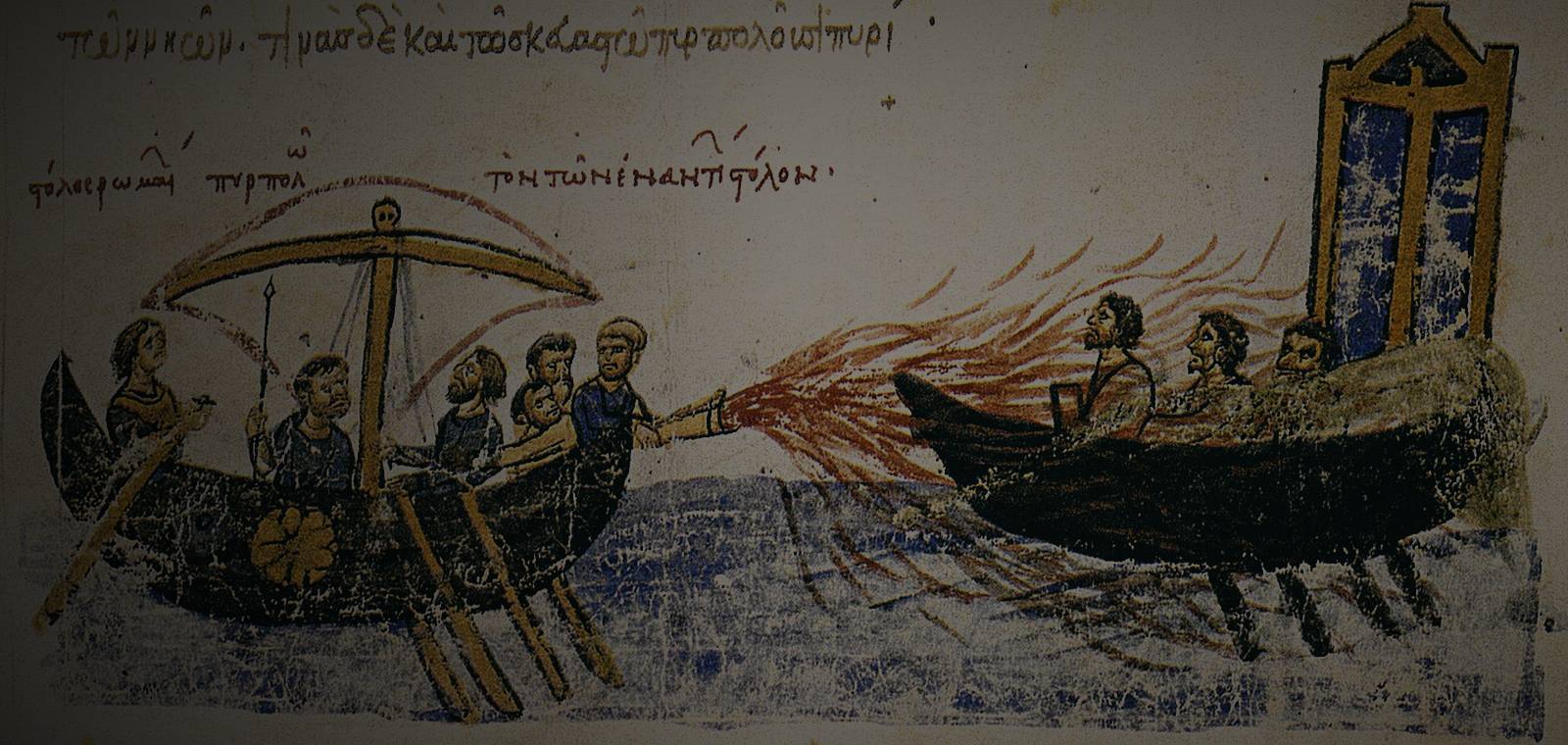
Greek fire was the secret weapon of the Byzantine Empire, the Greek-speaking eastern half of the Roman world, ruled from Constantinople. Writing in The Conversation in 2026, the historians Michael Charles and Eva Anagnostou-Laoutides explain that it was sprayed onto enemy fleets through a brass or bronze tube, the siphon, mounted on the bows of Byzantine ships. One account of its invention comes through Theophanes the Confessor, a monk writing in the early ninth century, who credits Kallinikos, an architect from Heliopolis in Syria.
Liudprand of Cremona, an Italian bishop, described the weapon at work against the Rus. Igor, king of the Rus, sailed on the city with a thousand ships or more. The emperor Romanos had only fifteen old galleys and ordered fire-throwers fitted at the bows, the stern and both sides. When the Greeks began to fling their fire all around, the Rus threw themselves into the sea, preferring to drown rather than burn, and some caught fire even as they swam.
The Byzantine princess Anna Comnena described how her father, the emperor Alexios, fitted out a fleet against the Pisans. On each prow he had a lion or other beast made in brass or iron with its mouth open, and the fire directed through tubes passed through their mouths, so that the beasts seemed to vomit fire.
What it was made of remains unknown. Charles and Anagnostou-Laoutides note that the emperor Constantine VII warned foreigners against seeking the secret recipe, which died with the Byzantine Empire. They write that research has settled on a special kind of crude oil found only between the Black Sea and the Caspian Sea.