The record
In 1900 sponge divers working off the small Greek island of Antikythera, between Crete and the Peloponnese, found an ancient shipwreck on the sea floor. Helped by the Greek Royal Navy, they brought up bronze statues, coins and many other finds over the next year. The National Archaeological Museum in Athens, which holds the finds, calls it the first major underwater archaeological expedition. A history published by the German Patent and Trade Mark Office says coins from Pergamon date the sinking to between 70 and 60 BC, and that in 1902 a lump of bronze in the museum's store, inventory number X 15087, was noticed to hold the remains of a precision mechanism.
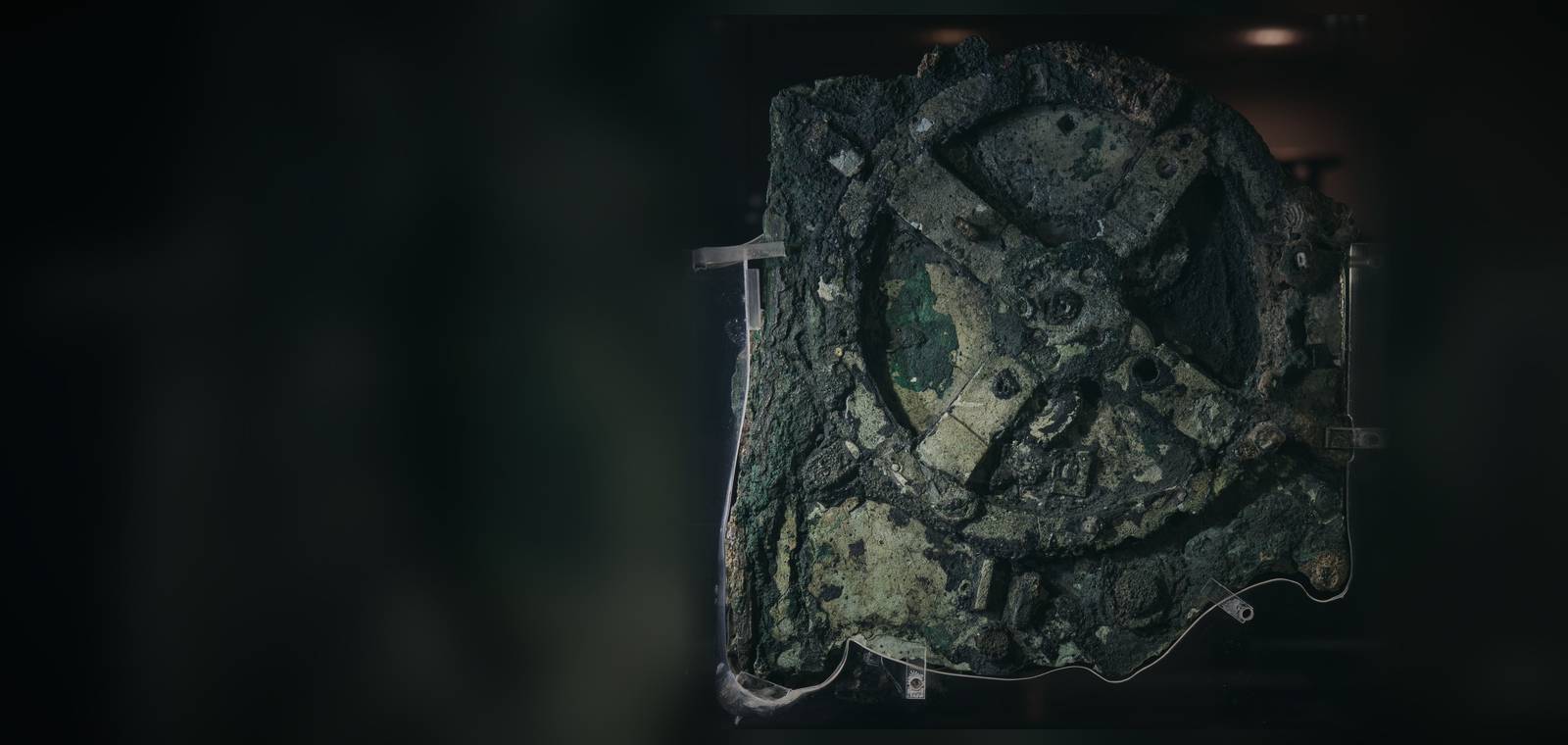
The lump turned out to be a box of bronze gears. In 1974 the historian of science Derek de Solla Price published Gears from the Greeks, the first full study, calling it a calendar computer. In 2006 a team led by Tony Freeth used high-resolution X-ray tomography and surface imaging to look inside the fragments. Writing in Nature, they reported that the device predicted lunar and solar eclipses from Babylonian cycles, built Hipparchos's theory of the Moon's uneven motion into its gearing, and dated it to around the end of the second century BC. They wrote that it is technically more complex than any known device for at least a millennium afterwards.
A 2021 paper by Freeth and colleagues in Scientific Reports describes what survives: the machine is Now split into 82 fragments, only a third of the original survives, including 30 corroded bronze gearwheels.
The X-rays also revealed thousands of tiny letters inside the fragments, instructions describing the motions of the Sun, the Moon and all five planets known in antiquity. The team proposed a new model for the lost front of the machine, a display of the Greek cosmos, and said it combines cycles from Babylonian astronomy, mathematics from Plato's Academy and Greek astronomical theory.
What is still open is who made it, where, and why nothing like it survives from the following centuries. Greek and Roman writers mention spheres that modeled the heavens, but no other geared device of this kind has been found from the ancient world. The fragments are on show in Athens.