Credible Theories Sign in

The record

Roman writers knew they had something unusual. The architect Vitruvius described a kind of powder which from natural causes produces astonishing results, found in the neighbourhood of Baiae and in the country belonging to the towns round about Mt. Vesuvius. Mixed with lime and rubble, it not only lends strength to buildings of other kinds, but even when piers of it are constructed in the sea, they set hard under water. The result, he wrote, was a mass which neither the waves nor the force of the water can dissolve. He blamed the volcanic heat under the hills, which he thought came from huge fires of burning sulphur or alum or asphalt.

A few generations later Pliny the Elder marveled at the same material. Who, he asked, could fail to be surprised at what is known as 'dust' only, on the hills about Puteoli, forming a barrier against the waves of the sea, becoming changed into stone the moment of its immersion, and increasing in hardness from day to day? That last claim, that the concrete grows harder in seawater over time, sounds like boasting. Modern work suggests he was right.

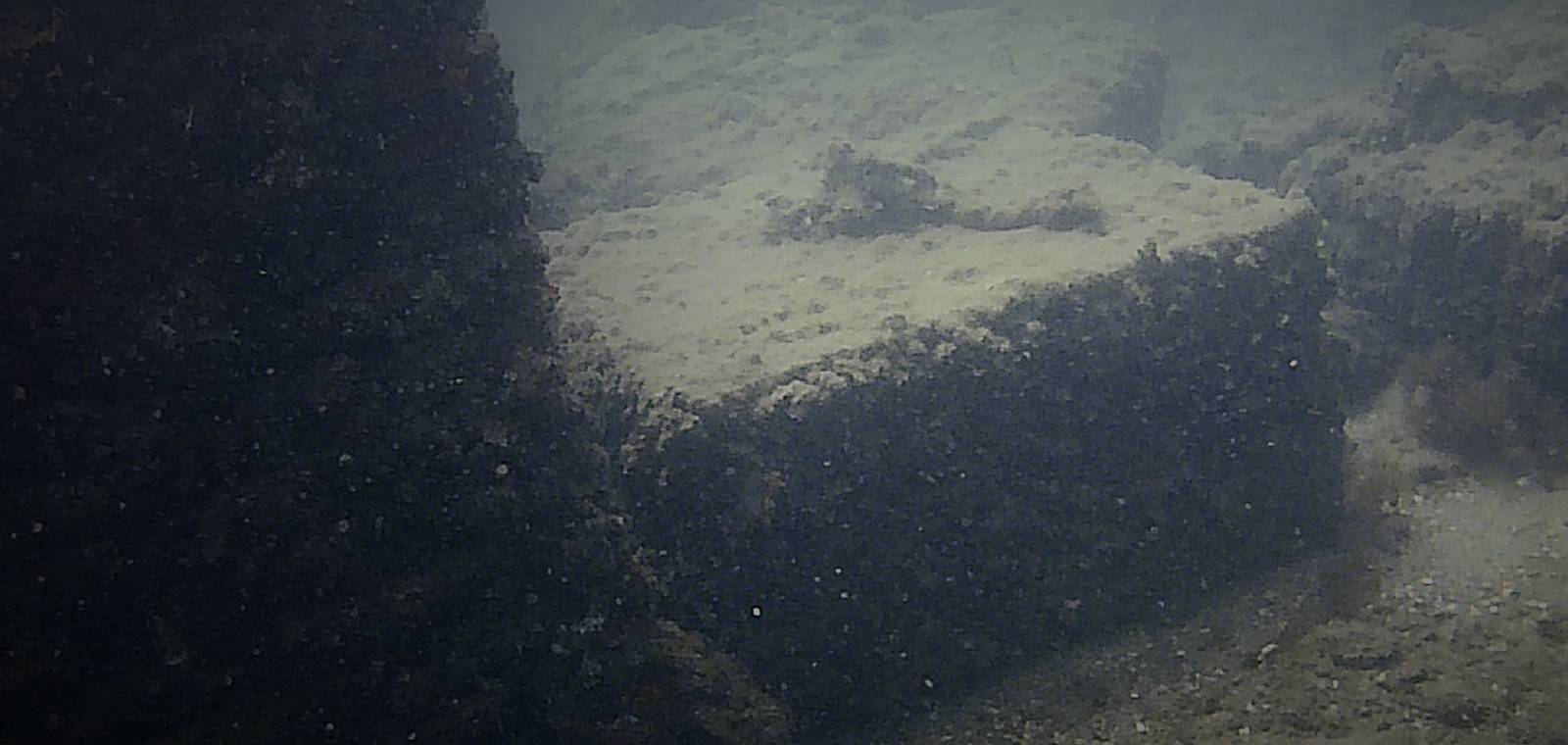
In 2017 a team led by Marie Jackson studied samples from Roman breakwaters in the Bay of Baiae (Baianus Sinus) and at Portus Neronis, and a pier at Portus Cosanus. Using X-ray beams from a synchrotron they found crystals of a rare mineral, aluminous tobermorite, and of the zeolite phillipsite growing inside the concrete's pores and in the volcanic grains themselves. These had formed at ambient seawater and surface temperatures, long after the concrete was poured. Their conclusion: Long-term chemical resilience of the concrete evidently relied on water-rock interactions, as Pliny the Elder inferred. Seawater seeping through the concrete kept building new mineral cement.

A second puzzle was the small white lumps of lime scattered through Roman mortar. A 2023 study in Science Advances mapped those lime clasts in detail and found evidence that the Romans employed hot mixing, using quicklime in conjunction with, or instead of, slaked lime. The authors propose that the lumps might serve as critical sources of reactive calcium for long-term pore and crack-filling, so that a crack running into a clast could fill itself in. When they made modern test mixes with the same kind of lumps, the samples showed self-healing potential.

So Roman concrete is not a lost secret in the usual sense. Vitruvius and Pliny wrote down where the special ash came from and what it did. What took two thousand years was the chemistry: a material that keeps reacting with the sea instead of being worn away by it. The same 2017 paper notes that the Roman processes may matter for new concretes used in the sea, for storing carbon dioxide in volcanic rock, and for sealing waste.
Questions people ask about Roman concrete

What was Roman concrete made of?

Lime, rubble and water mixed with a volcanic ash dug near the Bay of Naples, which builders later called pozzolana after the town of Pozzuoli.

Why is the ash called pozzolana?

Morgan's English Vitruvius heads the chapter Pozzolana, after Pozzuoli, the Roman Puteoli on the Bay of Naples, where Pliny says the dust came from.

Can we make Roman concrete today?

Lab batches have been made with the same kind of quicklime lumps, and cracks in them closed up on their own; those were lab samples, not decades-old walls.

The open question

Still strange: Concrete the Romans poured into the sea is still standing two thousand years later, and laboratory studies found that seawater has kept growing new mineral crystals inside it.

Greek Fire →
  1. Step 1 of 4 · This fileRoman concrete
  2. Step 2 of 4 · The longer textThe Natural History of Pliny, Volume 1 (of 6)
  3. Step 3 of 4 · Next fileGreek Fire
  4. Step 4 of 4 · Next fileThe Antikythera Mechanism: What Was Inside the Bronze Lump?
About these videos

Found by a YouTube search for this topic, not checked by us. The player loads from YouTube only when you press play.

Where this comes from

EvidenceDocumented

Comes from Vitruvius, The Ten Books on Architecture, book 2, chapter 6, trans. Morris Hicky Morgan…. Internet Archive: A nonprofit digital library in San Francisco, founded in 1996, that holds millions of scanned books, papers and recordings. A scan there shows the pages of a real printed book or document.

What this means

Ancient writers describe the material and modern laboratory studies have measured why it lasts.

For Roman concrete, the original record exists and is linked: Vitruvius, The Ten Books on Architecture, book 2, chapter 6, trans. Morris Hicky Morgan…. That tells you the record is real and what it says. It does not mean every claim in it is true.

Primary records exist: an original document, a published text, an official file or a dated report. We link to them. This level says the record exists and what it says, not that every claim in it is true.

See all five labels

Sources

  1. Internet ArchiveA nonprofit digital library in San Francisco, founded in 1996, that holds millions of scanned books, papers and recordings. A scan there shows the pages of a real printed book or document.Vitruvius, The Ten Books on Architecture, book 2, chapter 6, trans. Morris Hicky Morgan (Harvard University Press, 1914)Primary text
  2. Natural History, by Pliny the ElderA 37-book Roman encyclopedia of everything from stars to animals to art, by Pliny the Elder, published around AD 77. Pliny died in AD 79 near Mount Vesuvius as it erupted. It mixes careful observation with tall tales. Bostock and Riley's English version came out in 1855.Pliny the Elder, The Natural History, book 35, chapter 47, trans. John Bostock and H. T. Riley (London, 1855), Perseus Digital Library Online copyPrimary text
  3. DOI link to a research paperA DOI is a permanent ID number for a published research paper or book. The link takes you to the paper on its publisher's website, even if that site moves. The paper itself is what we cite.Marie D. Jackson, Sean R. Mulcahy, Heng Chen, Yao Li and others, "Phillipsite and Al-tobermorite mineral cements produced through low-temperature water-rock reactions in Roman marine concrete", American Mineralogist 102 (2017)
  4. DOI link to a research paperLinda M. Seymour, Janille Maragh, Paolo Sabatini, Michel Di Tommaso, James C. Weaver and Admir Masic, "Hot mixing: Mechanistic insights into the durability of ancient Roman concrete", Science Advances 9 (2023)

Quotations come from public-domain translations. A book in our Library links to its Library page; other links open the free online copy or the reference page.

Updated

Credible or not?

Tap one to see how other readers voted.

Discussion