The record
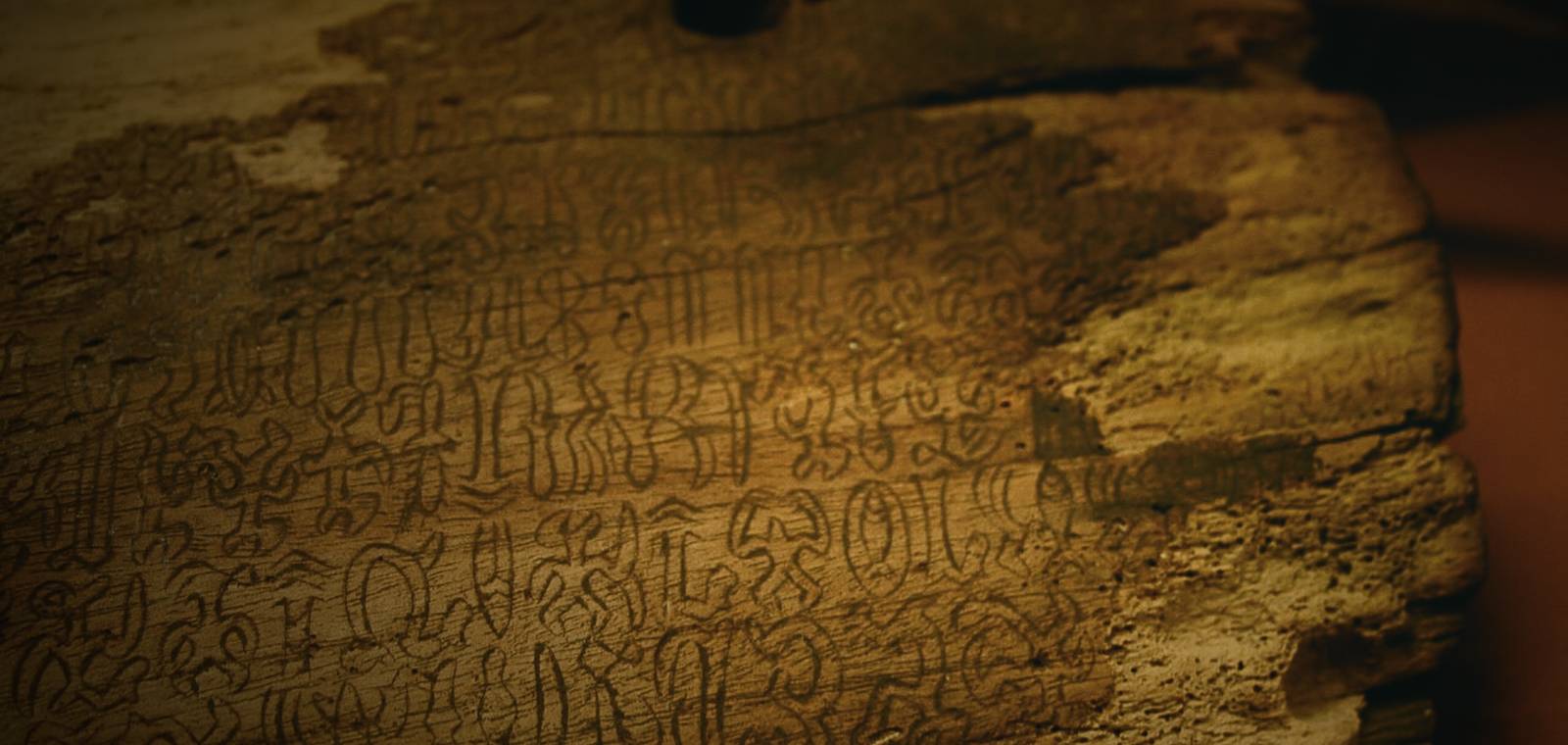
Easter Island is famous for its stone statues, but it also had a script. A 2024 study in Scientific Reports describes it as now engraved on fewer than 30 wooden objects, which is still undeciphered.
The islanders called the boards kohau rongorongo. Katherine Routledge, whose expedition reached the island in 1914, heard that they had been an integral part of life on the island within the memory of men not much past middle age.
How so few came to survive is a sad story told two ways. William J. Thomson, paymaster of the U.S. Navy ship Mohican, which anchored off the island on December 19, 1886, wrote that the natives stated that the missionaries had ordered all that could be found to be burned, with a view to destroying the ancient records.
Routledge recorded the other side: the Fathers, on the contrary, state that it was due to them that any were preserved,
and some certainly were, through Bishop Jaussen of Tahiti. She also heard of a man who made a fishing boat out of abandoned tablets; a piece of that wood was later found and acquired by the U.S.A. ship Mohican.
Thomson traced the loss of the readers to 1864, when Peruvian slave raiders carried off islanders, and among those kidnapped, were all of the officials and persons in authority.
Tradition, as Thomson heard it, said that Hotu-Matua, the first king, brought with him to the island sixty-seven tablets containing allegories, traditions, genealogical tables, and proverbs.
The people gathered at Anakena Bay once a year to hear all the tablets read, and not even war was allowed to interfere with it.
Routledge was told that each clan had rongorongo men, that the incision was made with a shark's tooth,
and that beginners practised on banana stems before they were promoted to toromiro wood. The lines run in a strange order: those on the first stand upright, and those on the next line are upside down,
so the reader turns the board at the end of every line.
Thomson tried to get a reading. An old man named Ure Vaeiko, who said he had been learning the signs when the slavers came, at first refused to touch a tablet. Shown photographs instead, he recited a story for each one through a long night. Thomson grew suspicious: it became evident that he was not actually reading the characters,
and when the photograph of another tablet was swapped in, the same story was continued without the change being discovered.
Ure Vaeiko then explained that the meaning of the signs had been forgotten, though each tablet could still be recognized and its story told, just as a person might recognize a book in a foreign language and be perfectly sure of the contents without being able to actually read it.
The big open question is whether the islanders invented writing on their own or copied the idea after Europeans arrived in the eighteenth century. In 2024 a team radiocarbon-dated four tablets kept in Rome. Three came out in the nineteenth century, but one specimen yielded a unique and secure mid-fifteenth c. date.
The authors conclude that the use of the script could be placed to a horizon that predates the arrival of external influence.
A radiocarbon date tells when the tree grew, not when the signs were cut, so the debate is not over, but it now leans toward a script invented on the island itself.