How the rabbit hole works. Start with anything that grabs you, say UFOs. Every person, place and document a page mentions links to its own page, so a UFO file leads to a witness, the witness leads to the people who investigated the case, and it keeps going.
The path you take shows in the bar under the top menu on every page, so you can step back any time or climb out and start again.
This is a summary of a passage from the Apocalypse of Abraham, a Jewish book probably written in the late 1st or 2nd century AD. An angel named Yahoel carries Abraham up on the wings of a sacrificed pigeon, and he sees a throne of fire, four living creatures and wheels full of eyes. A being named Azazel appears as an unclean bird and tries to warn him away.
ReferenceApocalypse of Abraham 12–18
Writtenc. 70–150 CE
SetAbraham
The angel Yahoel takes Abraham up on the wings of a sacrificed pigeon. He sees a fire with voices in it, a throne of fire with four living creatures, and wheels full of eyes. Azazel appears as an unclean bird and tries to warn him off.
Documented · Retold in English, c. 70–150 CE Summary by the editors. Translation: Summary in my own words
AdvertisementAd space
Read it literally
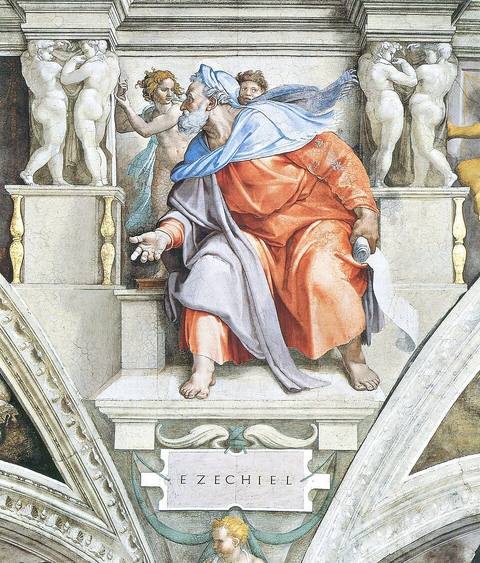
Ezekiel's wheels again, and Azazel active in the patriarchs' time, not only before the Flood.
Questions people ask about Apocalypse of Abraham 12–18
Is the Apocalypse of Abraham in the Bible?
No. It is not part of any Jewish or Christian Bible and is grouped with the pseudepigrapha, writings credited to famous biblical figures by later authors. It survives in six Slavonic manuscripts, the oldest from the 14th century. An English version appeared in 1898, and the better-known translation by G. H. Box and J. I. Landsman followed in 1918.
When was the Apocalypse of Abraham written?
Scholars date it between about 70 and 150 CE because it reflects the Roman destruction of the Jerusalem Temple in 70 CE, most clearly in chapter 27, where Abraham sees the Temple burned. The original was almost certainly in Hebrew and later translated into Slavonic, possibly through a lost Greek version.
What happens before Abraham's journey to heaven?
The first eight chapters tell how young Abraham helped his father Terah, who carved idols for a living. After idols break and a wooden one burns in the fire, Abraham realizes they cannot be gods. He hears a voice from heaven, leaves the house, and fire falls and destroys Terah's home with his idols inside.
Used on these files
Apocalypse of Abraham: Why Does Azazel Try to Stop His Ascent?DocumentedIn this ancient book Abraham rises to heaven on the wings of a sacrificed pigeon and turtledove. He sees a throne of fire and wheels full of eyes. Along the way, Azazel, the Watcher chief of Enoch, swoops down as an unclean bird to scare him off. Who is the guide, and what does Abraham see?
Azazel: Scapegoat of Leviticus 16 or Fallen Watcher?Myth or legendA strange word in an ancient ritual tells priests to send one goat into the wilderness "for Azazel," and the text never says who that is. Centuries later the Enoch writers answered: a fallen Watcher who taught swords, metalwork and makeup, locked in a named desert prison. Did they find a being, or invent one?
Where this comes from
EvidenceDocumented
Comes fromThe Apocalypse of Abraham, Apocalypse of Abraham 12–18. A Jewish book, probably written in the late 1st or 2nd century AD, in which Abraham turns away from idols and an angel carries him up to see heaven. ('Apocalypse' here means a revealing.) It survives only in Old Church Slavonic copies kept in Russia; G. H. Box published it in English in 1918.
What this means
The text exists and is quoted from a published translation. What it describes is a separate question.
Primary records exist: an original document, a published text, an official file or a dated report. We link to them. This level says the record exists and what it says, not that every claim in it is true.
The Apocalypse of AbrahamA Jewish book, probably written in the late 1st or 2nd century AD, in which Abraham turns away from idols and an angel carries him up to see heaven. ('Apocalypse' here means a revealing.) It survives only in Old Church Slavonic copies kept in Russia; G. H. Box published it in English in 1918.Apocalypse of Abraham, trans. G. H. Box (1918)Primary text
The Book of Enoch (1 Enoch)Jewish writings about Enoch, Noah's great-grandfather, the oldest parts from about 300 to 200 BC. It tells of angels called Watchers who came down to earth. Full copies survived only in Ethiopia, whose church still counts it as scripture. Pieces in Aramaic were found among the Dead Sea Scrolls in 1952.1 Enoch 8:1–3; 10:4–8, trans. R. H. Charles, The Book of Enoch (1917)Online copyPrimary textArchived copy, 2026-10-03
Scholarly dates are rounded. The wording follows the named public-domain translation.
More from Enoch, Jubilees and others
Two more stories, and what each shares with Abraham rides a bird into heaven.
In it, Menelik, the son of King Solomon and the Queen of Sheba, leaves Jerusalem with the Ark of the Covenant, and his group's wagons rise a cubit off the ground so a thirteen-day trip takes one day.