Credible Theories Sign in
Greece and Rome · Liudprand of Cremona, Antapodosis 5.15

Fire flung across the water, Liudprand of Cremona, Antapodosis 5.15

Share

In plain words

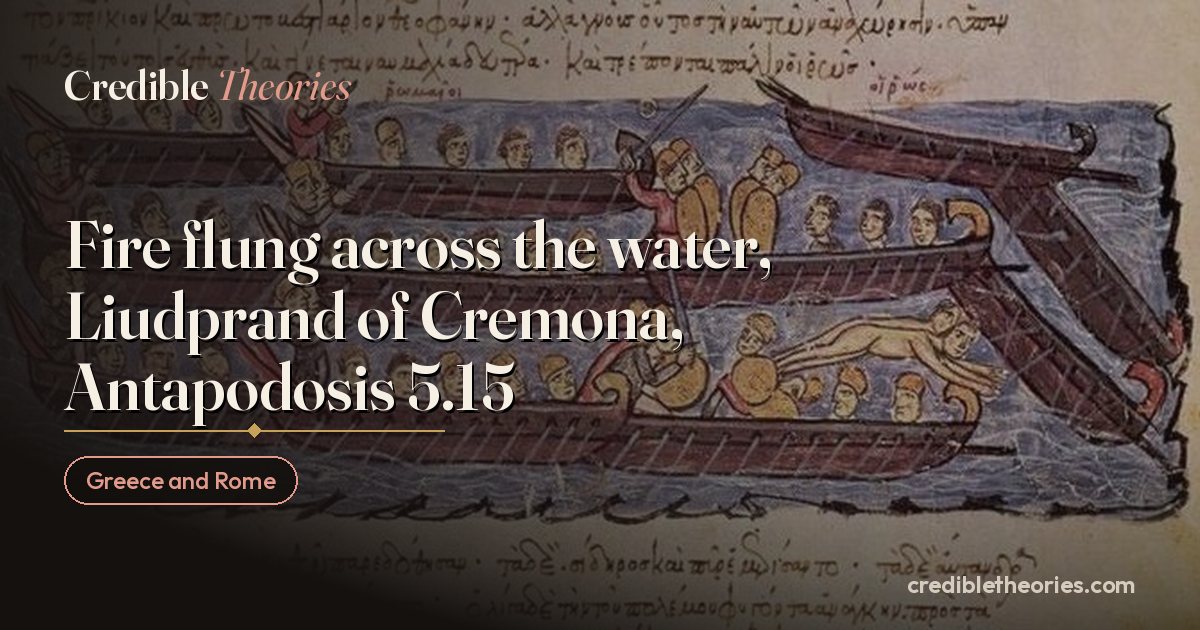
Liudprand tells how a Byzantine squadron, surrounded by the Rus fleet, began throwing its fire on every side. The Rus jumped from their ships, choosing to drown rather than burn. Some sank under their armor, some caught fire while swimming, and only those who reached the shore escaped.

ReferenceLiudprand of Cremona, Antapodosis 5.15
WrittenWritten by Liudprand of Cremona, an Italian bishop, in his history Antapodosis in the 900s
SetThe sea near Constantinople, as Igor's Rus fleet surrounds fifteen old Byzantine galleys
As they lay, surrounded by the enemy, the Greeks began to fling their fire all around; and the Rusi seeing the flames threw themselves in haste from their ships, preferring to be drowned in the water rather than burned alive in the fire. Some sank to the bottom under the weight of their cuirasses and helmets which they were never to see again; some caught fire even as they swam among the billows; not a man that day escaped save those who managed to reach the shore.

Documented · Medieval text, 900 Translation: F. A. Wright, 1930

Read it literally

Fifteen battered galleys, fitted with fire-throwers at the bow, the stern and both sides, face a fleet of a thousand ships. The Greek fire file sets this account beside Anna Comnena's brass lions that spat flame.

What scholars say

Liudprand says the prisoners were put to death in front of his stepfather, King Hugh's envoy.

Themes Looks like technology
Questions people ask about Liudprand of Cremona, Antapodosis 5.15

Why did the emperor have so few ships?

Liudprand says the main fleet was away fighting the Saracens or guarding the islands, leaving only fifteen old galleys in the yards.

What happened to the prisoners?

They were brought back to Constantinople and beheaded on Romanos' orders, in front of King Hugh's envoy, Liudprand's stepfather.

Used on these files

  • Greek Fire DocumentedThe Byzantine navy sprayed fire across the water from tubes on its ships, and enemies leapt into the sea to escape it. The recipe was kept so secret that it is lost.

Where this comes from

EvidenceDocumented

Comes from F. A. Wright, Liudprand of Cremona, Antapodosis 5.15. Internet Archive: A nonprofit digital library in San Francisco, founded in 1996, that holds millions of scanned books, papers and recordings. A scan there shows the pages of a real printed book or document.

What this means

The text exists and is quoted from a published translation. What it describes is a separate question.

Primary records exist: an original document, a published text, an official file or a dated report. We link to them. This level says the record exists and what it says, not that every claim in it is true.

See all five labels

Sources

  1. Internet ArchiveA nonprofit digital library in San Francisco, founded in 1996, that holds millions of scanned books, papers and recordings. A scan there shows the pages of a real printed book or document.F. A. Wright, The Works of Liudprand of Cremona (London: Routledge, 1930)Primary text
  2. Internet ArchiveAnna Comnena, The Alexiad, book 11, chapter 10, trans. Elizabeth A. S. Dawes (London, 1928)Primary text

Scholarly dates are rounded. The wording follows the named public-domain translation.

More from Greece and Rome

Two more stories, and what each shares with Fire flung across the water.

Photo credits
RelatedHephaestus' golden robotsIliad 18.373–377, 417–420

It describes the god Hephaestus at work.

Same theme: Looks like technology
Photo credits
RelatedTalos, the bronze giantApollonius, Argonautica 4.1638–1688

It describes Talos, a giant man made of bronze who guarded the island of Crete.

Same theme: Looks like technology

Updated

Discussion