How the rabbit hole works. Start with anything that grabs you, say UFOs. Every person, place and document a page mentions links to its own page, so a UFO file leads to a witness, the witness leads to the people who investigated the case, and it keeps going.
The path you take shows in the bar under the top menu on every page, so you can step back any time or climb out and start again.
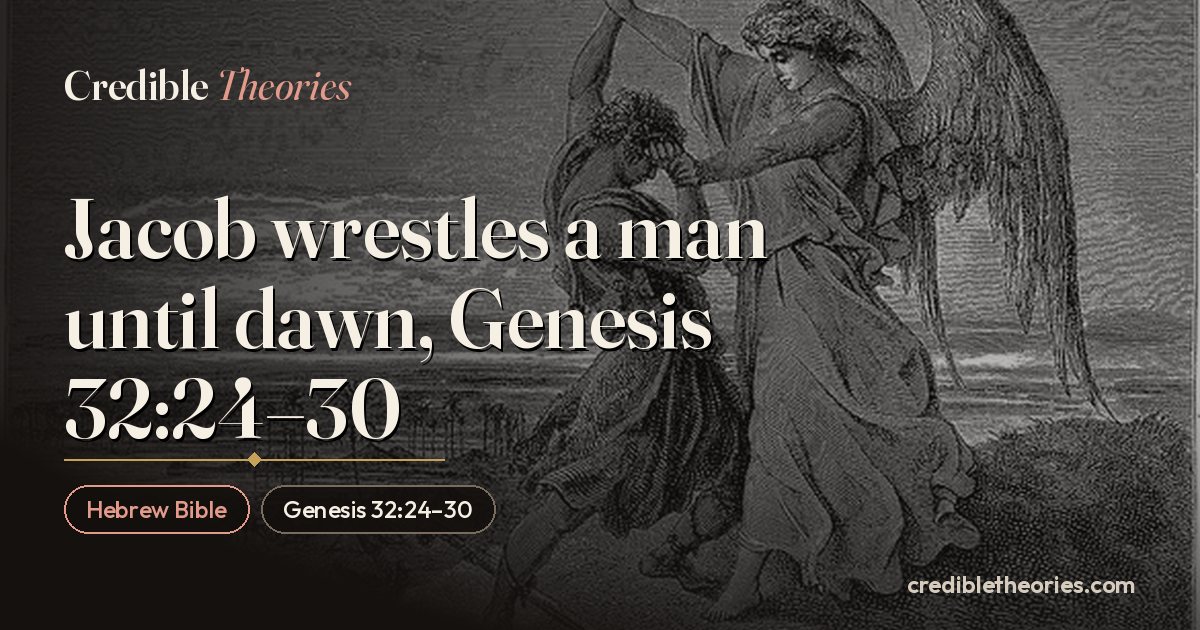
This is a short passage from Genesis, the first book of the Bible, written roughly 900 to 500 BCE. In the story, Jacob is left alone, and a man wrestles with him until the sun comes up. Afterward Jacob names the place Peniel and says he has seen God face to face and lived. A later book of the Bible, Hosea, calls the wrestler an angel.
ReferenceGenesis 32:24–30
Writtenc. 900–500 BCE
SetJacob, patriarchal era
And Jacob was left alone; and there wrestled a man with him until the breaking of the day… And Jacob called the name of the place Peniel: for I have seen God face to face, and my life is preserved.
Documented · Ancient text, c. 900–500 BCE Translation: KJV
AdvertisementAd space
Read it literally
The being is physical, strong but not all-powerful, and must leave before sunrise. He injures Jacob's hip with a touch. Why can't he be seen in daylight?
In Genesis 32:28 the stranger tells Jacob his name will now be Israel, because he has struggled with God and with men and won. The name is usually explained as he strives with God. Because the stranger touched Jacob's hip, the next verses say Israelites do not eat the sinew of the thigh, a rule still kept in kosher law.
What happens after Jacob wrestles the man?
The next morning, limping, Jacob goes to meet his brother Esau, who is coming with 400 men. Jacob fears revenge for the blessing he stole years earlier. He bows to the ground seven times, but Esau runs to him, hugs him and weeps. The brothers make peace and then go separate ways.
Who was the man that wrestled Jacob?
Genesis keeps it unclear. Jewish tradition in the midrash Genesis Rabbah says he was the guardian angel of Esau, and later sources name that angel Samael. Some early Christian writers saw him as an appearance of Christ before his birth. Many modern scholars think the story began as a tale about a river spirit guarding the crossing.
Where this comes from
EvidenceDocumented
Comes fromThe Book of Genesis, Genesis 32:24–30, read here in the King James Version. The first book of the Bible, telling of Creation, Adam and Eve, Noah's Flood and the families of Abraham, Isaac and Jacob. Scholars think it was written and edited over several centuries and finished by roughly 500 to 400 BC. The oldest surviving copies are pieces of the Dead Sea Scrolls.
What this means
The text exists and is quoted from a published translation. What it describes is a separate question.
Primary records exist: an original document, a published text, an official file or a dated report. We link to them. This level says the record exists and what it says, not that every claim in it is true.
The King James BibleThe English Bible made for King James I and first printed in 1611; the wording most people know comes from a 1769 update. It is out of copyright, which is why we quote it. The 1611 printing also had the Apocrypha, extra books kept in Catholic and Orthodox Bibles.King James Version (1611; standard 1769 text), with ApocryphaPrimary textArchived copy, 2026-10-03
Scholarly dates are rounded. The wording follows the named public-domain translation.
More from Hebrew Bible
The story before and after this one, and what each shares with Jacob wrestles a man until dawn.