How the rabbit hole works. Start with anything that grabs you, say UFOs. Every person, place and document a page mentions links to its own page, so a UFO file leads to a witness, the witness leads to the people who investigated the case, and it keeps going.
The path you take shows in the bar under the top menu on every page, so you can step back any time or climb out and start again.
This is a short passage from the Poetic Edda, a collection of Old Norse poems about the gods and the world's beginning and end, likely composed around 900 to 1100 CE. These lines describe the end of the world. The sun turns black, the earth sinks into the sea, and hot stars are thrown down from the sky.
ReferenceVoluspa 57 (Poetic Edda)
Writtenc. 900–1100 CE
SetThe end
The sun turns black, earth sinks in the sea, The hot stars down from heaven are whirled.
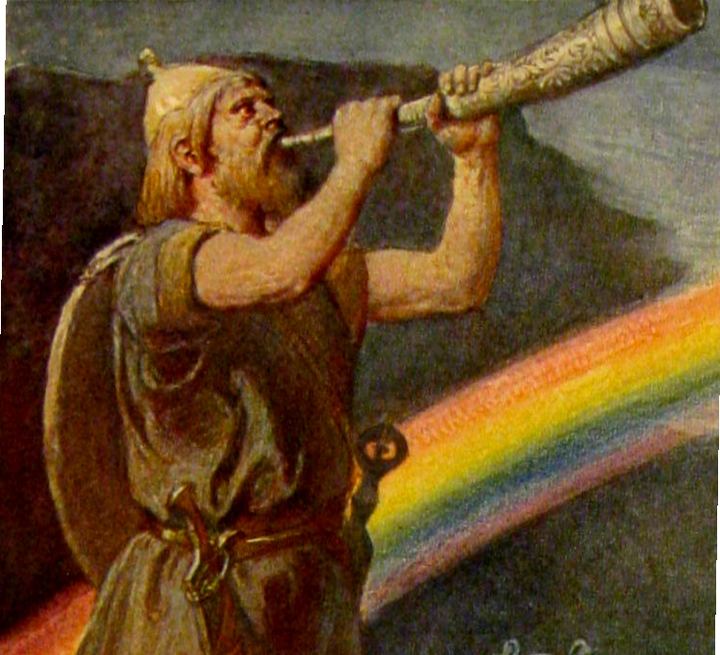
Gold, silver, bronze, iron: Greece, Persia and the Book of Daniel all count the ages of the world in metals, India counts four yugas, and the Norse and Maya see whole worlds destroyed and remade.
Poetic Edda, Voluspa (Ragnarok and the new earth) is one telling. The same story is told 9 more times, in 6 parts of the world. Follow it:
A god or a hero faces a giant serpent that blocks the waters, eats the young or threatens the whole world, and cuts it down. The same fight is told in Babylon, India, Greece, Egypt, Iceland, Japan and medieval Europe.
Prose Edda, Gylfaginning (Thor and the Midgard Serpent) is one telling. The same story is told 7 more times, in 6 parts of the world. Follow it:
The open question: Did one ancient story of a hero and a serpent spread across the world, or do people everywhere turn their fears into dragons on their own? Join the debate
Questions people ask about Voluspa 57
What is the Voluspa?
The Voluspa, or Prophecy of the Seeress, is the first poem in the Codex Regius, the main manuscript of the Poetic Edda. A seeress speaks to Odin and tells the story of the world from creation to its end and rebirth. The manuscript was written in Iceland around 1270, given to the Danish king in 1662, and returned to Iceland in 1971.
What happens after Ragnarok in the Voluspa?
The seeress describes a renewed world. Surviving gods meet again on the plain of Idavoll and find the old golden game pieces lying in the grass. Fields grow without being sown, and Baldr comes back from the dead. Worthy people live in a hall called Gimle, roofed with gold.
Could a real volcano lie behind the Ragnarok poem?
Some scholars think so. A 2018 study led by volcanologist Clive Oppenheimer argued that parts of the Voluspa echo the Eldgja eruption in Iceland around 939 CE, the largest lava flood in Iceland's recorded history. The study suggested the poem may have helped Icelanders accept Christianity. This is an argued idea, not a settled fact.
Where this comes from
EvidenceDocumented
Comes fromThe Poetic Edda, Voluspa 57 (Poetic Edda), read here in the Henry Adams Bellows. A collection of Old Norse poems about gods such as Odin and Thor and about the world's beginning and end. The poems are older, but they survive mainly in one Icelandic manuscript of about 1270, found in 1643 and now in Reykjavik.
What this means
The text exists and is quoted from a published translation. What it describes is a separate question.
Primary records exist: an original document, a published text, an official file or a dated report. We link to them. This level says the record exists and what it says, not that every claim in it is true.
The Poetic EddaA collection of Old Norse poems about gods such as Odin and Thor and about the world's beginning and end. The poems are older, but they survive mainly in one Icelandic manuscript of about 1270, found in 1643 and now in Reykjavik. Henry Adams Bellows's English version came out in 1923.Henry Adams Bellows, The Poetic Edda (1923)Online copyPrimary textArchived copy, 2026-08-20
Scholarly dates are rounded. The wording follows the named public-domain translation.
More from Norse
Two more stories, and what each shares with The stars fall at Ragnarok.