How the rabbit hole works. Start with anything that grabs you, say UFOs. Every person, place and document a page mentions links to its own page, so a UFO file leads to a witness, the witness leads to the people who investigated the case, and it keeps going.
The path you take shows in the bar under the top menu on every page, so you can step back any time or climb out and start again.
This is a short passage from Hesiod's Theogony, a Greek poem written around 700 BCE about how the world and the gods came to be. After a war, Zeus and the Olympian gods threw the older Titans down into Tartarus, a place deep under the earth. The poem says Tartarus is as far below the earth as the sky is above it.
ReferenceHesiod, Theogony 717–725
Writtenc. 700 BCE
SetThe war of gods and Titans
As far beneath the earth as heaven is above earth; for so far is it from earth to Tartarus. For a brazen anvil falling down from heaven nine nights and days would reach the earth upon the tenth.
Before anything existed there was dark water. Or an egg. Babylon, Genesis, the Rig Veda, Egypt, Finland and the Quran all start the world in almost the same place.
Hesiod, Theogony is one telling. The same story is told 9 more times, in 5 parts of the world. Follow it:
The open question: Why would people who never met all start the world in dark water? A shared idea, or the most natural guess anyone would make? Join the debate
Genesis has the Nephilim, Greece has the Giants, the North has the frost giants, Arabia has the tall people of 'Ad and the Maya have Zipacna, who piled up mountains. Why does almost everyone remember giants?
Apollodorus, The Library (the Gigantomachy) is one telling. The same story is told 7 more times, in 4 parts of the world. Follow it:
The open question: Real bones dug up and explained, a memory of older peoples, or something else that made giants a story almost everywhere? Join the debate
A god or a hero faces a giant serpent that blocks the waters, eats the young or threatens the whole world, and cuts it down. The same fight is told in Babylon, India, Greece, Egypt, Iceland, Japan and medieval Europe.
Hesiod, Theogony (Zeus and Typhoeus) is one telling. The same story is told 7 more times, in 6 parts of the world. Follow it:
The open question: Did one ancient story of a hero and a serpent spread across the world, or do people everywhere turn their fears into dragons on their own? Join the debate
Questions people ask about Hesiod, Theogony 717–725
Who was Hesiod?
Hesiod was a Greek poet from Ascra, a village in Boeotia near Mount Helicon. In the Theogony he says the Muses came to him while he was tending sheep on the mountain and gave him the gift of song. His other major poem, Works and Days, gives farming advice and tells the myth of Pandora.
How did the Titans end up in Tartarus?
After a ten-year war, Zeus freed the Hundred-Handers, Cottus, Briareos and Gyges, who joined the Olympians. They threw hundreds of rocks at the Titans at once, while Zeus hurled thunderbolts. The beaten Titans were chained in Tartarus behind bronze gates set there by Poseidon, and the Hundred-Handers guard them.
What happens after the Titans are locked away?
Gaia, the earth, has one more child with Tartarus: the monster Typhon, who has a hundred snake heads. Zeus defeats him with thunderbolts and throws him into Tartarus as well. The gods then ask Zeus to be their king. He shares out honors among them and marries Metis, his first wife, whom he later swallows.
Used on these files
Azazel: Scapegoat of Leviticus 16 or Fallen Watcher?Myth or legendA strange word in an ancient ritual tells priests to send one goat into the wilderness "for Azazel," and the text never says who that is. Centuries later the Enoch writers answered: a fallen Watcher who taught swords, metalwork and makeup, locked in a named desert prison. Did they find a being, or invent one?
Tartarus: From the Titans' Prison to 2 Peter's Fallen AngelsMyth or legendHesiod measured the Greek prison for defeated gods with a falling bronze anvil: nine days from sky to earth, nine more to reach it. Centuries later, 2 Peter used the same word for where fallen angels are chained. Why would a Greek pit show up in the New Testament? The page follows the trail.
Where this comes from
EvidenceDocumented
Comes fromHesiod's Theogony, Hesiod, Theogony 717–725, read here in the Hugh G. Evelyn-White. A Greek poem by Hesiod, a farmer and poet from central Greece, written about 700 BC. It tells how the world and the gods came to be, including the war in which Zeus and the Olympian gods threw the older Titans down into Tartarus.
What this means
The text exists and is quoted from a published translation. What it describes is a separate question.
Primary records exist: an original document, a published text, an official file or a dated report. We link to them. This level says the record exists and what it says, not that every claim in it is true.
The Book of Enoch (1 Enoch)Jewish writings about Enoch, Noah's great-grandfather, the oldest parts from about 300 to 200 BC. It tells of angels called Watchers who came down to earth. Full copies survived only in Ethiopia, whose church still counts it as scripture. Pieces in Aramaic were found among the Dead Sea Scrolls in 1952.1 Enoch 8:1–3; 10:4–8, trans. R. H. Charles, The Book of Enoch (1917)Online copyPrimary textArchived copy, 2026-10-03













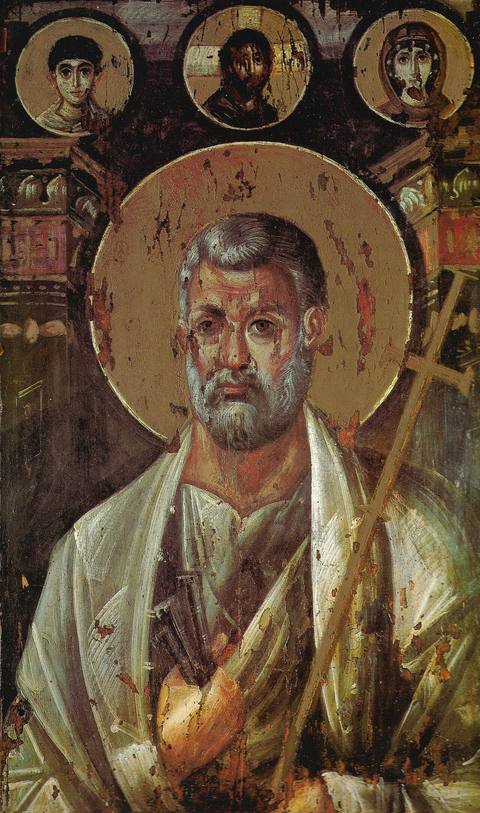 Peter the Apostle