Credible Theories Sign in

The record

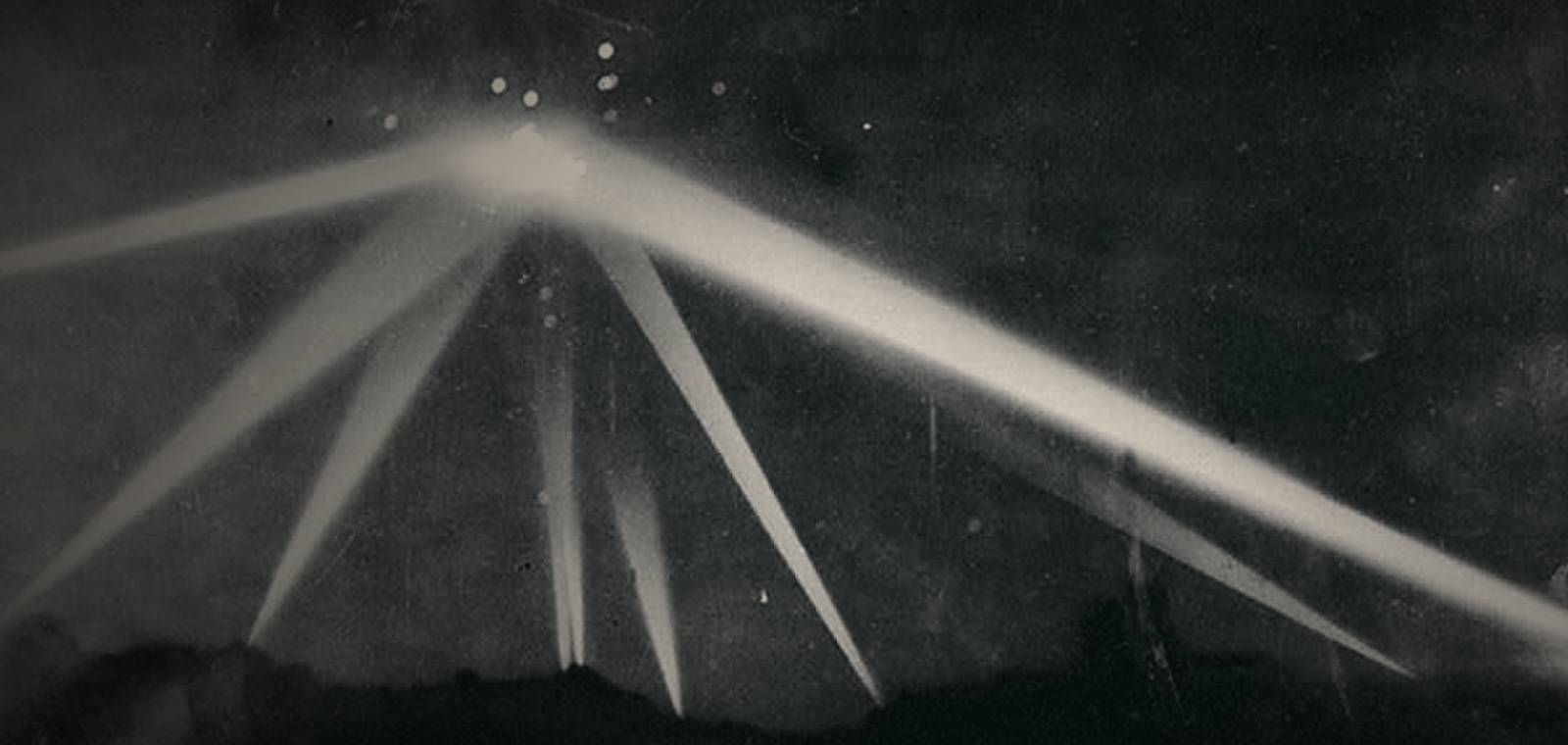
On the evening of 23 February 1942, during a fireside talk by President Roosevelt, a Japanese submarine surfaced off Ellwood, north of Santa Barbara, and shelled a refinery. The next night the coast was jumpy. The Army Air Forces' official history says radars picked up an unidentified target 120 miles west of Los Angeles early on the 25th; a blackout was ordered at 2:21 a.m., and the information center was flooded with reports of "enemy planes" even though the tracked object seems to have vanished.

At 3:06 a.m. a balloon carrying a red flare was seen over Santa Monica, four batteries opened fire, whereupon 'the air over Los Angeles erupted like a volcano.' For three hours people reported "swarms" of planes or balloons, from one to several hundred, at every height and speed. These mysterious forces dropped no bombs and, despite the fact that 1,440 rounds of antiaircraft ammunition were directed against them, suffered no losses. Dawn showed damage only from shell fragments, traffic accidents and the excitement, including at least one death from heart failure.

Navy Secretary Knox called it a false alarm the same day. After questioning witnesses, the Army concluded that one to five unidentified planes had been over the city, and War Secretary Stimson suggested enemy commercial planes or planes launched from submarines. The Army's own later history of continental defense says the guns' first target was probably a meteorological balloon. Stephen Nelson of the Fort MacArthur Museum told Military Times in 2017 that talk of visitors from space was absent from accounts at the time and grew mostly from a single retouched photograph in the Los Angeles Times.
Questions people ask about The Battle of Los Angeles (1942)

What did Congress ask?

Representative Leland Ford wanted to know whether it was a practice raid, a raid to throw a scare into 2,000,000 people, a mistaken identity raid, or a raid to take away Southern California's war industries.

What did the newspapers say?

The Washington Post called the handling of the episode a recipe for jitters. The New York Times wrote that if the batteries fired on nothing it was a sign of expensive incompetence.

What did Wendell Willkie tell Californians?

Speaking in Los Angeles on 26 February, he said that when a real air raid began, you won't have to argue about it, you'll just know.

The open question

Still strange: A city that shot at the sky.

The Navy called it a false alarm, the Army said one to five planes were there, and Japan later said it sent none.

The 1952 Washington UFO Sightings: What Did Radar See? →
  1. Step 1 of 4 · This fileThe Battle of Los Angeles
  2. Step 2 of 4 · Next fileThe 1952 Washington UFO Sightings: What Did Radar See?
  3. Step 3 of 4 · Next fileWhat Was Project Blue Book? Inside the Air Force UFO Files
  4. Step 4 of 4 · Next fileThe Robertson Panel: Why a CIA Panel Wanted to Debunk UFOs
About these videos

Found by a YouTube search for this topic, not checked by us. The player loads from YouTube only when you press play.

Where this comes from

EvidenceDocumented

Comes from Wesley Frank Craven and James Lea Cate, eds., The Army Air Forces in World War II, vol…. HyperWar (official US war histories): HyperWar is a free online library of official military histories. The books it copies were written by historians working for the US Army and Air Force from wartime records, so they are the government's own account.

What this means

Records exist and are linked below. This page says what the records say.

For The Battle of Los Angeles, the original record exists and is linked: Wesley Frank Craven and James Lea Cate, eds., The Army Air Forces in World War II, vol…. That tells you the record is real and what it says. It does not mean every claim in it is true.

Primary records exist: an original document, a published text, an official file or a dated report. We link to them. This level says the record exists and what it says, not that every claim in it is true.

See all five labels

Sources

  1. HyperWar (official US war histories)HyperWar is a free online library of official military histories. The books it copies were written by historians working for the US Army and Air Force from wartime records, so they are the government's own account.Wesley Frank Craven and James Lea Cate, eds., The Army Air Forces in World War II, vol. 1, Plans and Early Operations (University of Chicago Press for the Office of Air Force History, 1948), chapter 8, HyperWarPrimary text
  2. HyperWar (official US war histories)Stetson Conn, Rose C. Engelman and Byron Fairchild, Guarding the United States and Its Outposts, United States Army in World War II (Washington: Center of Military History, 1964), chapter 4, HyperWarPrimary text
  3. Military TimesAn independent news outlet that reports on the US military for service members and their families. A news story is a good guide to what happened and who said what, but it is not the original record.Kevin Lilley, "UFOs or no, 'Battle of Los Angeles' nears 75th anniversary", Military Times (19 February 2017)

Quotations come from public-domain translations. A book in our Library links to its Library page; other links open the free online copy or the reference page.

Updated

Credible or not?

Tap one to see how other readers voted.

Discussion