













What is Epimenides known for?
Epimenides was a Cretan holy man and poet, said to have lived around the 6th century BCE. Ancient writers credit him with religious poems, including a Theogony, and say the Athenians called him in to purify their city from a curse. Some scholars see him as a shaman-like figure, and much of his biography may be legend.
The best-known story, told by Diogenes Laertius, is that as a boy he was sent to look for a sheep, lay down in a cave at midday and slept for 57 years. When he woke he went on looking for the sheep and found everything changed, and his younger brother an old man.
He is also credited with the line that Cretans are always liars, which the New Testament Letter to Titus quotes from 'one of their own prophets'. Because a Cretan said it, logicians later turned it into the liar paradox.
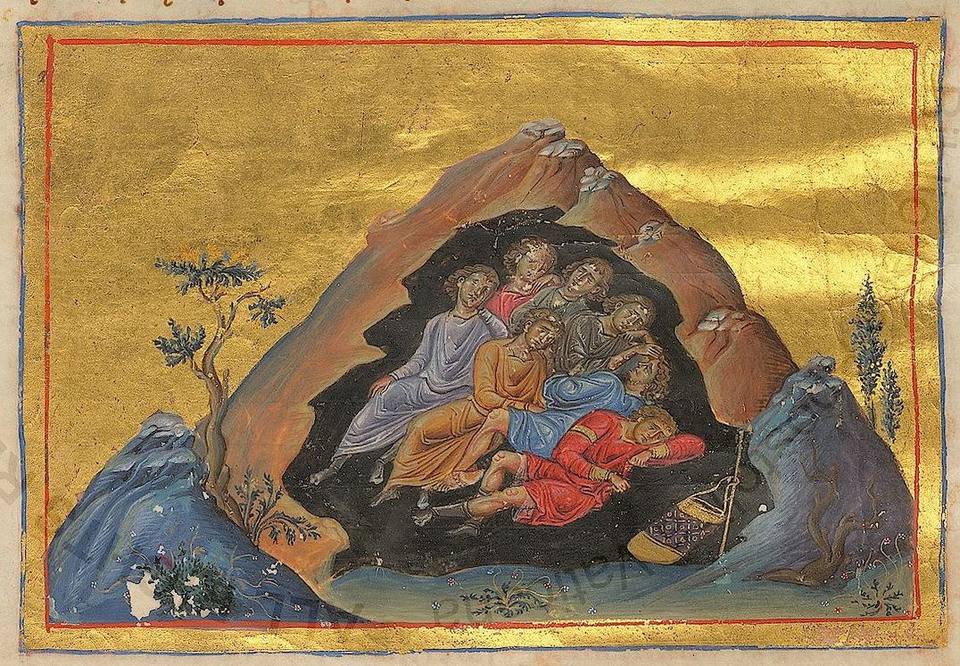
His long sleep is one of several ancient stories of a man who sleeps for decades, alongside Honi the Circle-Drawer in Jewish tradition, the man of Surah 2:259 in the Quran, and the Seven Sleepers.
Titles and honors
- Medals and honors
- Honoured as a god after death, per article
The same story, told elsewhere
Shared story · Death and return
Sleepers Who Wake Years Later: Epimenides, Honi, the Seven Sleepers and Rip Van Winkle
A man lies down for a nap and wakes to find his brother old, his village gone and his coins worth nothing. The same story is told in Crete, Judea, Ephesus, Arabia, India, Japan, Ireland and New York.
Diogenes Laertius, Lives of Eminent Philosophers (Epimenides) is one telling. The same story is told 8 more times, in 6 parts of the world. Follow it:
- GreekCrete · c. 200-250 CE · Ancient textTied to this page
- Hindu (Puranic)India · c. 300-500 CE · Ancient text
- Jewish (Babylonian Talmud)Judea · c. 500-600 CE · Medieval text
- Christian (Seven Sleepers of Ephesus)Ephesus · c. 500 CE · Medieval text
- IslamArabia · 7th century CE · Medieval text
- IslamArabia · 7th century CE · Medieval text
- JapaneseJapan · c. 759 CE · Medieval text
- IrishIreland · c. 1750 · Early modern text
- AmericanCatskill Mountains, New York · 1819 · Recorded folklore
The open question: Is the long sleep a story people passed along from Crete to Ephesus to New York, or does every culture invent it because everyone fears coming home to a world that has moved on? Join the debate
Mentioned on these pages
Linked people and places
Where this comes from
Comes from Encyclopaedia Britannica, 'Epimenides'. An encyclopedia first published in Scotland in 1768 and now online. Its articles are written and checked by named experts and editors, which makes it a reliable source for basic facts.
What this means
Scholars disagree about whether, or where, this was real.
For Epimenides, there is real evidence, but it does not settle the question (2 sources listed at the bottom of this page).
Serious people have done real work and there is real evidence for the idea, but it falls short of proof. We show what supports it, what is missing and who disagrees.
Sources
- Encyclopaedia BritannicaAn encyclopedia first published in Scotland in 1768 and now online. Its articles are written and checked by named experts and editors, which makes it a reliable source for basic facts.Encyclopaedia Britannica, 'Epimenides'Reference Archived copy, 2026-07-09
- WikipediaA free online encyclopedia written and edited by volunteers. It is a good starting point and usually lists its own sources, but anyone can change it, so we treat it as a guide to better sources, not the final word.Wikipedia, 'Epimenides'Reference Archived copy, 2026-09-16
No public-domain picture of this person yet. We do not show drawn or generated likenesses.