How the rabbit hole works. Start with anything that grabs you, say UFOs. Every person, place and document a page mentions links to its own page, so a UFO file leads to a witness, the witness leads to the people who investigated the case, and it keeps going.
The path you take shows in the bar under the top menu on every page, so you can step back any time or climb out and start again.
This is a short passage from the Quran, the holy book of Islam, which Muslims believe God revealed to the Prophet Muhammad from 610 to 632 CE. In the story, a man passing a ruined town is made to die for a hundred years and then brought back to life. He thinks only a day has passed, yet his food and drink have not rotted.
ReferenceSurah 2:259
Written610–632 CE
SetA man passing a ruined town (tradition names Uzair or Jeremiah)
Allah made him die a hundred years, then brought him back to life. He said: How long hast thou tarried? (The man) said: I have tarried a day or part of a day. (He) said: Nay, but thou hast tarried for a hundred years. Just look at thy food and drink which have not rotted!
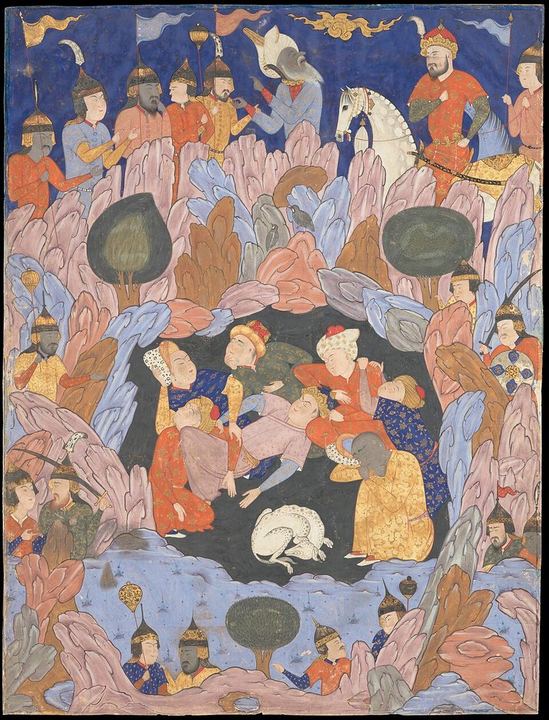
A man lies down for a nap and wakes to find his brother old, his village gone and his coins worth nothing. The same story is told in Crete, Judea, Ephesus, Arabia, India, Japan, Ireland and New York.
Quran, Surah al-Baqarah (the man who slept a hundred years) is one telling. The same story is told 8 more times, in 6 parts of the world. Follow it:
The open question: Is the long sleep a story people passed along from Crete to Ephesus to New York, or does every culture invent it because everyone fears coming home to a world that has moved on? Join the debate
Questions people ask about Surah 2:259
Where is Surah 2:259 found?
It is in Al-Baqarah, The Cow, the second and longest surah of the Quran, with 286 verses. The verse comes shortly after the Throne Verse, 2:255, one of the best-known passages in Islam. Nearby verses tell of Abraham debating a king about life and death, and of Abraham watching four birds brought back to life.
When was Surah 2:259 revealed?
Al-Baqarah is a Medinan surah, so Muslims date its revelation to the years after Muhammad and his followers moved from Mecca to Medina in 622 CE. It is thought to have been revealed over a span of years rather than all at once. Many of its passages deal with law and with the earlier prophets.
Are there other stories of a long magical sleep?
Yes, many. The Greek writer Diogenes Laertius said the Cretan seer Epimenides fell asleep in a cave and woke 57 years later. Christians and Muslims tell of the Seven Sleepers of Ephesus, who slept for centuries. In 1819 Washington Irving's Rip Van Winkle turned the idea into an American classic.
Where this comes from
EvidenceDocumented
Comes fromThe Quran, Surah 2:259, read here in the Marmaduke Pickthall. The holy book of Islam, which Muslims believe God revealed to the Prophet Muhammad from about AD 610 to 632. Its chapters are called surahs.
What this means
The text exists and is quoted from a published translation. What it describes is a separate question.
Primary records exist: an original document, a published text, an official file or a dated report. We link to them. This level says the record exists and what it says, not that every claim in it is true.