How the rabbit hole works. Start with anything that grabs you, say UFOs. Every person, place and document a page mentions links to its own page, so a UFO file leads to a witness, the witness leads to the people who investigated the case, and it keeps going.
The path you take shows in the bar under the top menu on every page, so you can step back any time or climb out and start again.
This is a summary from the Popol Vuh, the sacred story of the K'iche' Maya of Guatemala, written down around 1554 to 1558 CE from older tradition. In it, the gods make the first four humans from maize. These people can see everything, through the sky and earth to the edge of the world. Worried they will become equals, the gods blur their eyes like breath on a mirror.
ReferencePopol Vuh
WrittenWritten down c. 1554–1558 CE from older K'iche' Maya tradition
SetCreation of humans
The first four humans, made of maize, see everything: through the sky and the earth, to the edge of the world. The gods worry they will become their equals, so they blur their eyes like breath on a mirror.
Documented · Retold in English, c. 1554–1558 CE Summary by the editors. Translation: Summary in my own words
AdvertisementAd space
Read it literally
Humans were built better and then downgraded on purpose.
A god warns one good man, a boat is built, the world drowns and birds are sent out to find land. The same story turns up from Iraq to India to Greece, with cousins in China, Scandinavia and Guatemala.
Popol Vuh (the wooden people) is one telling. The same story is told 9 more times, in 6 parts of the world. Follow it:
Gold, silver, bronze, iron: Greece, Persia and the Book of Daniel all count the ages of the world in metals, India counts four yugas, and the Norse and Maya see whole worlds destroyed and remade.
Popol Vuh (the failed creations) is one telling. The same story is told 9 more times, in 6 parts of the world. Follow it:
A god kneels in the mud, shapes a body with his hands and breathes it into life. That scene is told in Iraq, Israel, Egypt, Greece, China, Arabia, Guatemala, Sudan and New Zealand.
Popol Vuh (the man of clay), as summarized by H. H. Bancroft is one telling. The same story is told 8 more times, in 6 parts of the world. Follow it:
The open question: Did one old story about a potter god travel from people to people, or does anyone who works with clay end up imagining that we were made from it? Join the debate
Questions people ask about Popol Vuh
What does the name Popol Vuh mean?
It is usually translated 'Book of the Council' or 'Book of the Community'. The work tells the K'iche' Maya story of creation, the adventures of the Hero TwinsHunahpu and Xbalanque in the underworld, and the history of K'iche' ruling families. Its authors wrote it in their own language using the Latin alphabet.
Who wrote the Popol Vuh, and where is the manuscript now?
It was written by K'iche' nobles whose names are not recorded, some years after the Spanish conquest. Their original is lost. What survives is a copy made by the Dominican friar Francisco Ximénez in the town of Chichicastenango, Guatemala. That manuscript is now kept at the Newberry Library in Chicago.
What were humans made of before the gods used maize?
The gods first shaped people from mud, but they crumbled and could not think. Next they carved people from wood, who could talk but had no hearts and forgot their makers, so the gods sent a flood. Survivors of the wooden people became monkeys. Only then did the gods make the four maize men.
Where this comes from
EvidenceDocumented
Comes fromThe Popol Vuh, Popol Vuh. The sacred story of the K'iche' Maya of Guatemala: how gods made people from maize, and the Hero Twins' contest with the lords of the underworld. It was written down in the K'iche' language in the mid 1500s; the only surviving copy, made by the friar Francisco Ximénez around 1701, is at the Newberry Library, Chicago.
What this means
The text exists and is quoted from a published translation. What it describes is a separate question.
Primary records exist: an original document, a published text, an official file or a dated report. We link to them. This level says the record exists and what it says, not that every claim in it is true.













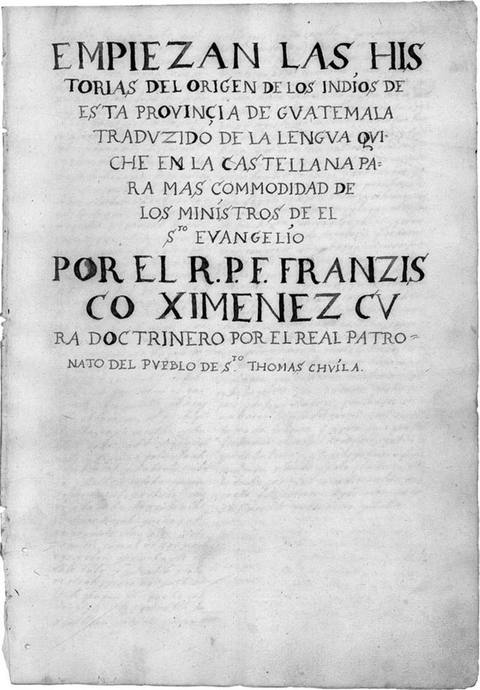 Francisco Ximénez