Credible Theories Sign in
Persia · Vendidad, Fargard 2

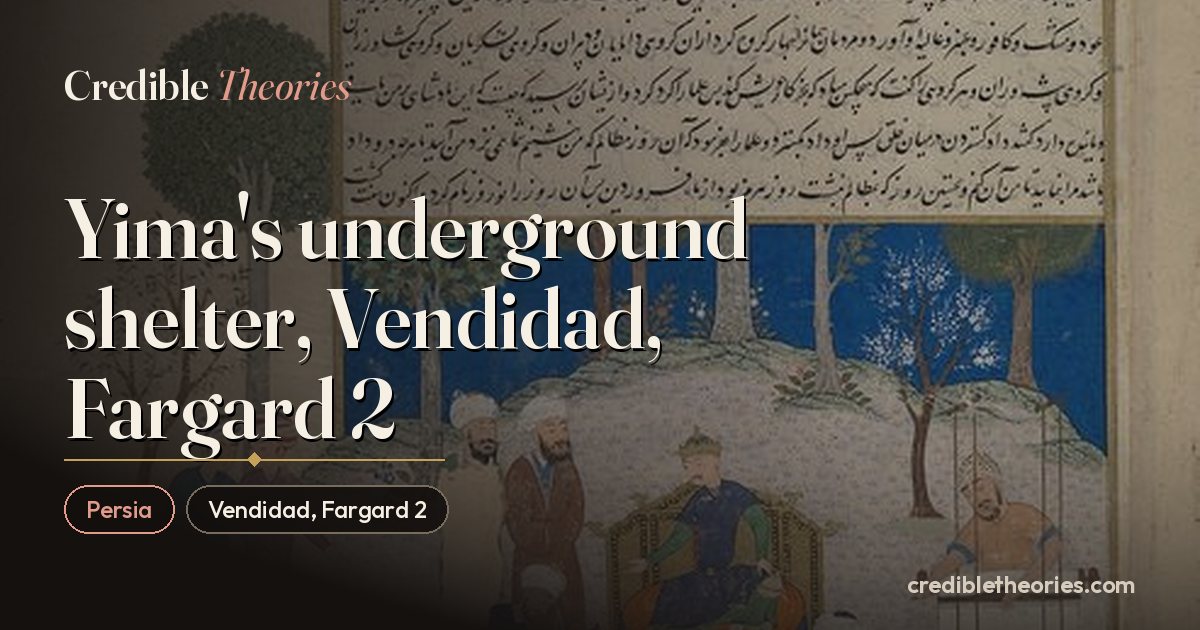
Yima's underground shelter, Vendidad, Fargard 2

Share

In plain words

This is a short passage from the Vendidad, part of the holy books of Zoroastrianism, the old religion of Persia. Its teachings were passed down by mouth from about 1000 BCE and written down later. In the story, King Yima builds a walled shelter to save people and animals from a deadly winter. Inside, the text says, a whole year seems like a single day.

ReferenceVendidad, Fargard 2
WrittenAvesta, oral from c. 1000 BCE; written c. 500 BCE–500 CE
SetThe first king, before a killing winter
There are uncreated lights and created lights. There the stars, the moon, and the sun are only once (a year) seen to rise and set, and a year seems only as a day.

Documented · Ancient text, c. 1000 BCE Translation: Darmesteter, 1880 · About the translator

Read it literally

Ahura Mazda warns Yima of deadly winters and tells him to build an enclosure holding the seeds of the best people, animals and plants, lit by made lights. A vault that survived the reset.

What scholars say

Zoroastrian scripture. The Vara is often compared to Noah's Ark.

Themes Looks like technology Strange time
People and places hereNoah

The same story, told elsewhere

Shared story · Floods and lost lands

Flood Stories Around the World

A god warns one good man, a boat is built, the world drowns and birds are sent out to find land. The same story turns up from Iraq to India to Greece, with cousins in China, Scandinavia and Guatemala.

Vendidad, Fargard 2 (Yima's Vara) is one telling. The same story is told 9 more times, in 6 parts of the world. Follow it:

  1. Vedic IndiaNorthern India · c. 800-600 BCE · Ancient text
  2. Babylonian (Akkadian)Mesopotamia · 7th century BCE · Ancient text
  3. Hebrew BibleJudah / Babylon · c. 600-400 BCE · Ancient text
  4. ChineseYellow River valley, China · 1st millennium BCE · Ancient text
  5. Zoroastrian (Persian)Iran / Central Asia · 1st millennium BCE · Ancient textTied to this page
  6. Babylonian, retold in GreekBabylon · c. 280 BCE · Ancient text
  7. GreekGreece · 1st or 2nd century CE · Ancient text
  8. IslamArabia · 7th century CE · Medieval text
  9. NorseIceland · c. 1220 CE · Medieval text
  10. K'iche' MayaHighland Guatemala · c. 1554-1558 · Retold in English

The open question: One real flood remembered by many peoples, or many different floods that each people told in its own way? Join the debate

Questions people ask about Vendidad, Fargard 2

Who is Yima in Persian tradition?

Yima is the first king and ruler of a golden age in the Avesta. In later Persian legend he became Jamshid, the great king of Ferdowsi's Shahnameh, who is overthrown after he grows proud. He shares his origins with Yama of the Indian Vedas, who in Hindu belief became the god of death.

What is the Vendidad?

The Vendidad is a part of the Avesta, the Zoroastrian sacred texts, written in the Avestan language. Its name means 'the law against the demons'. Its 22 chapters, called fargards, deal mostly with rules of purity, such as how to handle the dead, along with some myths like Yima's story.

What happened to Yima after his golden age?

In the Avesta's Zamyad Yasht, Yima loses his khvarenah, the divine glory of kingship, after he tells a lie. The glory leaves him in the shape of a bird. In the Shahnameh, Jamshid's pride turns his people against him, and the serpent-shouldered tyrant Zahhak takes his throne and later kills him.

Used on these files

  • Yima and the Vara: An Ancient Shelter Against the Ice? Myth or legendWarned of killing winters, the first king of the Iranian tradition built an underground enclosure and filled it with the seeds of the finest people, animals and plants. Inside, the sun and stars rise and set only once a year; some speculative readers say that matches the far north. What was this refuge really describing?

Where this comes from

EvidenceDocumented

Comes from The Vendidad (part of the Zend-Avesta), Vendidad, Fargard 2, read here in the James Darmesteter. Part of the Avesta, the holy books of Zoroastrianism, the old religion of Persia. Chapter 2 tells how King Yima built a walled shelter to save people and animals from a deadly winter.

What this means

The text exists and is quoted from a published translation. What it describes is a separate question.

Primary records exist: an original document, a published text, an official file or a dated report. We link to them. This level says the record exists and what it says, not that every claim in it is true.

See all five labels

Sources

  1. The Vendidad (part of the Zend-Avesta)Part of the Avesta, the holy books of Zoroastrianism, the old religion of Persia. Chapter 2 tells how King Yima built a walled shelter to save people and animals from a deadly winter. The texts were first written down between AD 224 and 651. James Darmesteter's English version came out in 1880.James Darmesteter, The Zend-Avesta Part I: The Vendidad, SBE 4 (1880) Online copyPrimary text Archived copy, 2026-10-03
  2. The Vendidad (part of the Zend-Avesta)Vendidad, Fargard 2, trans. James Darmesteter, Sacred Books of the East vol. 4 (1880) Online copyPrimary text Archived copy, 2026-08-04

Scholarly dates are rounded. The wording follows the named public-domain translation.

More from Persia

Two more stories, and what each shares with Yima's underground shelter.

Photo credits
RelatedWhat Azazel taught1 Enoch 8:1–3

A Watcher named Azazel teaches people to make swords, knives, shields and armor and to work metals.

Also about NoahSame theme: Looks like technology
Photo credits
RelatedGadreel and the weapons of death1 Enoch 69:6

The Book of Enoch is a set of Jewish writings about Noah's great-grandfather Enoch.

Also about NoahSame theme: Looks like technology

Updated

Discussion