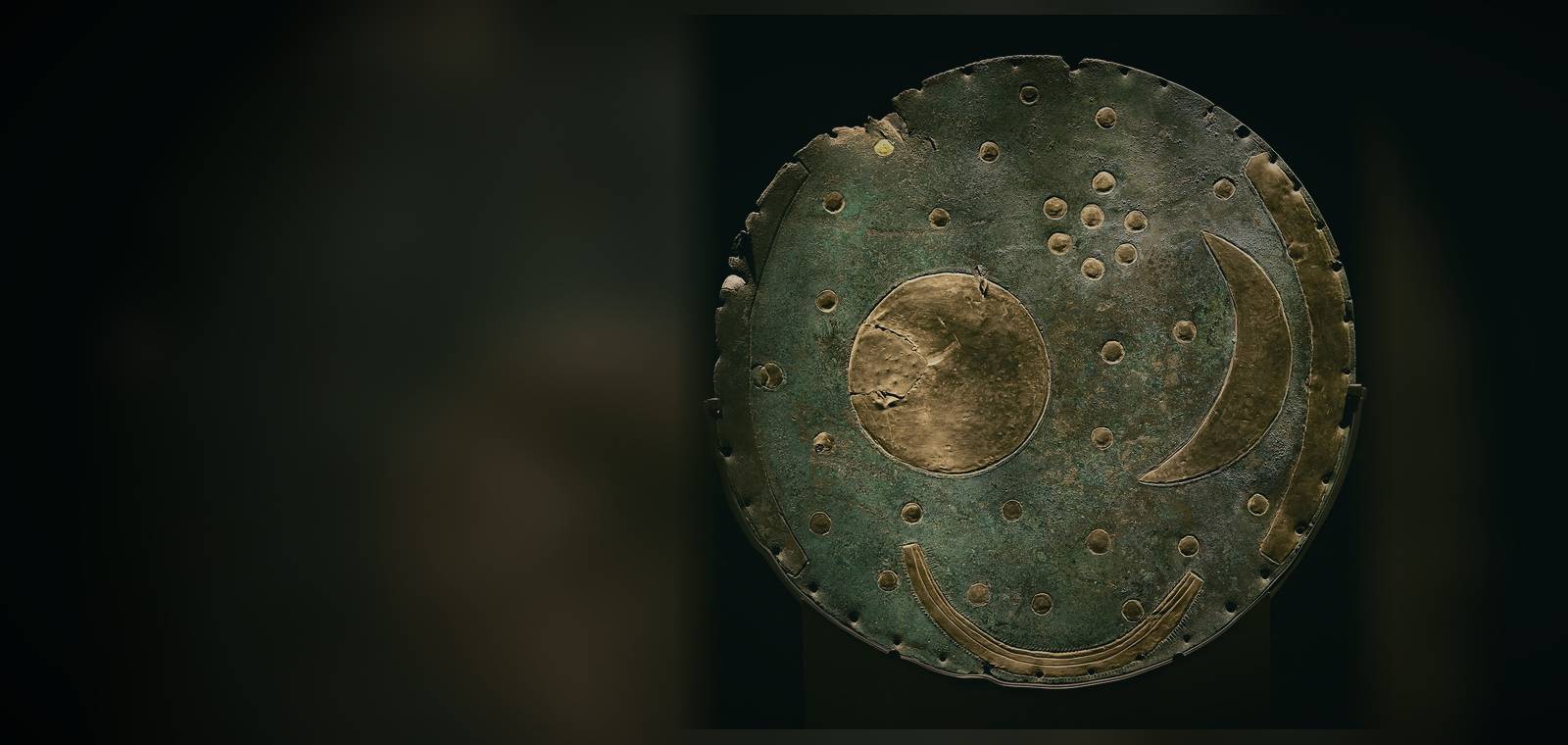
The record
The State Museum of Prehistory in Halle, which keeps it, calls the disc one of the most important archaeological finds of the past century
and says It shows the world's oldest concrete depiction of astronomical phenomena that we know.
On the bronze disc, gold shapes show a full circle, a crescent and a scatter of stars, with arcs along the edges. The museum reads one arc as a boat: A boat appears between the horizons on a nocturnal voyage across the celestial ocean.
UNESCO added it to its Memory of the World register in 2013.
It was not found by archaeologists. On 4 July 1999, two looters discovered an Early Bronze Age hoard on the Mittelberg hill near Nebra,
made up of two swords, two axes, one chisel, and two arm spirals as well as a bronze disc which was almost completely covered with adhering soil.
Cleaning it roughly, they revealed the gold, and A few days later, the looters sold the entire find to the first dealer.
The hoard passed through the hands of dealers until, as the museum puts it, In February 2002, the Basel police
secured the find, working with the state authorities in Saxony-Anhalt. It was recovered in a Swiss hotel.
The looters' word about where they found it became a court matter. The regional court in Halle heard them and the dealers, and the presiding judge concluded: After a comprehensive review of all the evidence, there was no doubt about the find location of the Nebra Sky Disc.
Soil stuck to the disc, gold and copper traces in the ground at the findspot and the marks left by the looters' digging were all checked against their story.
Doubts did not stop there. Early on, some argued it was a modern fake; scientific analyses ruled that out, and a 2020 review states that the analyses also disproved an earlier claim that the Sky Disc was a modern fake.
In 2020 two other scholars argued that the disc did not belong with the hoard and should be dated to the Iron Age instead. The excavation team answered that, since there is no scientific method yet available to date copper alloys exactly,
the disc's date comes from the swords and axes buried with it, which are typologically and radiocarbon dated to around 1600 BC.
The copper matches the Bronze Age mines of Mitterberg in Austria, and the team traces the gold to the Carnon River in Cornwall.
How it was made is now clearer too. A 2024 metal study examined a small piece from the outer part of the disc and compared it with a replica. It found that the disc was manufactured from a flat cast followed by hot forging process,
and that During the forging process the disc was heated and forged for approximately 10 times.
What the smiths meant by their sky is still a matter of reading the picture, but the object itself has been dated, sourced and traced from the hilltop to the museum case.