












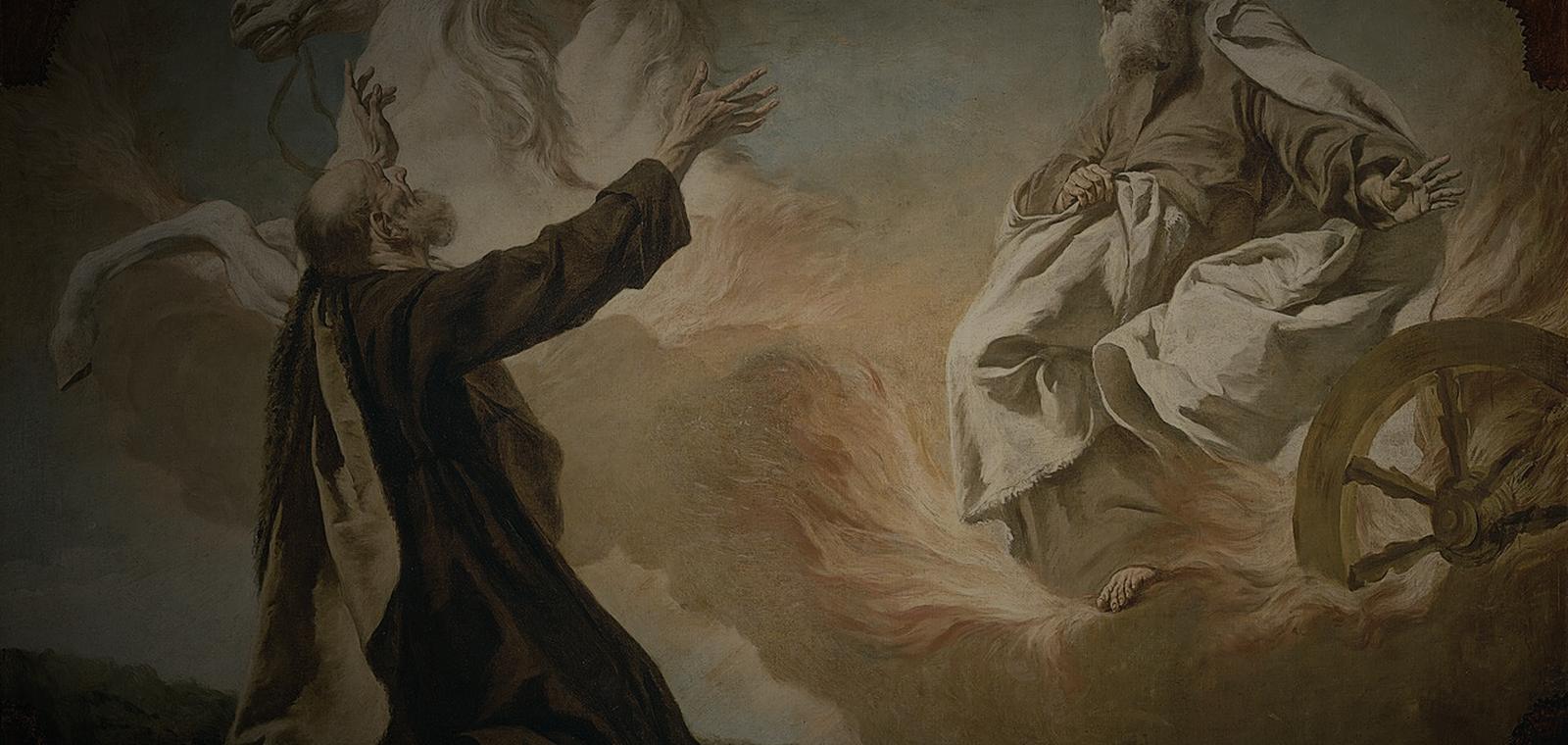
What is Elijah known for?
Elijah the Tishbite is a prophet in the northern kingdom of Israel during the reign of Ahab in the 9th century BCE. In 1 Kings he opposes the worship of Baal promoted by Ahab and Jezebel, and on Mount Carmel calls down fire on his sacrifice.
His departure is one of the Bible's most vivid scenes. In 2 Kings 2, as Elijah and his successor Elisha walk together, a chariot of fire and horses of fire come between them, and Elijah goes up by a whirlwind into heaven. Fifty men search the hills for three days and find no body. Malachi 4:5 promises that Elijah will return before the day of the Lord, which is why Jewish tradition sets a cup for him at Passover and the Gospels link him to John the Baptist and the Transfiguration. Islam honors him as the prophet Ilyas.
Historians accept that the stories are set in a real period, with Ahab known from Assyrian records, but the Elijah cycle itself is read as prophetic legend.
Titles and honors
- Titles
- Prophet, in the northern kingdom of Israel
- Saint, feast day 20 July in the Latin Church
- Patron saint of Bosnia and Herzegovina
- Death toll and kills
- In the text Slew the 450 prophets of Baal at the River Kishon, 1 Kings 18
The same story, told elsewhere
Shared story · Death and return
Taken Up to Heaven: Ascension Stories Compared
Enoch, Elijah, Romulus, Heracles, Krishna and Jesus all leave the earth by going up: in a whirlwind, a cloud, a storm or a blaze of light. The stories quoted side by side.
2 Kings 2:11 (Elijah) is one telling. The same story is told 6 more times, in 3 parts of the world. Follow it:
- Hebrew BibleJudah · c. 600-400 BCE · Ancient text
- Hebrew BibleNear the Jordan River, Israel · c. 600-550 BCE · Ancient textTied to this page
- HinduDvaraka, western India · c. 400 BCE · Ancient text
- GreekMount Oeta, central Greece · c. 1st-2nd century CE · Ancient text
- ChristianMount of Olives, Jerusalem · c. 80-90 CE · Ancient text
- RomanRome, near the Goat's Marsh · c. 100 CE · Ancient text
- IslamicMecca to Jerusalem · c. 620 CE · Medieval text
The open question: Why do so many stories end with a great figure leaving the earth alive instead of dying like everyone else? Join the debate
Shared story · Death and return
The King Who Will Return: Arthur, Barbarossa and Kalki
He did not die. He sleeps inside a mountain, under a castle or on a far island, and when his people need him most he will wake. Britain, Germany, Denmark, Persia, India, Israel and Mexico all tell of a hero who is only waiting.
2 Kings 2 and Malachi 4 (Elijah taken up, and promised again) is one telling. The same story is told 7 more times, in 4 parts of the world. Follow it:
- Hebrew BibleIsrael and Judah · c. 600-550 BCE · Ancient textTied to this page
- Hindu (Puranic)India · c. 300-500 CE · Ancient text
- Zoroastrian (Persian)Iran · c. 9th century CE · Medieval text
- DanishKronborg castle, Helsingør · c. 1100 · Medieval text
- English (Anglo-Norman chronicle)Malmesbury Abbey, England · c. 1125 CE · Medieval text
- GermanKyffhäuser hills, Thuringia, Germany · 13th century · Retold in English
- English (Arthurian romance)England · c. 1470 · Medieval text
- Aztec (Nahua), as told by Spanish chroniclersCentral Mexico and the Gulf coast · c. 1550-1580 · Retold in English
The open question: Is the sleeping king a hope people invent whenever they lose a leader they loved, or one very old idea that has travelled from land to land? Join the debate
Mentioned on these pages
- ChapterOne History 10: The watch
- PassageElijah's chariot of fire (2 Kings 2:11)
- PersonElisha
- PersonKing Ahab
- Personal-Khidr
Where this comes from
Comes from 2 Kings 2 (KJV), Bible Gateway. The Books of Kings (1 and 2 Kings): Two books of the Bible running from King Solomon to the fall of Jerusalem to Babylon in the 580s BC, with stories of the prophets Elijah and Elisha. Scholars think they were finished around the 500s BC, using older royal records.
What this means
A story or tradition. It is documented as a story; nothing independent shows it happened.
Elijah is known from stories, scripture or tradition. The texts are real and we quote them (for example 2 Kings 2 (KJV), Bible Gateway), but nothing outside those texts shows that Elijah was real as described.
The page covers something known from myths, scripture or tradition. The texts are real and we quote them, but no independent record shows the events or beings were real.
Sources
- The Books of Kings (1 and 2 Kings)Two books of the Bible running from King Solomon to the fall of Jerusalem to Babylon in the 580s BC, with stories of the prophets Elijah and Elisha. Scholars think they were finished around the 500s BC, using older royal records.2 Kings 2 (KJV), Bible Gateway Online copyPrimary text Archived copy, 2026-08-01
- WikipediaA free online encyclopedia written and edited by volunteers. It is a good starting point and usually lists its own sources, but anyone can change it, so we treat it as a guide to better sources, not the final word.Wikipedia, 'Elijah'Reference Archived copy, 2026-10-01
No public-domain picture of this person yet. We do not show drawn or generated likenesses.