How the rabbit hole works. Start with anything that grabs you, say UFOs. Every person, place and document a page mentions links to its own page, so a UFO file leads to a witness, the witness leads to the people who investigated the case, and it keeps going.
The path you take shows in the bar under the top menu on every page, so you can step back any time or climb out and start again.
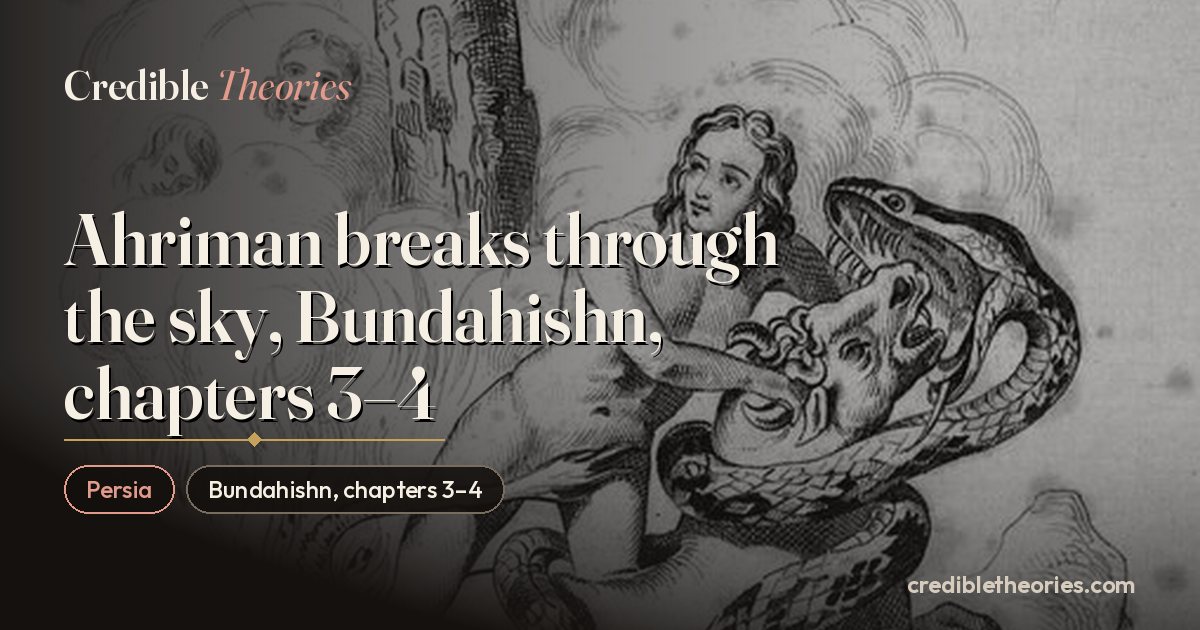
This is a summary from the Bundahishn, a Zoroastrian book about the creation of the world, put in its final form around 800 to 900 CE from older teaching. In it, the evil spirit Ahriman attacks creation from outside, breaking through the sky like a snake and spreading darkness and poison. The first man, Gayomard, and the first ox die, and humans and animals come from their seed.
ReferenceBundahishn, chapters 3–4
Writtenc. 800–900 CE from older Zoroastrian tradition
SetThe first attack on creation
The evil spirit Ahriman attacks creation from outside. He pierces the sky, leaps in like a snake, and spreads darkness and poison. The first man, Gayomard, and the first ox die, and from their seed come humans and animals.
Gold, silver, bronze, iron: Greece, Persia and the Book of Daniel all count the ages of the world in metals, India counts four yugas, and the Norse and Maya see whole worlds destroyed and remade.
Bundahishn is one telling. The same story is told 9 more times, in 6 parts of the world. Follow it:
The open question: Why do so many traditions believe the past was better and the world is running down? Memory, or human nature? Join the debate
Questions people ask about Bundahishn, chapters 3–4
Where is the Bundahishn found?
Bundahishn means primal creation. It is a Zoroastrian book in Middle Persian, written in the Pahlavi script, and it comes down in two versions: a shorter Indian one kept by the Parsis and a longer Iranian one often called the Greater Bundahishn. It gathers older teaching on creation, the calendar, geography and the end of the world.
What happens after Ahriman's attack in the Bundahishn?
The book places the attack inside a fixed world history of 12,000 years, divided into four ages of 3,000 years. Good and evil stay mixed until the final age, when a savior called the Saoshyant raises the dead. Then comes Frashokereti, the making new of the world, in which evil is destroyed for good.
How were the first humans born in the Bundahishn?
When Gayomard dies, his seed falls to the earth and is purified by the sun. After forty years a rhubarb plant grows from it, and from that plant come Mashya and Mashyana, the first man and woman. At first the pair grow joined together as one stalk, and only later take separate human form.
Used on these files
Ahriman: Who Is Zoroastrianism's Destructive Spirit?Myth or legendIn the Zoroastrian creation story, evil does not creep in, it attacks from outside. Ahriman pierces the sky, leaps into a perfect, motionless world, spreads darkness and kills the first man; in one version he even tore out of the womb first to claim a promised kingship. What happens in a world whose history is fixed at twelve thousand years?
Where this comes from
EvidenceDocumented
Comes fromThe Bundahishn, Bundahishn, chapters 3–4, read here in the E. W. West. A Zoroastrian book in Middle Persian about the creation of the world and the fight between the good god Ohrmazd and the evil spirit Ahriman. It was put into its final form around the AD 800s, using much older teaching.
What this means
The text exists and is quoted from a published translation. What it describes is a separate question.
Primary records exist: an original document, a published text, an official file or a dated report. We link to them. This level says the record exists and what it says, not that every claim in it is true.
The BundahishnA Zoroastrian book in Middle Persian about the creation of the world and the fight between the good god Ohrmazd and the evil spirit Ahriman. It was put into its final form around the AD 800s, using much older teaching. E. W. West's English version came out in 1880.E. W. West, Pahlavi Texts Part I (Bundahishn), SBE 5 (1880)Primary text