How the rabbit hole works. Start with anything that grabs you, say UFOs. Every person, place and document a page mentions links to its own page, so a UFO file leads to a witness, the witness leads to the people who investigated the case, and it keeps going.
The path you take shows in the bar under the top menu on every page, so you can step back any time or climb out and start again.
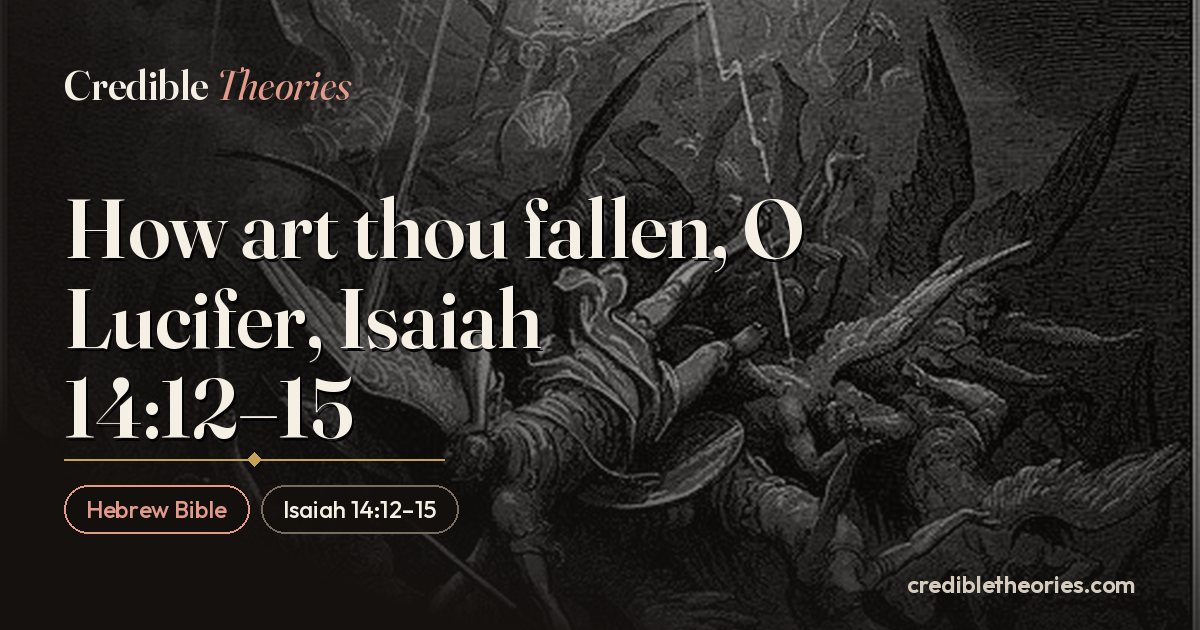
This is a short passage from Isaiah, a book of the Bible named after a prophet in Jerusalem, written around 550 BCE. It is a taunt against the king of Babylon, mocking someone who planned to climb into heaven and set his throne above the stars, but fell. The name Lucifer is Latin for a Hebrew name meaning "shining one, son of dawn," the morning star Venus.
ReferenceIsaiah 14:12–15
Writtenc. 550 BCE
SetA taunt against the king of Babylon
How art thou fallen from heaven, O Lucifer, son of the morning!… For thou hast said in thine heart, I will ascend into heaven, I will exalt my throne above the stars of God.
Documented · Ancient text, c. 550 BCE Translation: KJV
AdvertisementAd space
Read it literally
A leader who tried to take the high ground among the 'stars of God' and was thrown down.
What scholars say
Lucifer is the Latin for Hebrew Helel ben Shahar, 'shining one, son of dawn', the morning star (Venus).
Themes From the sky Council of gods
Questions people ask about Isaiah 14:12–15
Is Lucifer in Isaiah 14 the devil?
In its setting, the poem mocks a human king of Babylon (Isaiah 14:4). Early Christian writers such as Origen and Tertullian read it as describing Satan's fall from heaven, often linking it with Luke 10:18, where Jesus says he saw Satan fall like lightning. That reading made Lucifer a popular name for the devil, even though the Hebrew text never uses it as one.
Who wrote Isaiah 14?
The book is credited to Isaiah son of Amoz, a prophet in Jerusalem in the 700s BCE. Most scholars think the book grew over time, with chapters 40 to 55 written during the Babylonian exile by an unnamed prophet. The oracles against Babylon in chapters 13 and 14 are also often dated later than Isaiah himself, since Babylon was not yet the main threat in his day.
Is there an older myth behind the fall of the morning star?
Many scholars point to Canaanite stories from Ugarit. In one, the god Athtar tries to sit on Baal's throne but is too small for it, so he comes down to rule the earth instead. Isaiah 14:13 also mentions the mount of assembly in the far north, which matches Mount Zaphon, the home of the gods in Ugaritic poems.
Used on these files
Helel ben Shahar: How Did Isaiah's Morning Star Become Lucifer?Myth or legendThe name Lucifer comes from a Latin word for the planet Venus as the morning star, which rises bright and vanishes in the sun's glare. In Isaiah 14 a shining one tries to lift his throne above the stars and is thrown down. In context it mocks a king of Babylon. So how did it become a story about Satan?
Where this comes from
EvidenceDocumented
Comes fromThe Book of Isaiah, Isaiah 14:12–15, read here in the King James Version. A book of the Bible named after Isaiah, a prophet in Jerusalem in the 700s BC; scholars think later writers added to it. The Great Isaiah Scroll, found near the Dead Sea in 1947 and about 2,100 years old, is the oldest complete copy of a book of the Bible.
What this means
The text exists and is quoted from a published translation. What it describes is a separate question.
Primary records exist: an original document, a published text, an official file or a dated report. We link to them. This level says the record exists and what it says, not that every claim in it is true.
The King James BibleThe English Bible made for King James I and first printed in 1611; the wording most people know comes from a 1769 update. It is out of copyright, which is why we quote it. The 1611 printing also had the Apocrypha, extra books kept in Catholic and Orthodox Bibles.King James Version (1611; standard 1769 text), with ApocryphaPrimary textArchived copy, 2026-10-03
The Book of IsaiahA book of the Bible named after Isaiah, a prophet in Jerusalem in the 700s BC; scholars think later writers added to it. The Great Isaiah Scroll, found near the Dead Sea in 1947 and about 2,100 years old, is the oldest complete copy of a book of the Bible.Isaiah 14:4–15, King James VersionOnline copyPrimary textArchived copy, 2026-10-03
Scholarly dates are rounded. The wording follows the named public-domain translation.
More from Hebrew Bible
The story before and after this one, and what each shares with How art thou fallen, O Lucifer.