How the rabbit hole works. Start with anything that grabs you, say UFOs. Every person, place and document a page mentions links to its own page, so a UFO file leads to a witness, the witness leads to the people who investigated the case, and it keeps going.
The path you take shows in the bar under the top menu on every page, so you can step back any time or climb out and start again.
This is a summary of a passage from the Genesis Apocryphon, a retelling of Genesis stories written in Aramaic about 2,000 years ago and found in a cave near the Dead Sea in 1947. Lamech fears his newborn son Noah came from the Watchers, whom the text also calls sons of heaven. His wife Batenosh swears by the Great Holy One that the child is his.
ReferenceGenesis Apocryphon, column 2 (1QapGen)
WrittenCopy c. 50 BCE–50 CE
SetBirth of Noah
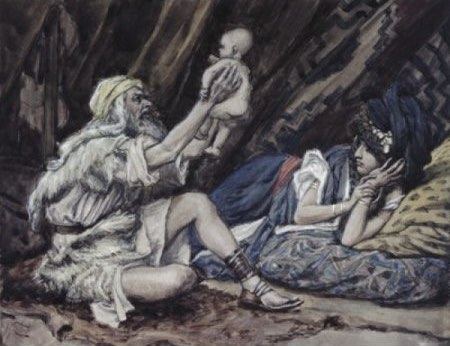
Lamech is afraid his son was conceived 'from the Watchers' and confronts his wife Batenosh. She reminds him of their intimacy and swears by the Great Holy One that the child is his and 'from no stranger, no Watcher, no son of heaven'.
Documented · Retold in English, c. 50 BCE Summary by the editors. Translation: Summary in my own words
AdvertisementAd space
Read it literally
A domestic scene with huge stakes. Great material for a chapter.
What scholars say
Aramaic scroll from Qumran Cave 1, published 1956. No public-domain English version.
Questions people ask about Genesis Apocryphon, column 2
How was the Genesis Apocryphon found?
Bedouin found it in Qumran Cave 1 in 1947, one of the first seven Dead Sea Scrolls. It was bought by the Syrian Orthodox Metropolitan Mar Samuel, who later advertised the scrolls in the Wall Street Journal. In 1954 Yigael Yadin bought them for Israel. It was so fragile that scholars did not unroll it until the mid-1950s. It is now in the Shrine of the Book in Jerusalem.
What else is in the Genesis Apocryphon?
The surviving columns retell parts of Genesis in Aramaic, from Noah's birth to Abram's time. Abram tells his own story in the first person, including a dream about a cedar and a palm tree that warns him Sarai's beauty will put him in danger in Egypt. The scroll praises Sarai's beauty in a long, detailed poem not found in Genesis.
What does Lamech do after Batenosh swears?
Lamech is still not sure, so he runs to his father Methuselah and asks him to go to Enoch, who lives with the angels and knows all things. Enoch's answer, partly preserved, confirms the child is Lamech's. The same story, told at greater length, appears in 1 Enoch 106 and 107.
Used on these files
Lamech and Bitenosh: Why Did Noah's Father Fear a Watcher?Myth or legendA Dead Sea Scroll describes a newborn who lights up the whole house like the sun, with hair white as wool. His terrified father suspects the child was fathered by a Watcher, and his wife swears an oath that he is wrong. It is one of the few female voices in this literature. Whose child was Noah?
The Watchers: Who Were the Fallen Angels of Enoch?Myth or legendThe story says some angels who never sleep came down to a real mountain summit, picked up human wives, and taught people metalworking, spells and astronomy. Their leaders are named, each in charge of ten others. The same word shows up in the Book of Daniel as a heavenly council. So who exactly were the Watchers?
Where this comes from
EvidenceDocumented
Comes fromThe Genesis Apocryphon, Genesis Apocryphon, column 2 (1QapGen). A retelling of stories from Genesis written in Aramaic, the everyday language of the region, about 2,000 years ago. Bedouin shepherds found the scroll in a cave near the Dead Sea in 1947.
What this means
The text exists and is quoted from a published translation. What it describes is a separate question.
Primary records exist: an original document, a published text, an official file or a dated report. We link to them. This level says the record exists and what it says, not that every claim in it is true.
The Book of Enoch (1 Enoch)Jewish writings about Enoch, Noah's great-grandfather, the oldest parts from about 300 to 200 BC. It tells of angels called Watchers who came down to earth. Full copies survived only in Ethiopia, whose church still counts it as scripture. Pieces in Aramaic were found among the Dead Sea Scrolls in 1952.1 Enoch 106:1–18, trans. R. H. Charles, The Book of Enoch (1917)Online copyPrimary textArchived copy, 2026-08-02