How the rabbit hole works. Start with anything that grabs you, say UFOs. Every person, place and document a page mentions links to its own page, so a UFO file leads to a witness, the witness leads to the people who investigated the case, and it keeps going.
The path you take shows in the bar under the top menu on every page, so you can step back any time or climb out and start again.
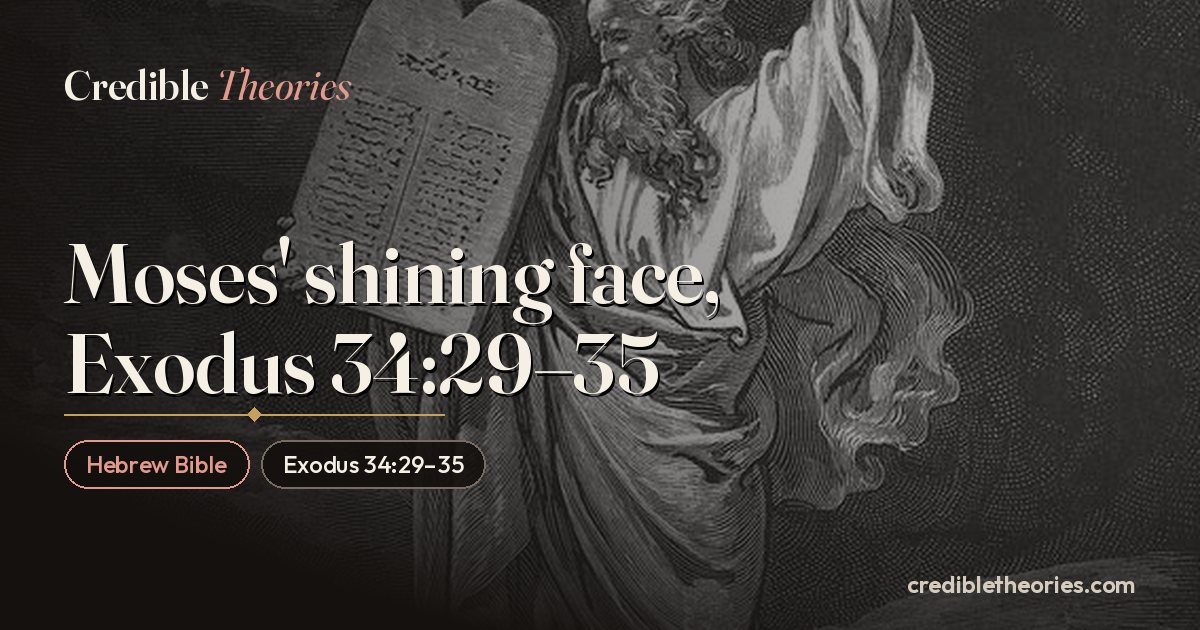
This is a short passage from Exodus, the second book of the Bible, written roughly 900 to 500 BCE. After Moses talks with God, the text says the skin of his face shines, and the people are afraid to come near him, so he wears a veil. A Latin mistranslation turned "shone" into "horned," which is why Michelangelo's statue of Moses has horns.
ReferenceExodus 34:29–35
Writtenc. 900–500 BCE
SetThe Exodus
The skin of his face shone while he talked with him… and they were afraid to come nigh him.
Documented · Ancient text, c. 900–500 BCE Translation: KJV
AdvertisementAd space
Read it literally
After forty days in close contact, Moses gives off something that frightens people, so he wears a veil. Exposure to something.
What scholars say
A Latin mistranslation of 'shone' as 'horned' gave Michelangelo's Moses his horns.
The Hebrew verb for shone, qaran, comes from the same root as qeren, horn. Jerome's Latin Vulgate translated it as horned, and many medieval artists followed. Michelangelo's marble Moses, carved around 1513 to 1515 for the tomb of Pope Julius II, sits in the church of San Pietro in Vincoli in Rome.
What does Paul say about Moses' veil?
In 2 Corinthians 3, Paul says Moses covered his face so the Israelites would not watch the glow fade away. He then uses the veil as a picture, saying a veil lies over people's hearts when the old covenant is read, and is removed only when someone turns to the Lord. Jewish readers do not accept this interpretation.
What was Moses doing during the forty days on the mountain?
Exodus 34 says Moses went back up Mount Sinai after he had broken the first stone tablets over the golden calf. For forty days and nights he ate no bread and drank no water. He received the commandments again on a new pair of tablets that he had cut himself, and came down with his face shining.
The text exists and is quoted from a published translation. What it describes is a separate question.
Primary records exist: an original document, a published text, an official file or a dated report. We link to them. This level says the record exists and what it says, not that every claim in it is true.
The King James BibleThe English Bible made for King James I and first printed in 1611; the wording most people know comes from a 1769 update. It is out of copyright, which is why we quote it. The 1611 printing also had the Apocrypha, extra books kept in Catholic and Orthodox Bibles.King James Version (1611; standard 1769 text), with ApocryphaPrimary textArchived copy, 2026-10-03
Scholarly dates are rounded. The wording follows the named public-domain translation.
More from Hebrew Bible
The story before and after this one, and what each shares with Moses' shining face.