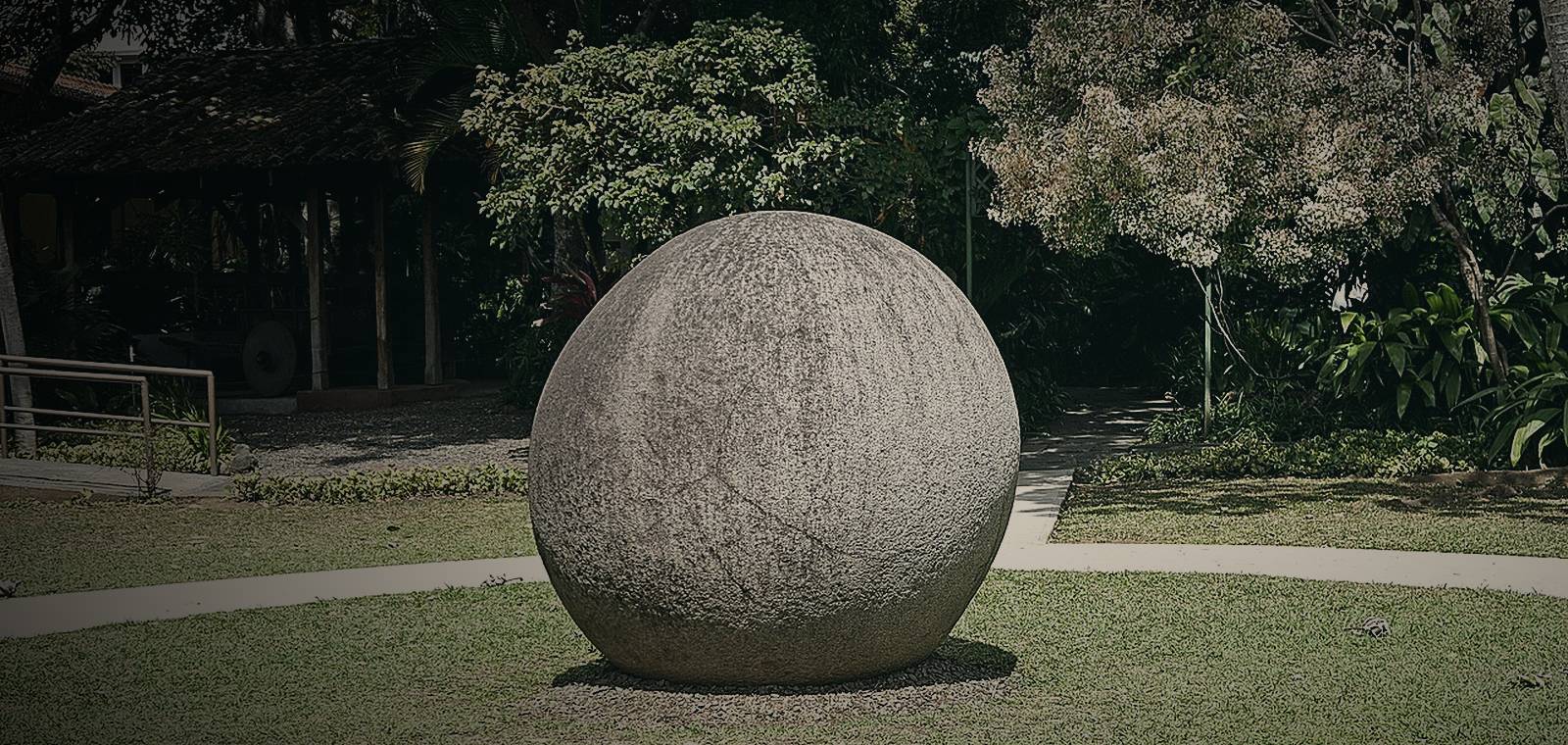
The record
The spheres came to light because of bananas. Costa Rica's own nomination to UNESCO explains that In the 1930s, the United Fruit Company, a U.S.A.-based company, signed a contract with the government of Costa Rica to relocate its banana plantation activity from the Caribbean to the Pacific coast.
Clearing and draining the Diquís Delta exposed old village sites, and in many cases looted.
Harvard Magazine put the numbers this way: more than 300 of them exist, from a few inches in size to a whopper more than eight feet in diameter.
The first scholar to study them was Doris Stone, who, the nomination says, was the first professional who studied and excavated sites with stone spheres in the Térraba Watershed.
She was the daughter of Samuel Zemurray, the main shareholder of the banana company, which let her see sites before they were cleared. She examined five sites with stone spheres between 1939 and 1941.
In 1948, through Doris Stone's help, Samuel Lothrop of Harvard's Peabody Museum came to work on the banana company's lands, and his 1963 report is still called a very valuable source of information about the archaeological contexts in the Delta.
How do you make a stone ball that round? The anthropologist John Hoopes explained that they are of granodiorite, a hard igneous rock: By successive use of heat (building a fire on the stone) and cold (dashing it with cold water), a person could reduce an irregular boulder to a sphere. The greater amount of labor appears to have gone into grinding and polishing.
Harvard Magazine adds that the banana planters removed many balls with little notice taken of their locations,
so for most spheres the original arrangement is lost.
Excavations at the site called Finca 6 recovered spheres still in place. Two spheres 1.10 metres across stood at either side of the lower end of the ramp of Mound 1,
a find that helped strengthen the hypothesis that the spheres functioned as symbols of rank.
Four radiocarbon dates place the occupation of that site between A.D. 750 and 1450.
Hoopes's own view: We believe that the balls may have sat in front of the houses of prominent people, perhaps as a display of power, of esoteric knowledge, or of control over labor.
Some spheres left the country. In 1964 Costa Rica's National Museum sent two to the New York World's Fair; afterwards one went to the National Geographic Society and the other to the Peabody Museum at Harvard, where, Harvard Magazine recalls, it was known jokingly as the "Doris Stone." In 2014, JSTOR Daily notes, UNESCO placed the spheres on the World Heritage list. The people who made the spheres left no writing, so their meaning has to be read from where they stand.