Credible Theories Sign in

The record

The first published report came from the Orkney antiquary George Petrie, read to the Society of Antiquaries of Scotland in April 1867. About fifteen or sixteen years earlier, he wrote, the drift-sand, which had accumulated to a great height at a place called Skara, on the south side of the bay above named, was undermined and swept away by the wild waves of the Atlantic. What lay underneath was an immense midden, a refuse heap of ashes thickly studded with bones, shells, pieces of horns of the ox and deer. Historic Environment Scotland dates the moment to 1850, when a storm in 1850 eroded away some of the sand covering it. Even that date has been argued over: in 1967 Dr Ernest Marwick, writing in The Orcadian newspaper, called the idea that the village was unknown before the storm a complete fiction, though the agency's own review concludes it is still very possible that Skara Brae was first discovered in 1850.

The landowner, William Watt, dug for years, and Petrie came back again and again to measure. I have repeatedly visited Skara during Mr Watt's explorations, he wrote, and the ruins were altogether so different in type from any hitherto discovered. He described a group of chambers and cells, arranged on both sides of, and opening into, a long zig-zag or winding passage. In one doorway a long stone was found, which had evidently been used as a bar to support or barricade a door.

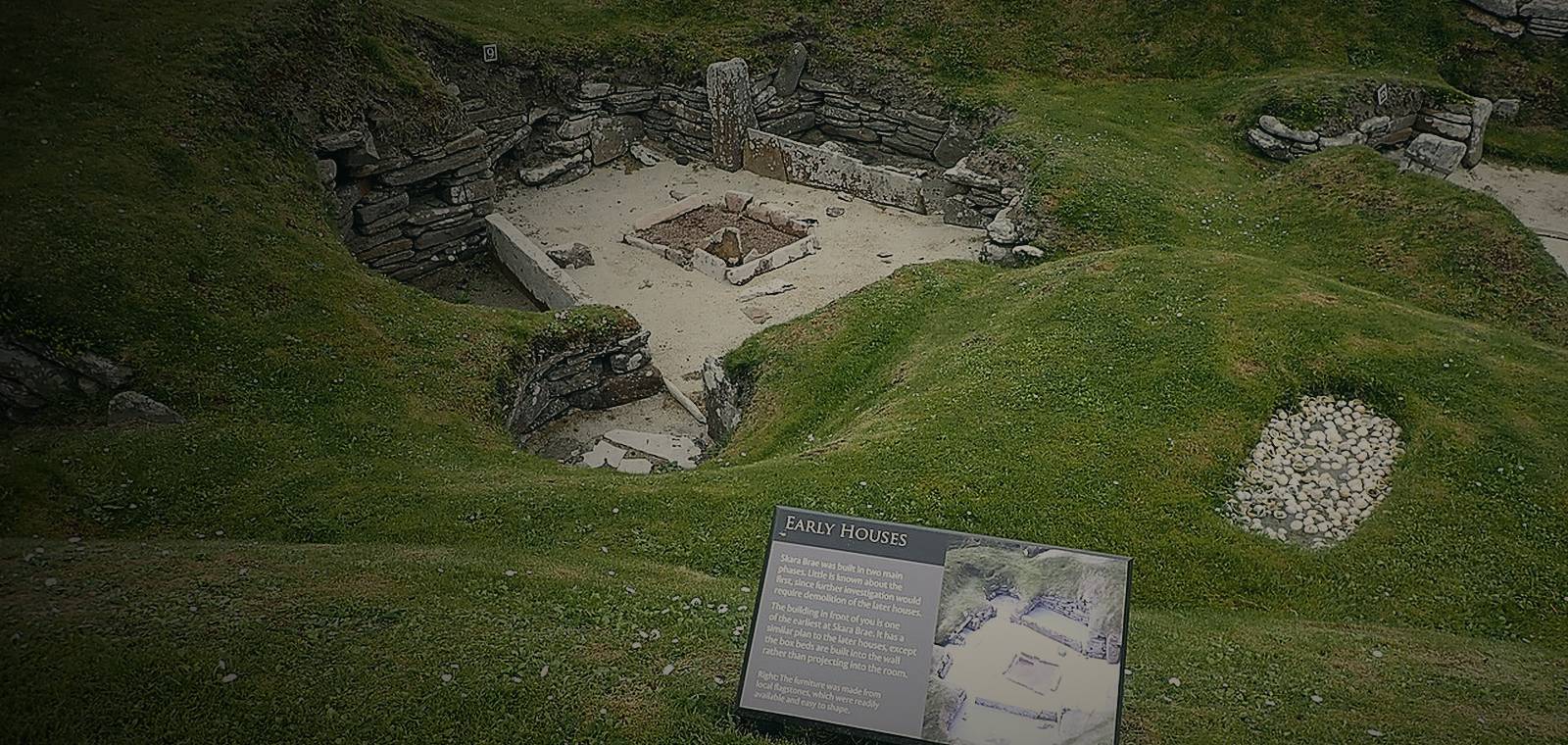
What makes the place famous is what is still inside. Each house is a single room of about 40 square metres, the houses are linked by covered passageways, and the furniture is stone: a ‘dresser’ – perhaps to store and display special objects, "two box-beds," a central hearth and small tanks set into the floor. Historic Environment Scotland says: Nowhere else in Western Europe can we see such rich evidence of how our remote ancestors actually lived. It also notes that No weapons have been found and the village was not in a readily defended location, both of which suggest a peaceful life.

The big excavations began in 1927, and the first report, by V. Gordon Childe and J. Wilson Paterson, covers the 1927 and 1928 seasons. Clearing a low side passage, the diggers found a small chamber, which they took to be a cache, holding beads, over three thousand being recovered along with teeth and bone needles, and a cluster at the doorway that they restrung as a necklace. The report suggests the necklace had fallen from the wearer while passing through the low doorway. They got the age badly wrong, though. Initially the site was interpreted as ‘Pictish’ and therefore belonging to the Iron Age, and Childe's 1931 book called it Skara Brae, a Pictish village in Orkney. Only when the pottery was matched with Neolithic pottery found elsewhere was the date pushed back, and in the 1970s, over a century since Skara Brae had been uncovered by the storm, the first radiocarbon dates confirmed it as being Neolithic.

Today's dates come from statistical modelling of many radiocarbon results. People were living on the spot from sometime between 3360 and 3160 cal BC, the houses that survive were built from 2920–2885 cal BC, and the village remained in use until 2545–2440 cal BC. How it ended is still debated. At one time, a popular theory suggested that the villagers abruptly fled to escape a looming sandstorm. But more recent research indicates that the process may have been more gradual, possibly spanning over 20-30 years. The same blowing sand that may have pushed them out is what kept their beds and shelves standing for nearly five thousand years.
Questions people ask about Skara Brae

Can you visit Skara Brae?

Yes. It is in state care on the Bay of Skaill in Orkney, run by Historic Environment Scotland, and most of the finds are shown in its visitor centre.

Who found Skara Brae?

Sand stripped away by storm and sea revealed it; the landowner William Watt cleared much of it, and George Petrie measured and published it.

Is Skara Brae part of a World Heritage Site?

Yes. Since 1999 it has formed part of the UNESCO site called the Heart of Neolithic Orkney.

The open question

Still strange: A Stone Age village on Orkney survived with its stone beds, shelves and hearths still in place, and its first excavators took it for an Iron Age 'Pictish' village, thousands of years too late.

Newgrange and the winter sunrise →
  1. Step 1 of 4 · This fileSkara Brae
  2. Step 2 of 4 · Next fileNewgrange and the winter sunrise
  3. Step 3 of 4 · Next fileThe Carnac Stones: Who Set Up 3,000 Stones in Rows?
  4. Step 4 of 4 · Next fileGöbekli Tepe: Who Built It 11,000 Years Ago, and Why?
About these videos

Found by a YouTube search for this topic, not checked by us. The player loads from YouTube only when you press play.

Where this comes from

EvidenceDocumented

Comes from George Petrie, "Notice of Ruins of Ancient Dwellings at Skara, Bay of Skaill, in the…. A research article: An article written by a researcher and published in a scholarly journal or book. Most such journals have other experts check a paper before it is printed, so it carries more weight than a news story, though later studies can still change the picture.

What this means

The village is excavated, published and radiocarbon dated; why it was abandoned is still debated.

For Skara Brae, the original record exists and is linked: George Petrie, "Notice of Ruins of Ancient Dwellings at Skara, Bay of Skaill, in the…. That tells you the record is real and what it says. It does not mean every claim in it is true.

Primary records exist: an original document, a published text, an official file or a dated report. We link to them. This level says the record exists and what it says, not that every claim in it is true.

See all five labels

Sources

  1. A research articleAn article written by a researcher and published in a scholarly journal or book. Most such journals have other experts check a paper before it is printed, so it carries more weight than a news story, though later studies can still change the picture.George Petrie, "Notice of Ruins of Ancient Dwellings at Skara, Bay of Skaill, in the Parish of Sandwick, Orkney, Recently Excavated", Proceedings of the Society of Antiquaries of Scotland 7 (1870; read April 1867)Primary text
  2. A research articleV. Gordon Childe and J. Wilson Paterson, "Provisional Report on the Excavations at Skara Brae, and on Finds from the 1927 and 1928 Campaigns", Proceedings of the Society of Antiquaries of Scotland 63 (1929)Primary text
  3. Historic Environment Scotland publicationsThe file store Historic Environment Scotland uses for its published documents, such as the Statement of Significance for each site in its care.Historic Environment Scotland, Statement of Significance: Skara Brae (2024)Primary text
  4. Historic Environment ScotlandThe public body that looks after Scotland's historic sites, including Skara Brae, which has been in state care since 1924. Its pages and Statements of Significance set out what is known about each site.Historic Environment Scotland Blog, "The Story of Skara Brae" (19 January 2026)
  5. Historic Environment ScotlandHistoric Environment Scotland, "Skara Brae: History and stories"

Quotations come from public-domain translations. A book in our Library links to its Library page; other links open the free online copy or the reference page.

Updated

Credible or not?

Tap one to see how other readers voted.

Discussion