How the rabbit hole works. Start with anything that grabs you, say UFOs. Every person, place and document a page mentions links to its own page, so a UFO file leads to a witness, the witness leads to the people who investigated the case, and it keeps going.
The path you take shows in the bar under the top menu on every page, so you can step back any time or climb out and start again.
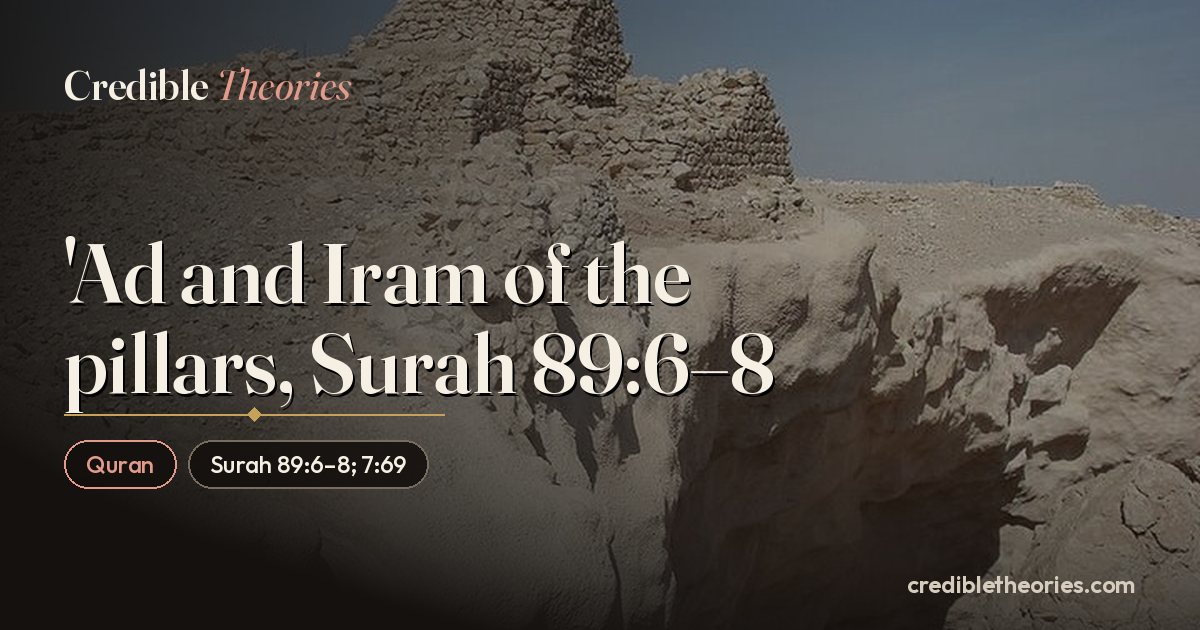
This is a short passage from the Quran, the holy book of Islam, which Muslims believe God revealed to the Prophet Muhammad from 610 to 632 CE. It recalls how God dealt with 'Ad, an ancient Arabian people, and their city Iram of the many columns, said to be unlike anything else in the lands. Another verse says they were given great size, and commentators describe them as giants.
ReferenceSurah 89:6–8; 7:69
Written610–632 CE
SetAncient Arabia
Dost thou not consider how thy Lord dealt with (the tribe of) A'ad, With many-columned Iram, The like of which was not created in the lands.
Genesis has the Nephilim, Greece has the Giants, the North has the frost giants, Arabia has the tall people of 'Ad and the Maya have Zipacna, who piled up mountains. Why does almost everyone remember giants?
Quran, Surah al-A'raf (the people of 'Ad) is one telling. The same story is told 7 more times, in 4 parts of the world. Follow it:
The open question: Real bones dug up and explained, a memory of older peoples, or something else that made giants a story almost everywhere? Join the debate
Questions people ask about Surah 89:6–8
Where is the story of 'Ad found in the Quran?
The lines on Iram are in Surah 89, Al-Fajr, The Dawn, which has 30 verses. The people of 'Ad come up in several other chapters too. Surah 46 is named Al-Ahqaf, the sand dunes, after their homeland, and Surah 11 is named after Hud, the prophet sent to warn them before the destroying wind.
When was Surah 89 revealed?
Surah 89 is counted among the early Meccan chapters, revealed in the first years of Muhammad's preaching, before the move to Medina in 622 CE. Like many early surahs, it is short and uses vivid oaths and examples of past peoples, such as 'Ad, Thamud and Pharaoh, to warn listeners about pride.
Was the lost city of Iram ever found?
In 1992 a team including filmmaker Nicholas Clapp, explorer Ranulph Fiennes and archaeologist Juris Zarins announced they had found the lost city of Ubar at Shisr in Oman, a site often linked to Iram. Zarins later doubted it was Iram. Shisr is now part of the Land of Frankincense, a UNESCO World Heritage Site since 2000.
Used on these files
Iram of the Pillars: What Happened to the People of 'Ad?Myth or legendThe Quran speaks of a people of great stature and a city of pillars, "the like of which was not created in the lands," erased by a furious wind. Medieval writers turned it into a golden city. In the 1990s, NASA radar images were used to trace caravan tracks in the hunt for it under Oman's sands.
Where this comes from
EvidenceDocumented
Comes fromThe Quran, Surah 89:6–8; 7:69, read here in the Marmaduke Pickthall. The holy book of Islam, which Muslims believe God revealed to the Prophet Muhammad from about AD 610 to 632. Its chapters are called surahs.
What this means
The text exists and is quoted from a published translation. What it describes is a separate question.
Primary records exist: an original document, a published text, an official file or a dated report. We link to them. This level says the record exists and what it says, not that every claim in it is true.