How the rabbit hole works. Start with anything that grabs you, say UFOs. Every person, place and document a page mentions links to its own page, so a UFO file leads to a witness, the witness leads to the people who investigated the case, and it keeps going.
The path you take shows in the bar under the top menu on every page, so you can step back any time or climb out and start again.
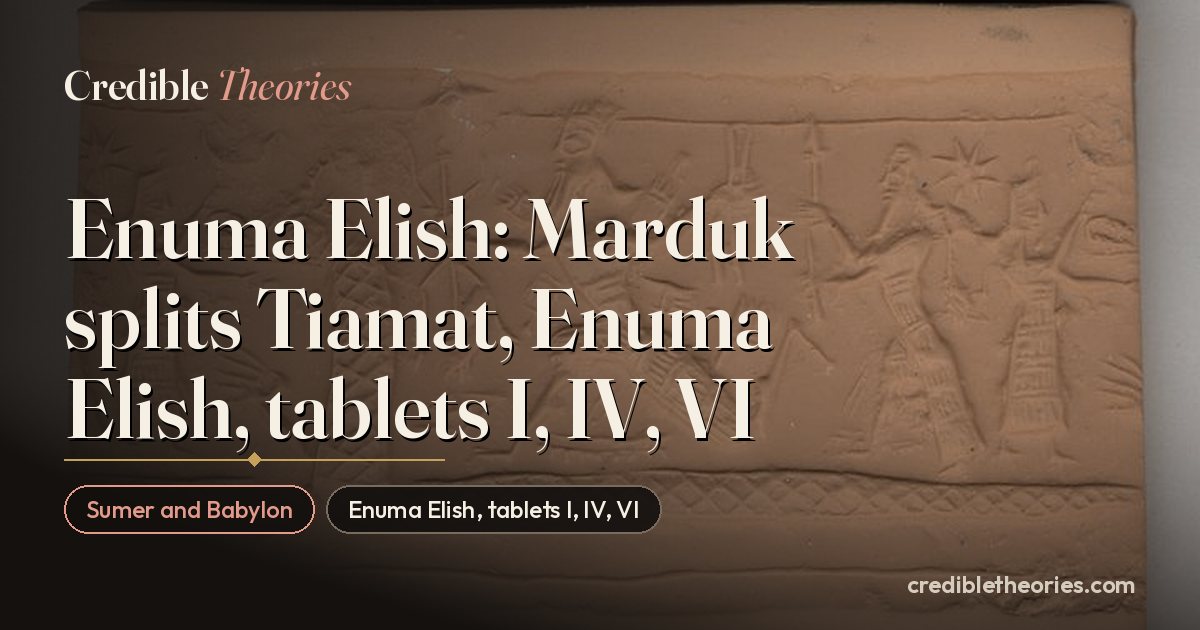
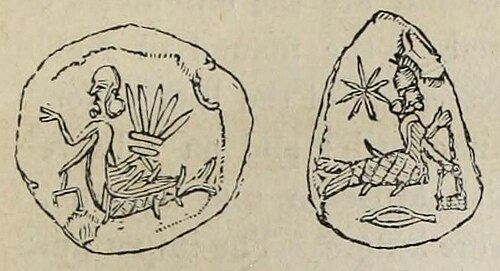
This is a short passage from the Enuma Elish, the Babylonian creation story, written around 1200 to 1100 BCE. It begins in a time before heaven and earth had names. The god Marduk defeats the sea monster Tiamat, splits her body in two like a fish, and makes one half into a covering for the sky.
ReferenceEnuma Elish, tablets I, IV, VI
Writtenc. 1200–1100 BCE
SetBefore creation
When in the height heaven was not named, And the earth beneath did not yet bear a name… He split her up like a flat fish into two halves; One half of her he stablished as a covering for heaven.
Documented · Ancient text, c. 1200–1100 BCE Translation: L. W. King, 1902
AdvertisementAd space
Read it literally
A war in the heavens, a body split in two to make sky and earth, and humans made from the blood of a defeated rebel god (Kingu) to do the gods' work.
What scholars say
Babylon's creation epic, promoting the god Marduk.
Before anything existed there was dark water. Or an egg. Babylon, Genesis, the Rig Veda, Egypt, Finland and the Quran all start the world in almost the same place.
Enuma Elish, Tablet I is one telling. The same story is told 9 more times, in 5 parts of the world. Follow it:
The open question: Why would people who never met all start the world in dark water? A shared idea, or the most natural guess anyone would make? Join the debate
A god or a hero faces a giant serpent that blocks the waters, eats the young or threatens the whole world, and cuts it down. The same fight is told in Babylon, India, Greece, Egypt, Iceland, Japan and medieval Europe.
Enuma Elish, Tablet IV (Marduk fights Tiamat) is one telling. The same story is told 7 more times, in 6 parts of the world. Follow it:
The open question: Did one ancient story of a hero and a serpent spread across the world, or do people everywhere turn their fears into dragons on their own? Join the debate
Questions people ask about Enuma Elish, tablets I, IV, VI
When was the Enuma Elish discovered?
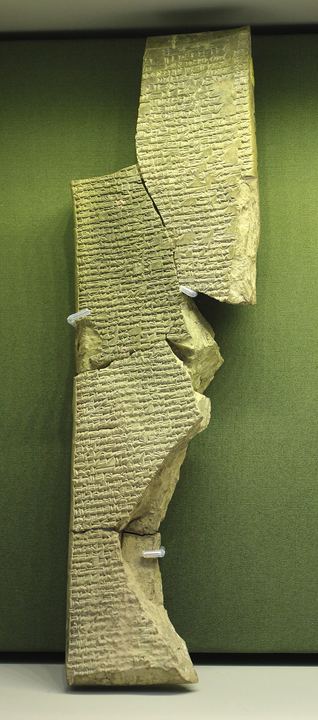
The tablets were found in the ruins of King Ashurbanipal's library at Nineveh, dug up by Austen Henry Layard and Hormuzd Rassam starting in 1849. George Smith of the British Museum published the first translation in 1876 in The Chaldean Account of Genesis. The poem is spread across seven tablets.
How did the Babylonians use the Enuma Elish?
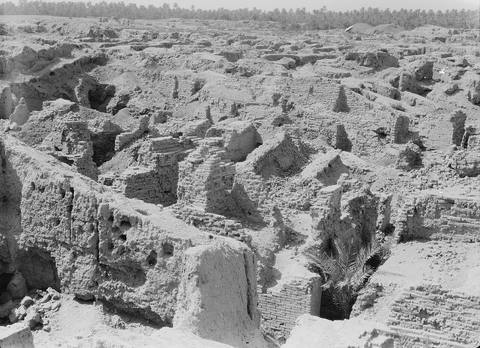
It was recited during the Akitu, the New Year festival held in Babylon in the spring month of Nisan. Reading it aloud celebrated Marduk's victory and his rule as king of the gods, and it supported the standing of Babylon and its kings. The poem ends with a list of Marduk's fifty names.
Is the Enuma Elish connected to Genesis 1?
Many scholars see links. The Hebrew word for the deep in Genesis 1:2, tehom, is related to the name Tiamat, and both stories separate waters above from waters below. Genesis has no battle, but other Bible passages, such as Psalm 74 and Isaiah 51, speak of God crushing sea monsters like Leviathan and Rahab.
Used on these files
Marduk: How Babylon's God Became King of the GodsMyth or legendWhen enemies captured Marduk's statue and carried it abroad, Babylonian writers explained the loss as the god choosing to go on a journey. He began as the minor god of a minor city; in the epic Enuma Elish he splits the sea-monster Tiamat in two and earns fifty names. How does a small-town god become king?
Where this comes from
EvidenceDocumented
Comes fromThe Enuma Elish (Babylonian Creation Epic), Enuma Elish, tablets I, IV, VI, read here in the L. W. King. The Babylonian creation story, named after its first words, 'When on high'. The god Marduk defeats the sea monster Tiamat and makes heaven and earth from her body.
What this means
The text exists and is quoted from a published translation. What it describes is a separate question.
Primary records exist: an original document, a published text, an official file or a dated report. We link to them. This level says the record exists and what it says, not that every claim in it is true.
The Enuma Elish (Babylonian Creation Epic)The Babylonian creation story, named after its first words, 'When on high'. The god Marduk defeats the sea monster Tiamat and makes heaven and earth from her body. It filled seven clay tablets and was probably written in the 1100s BC; copies were dug up at Nineveh from 1849 on.L. W. King, The Seven Tablets of Creation (1902)Online copyPrimary textArchived copy, 2026-05-23













 Babylon