How the rabbit hole works. Start with anything that grabs you, say UFOs. Every person, place and document a page mentions links to its own page, so a UFO file leads to a witness, the witness leads to the people who investigated the case, and it keeps going.
The path you take shows in the bar under the top menu on every page, so you can step back any time or climb out and start again.
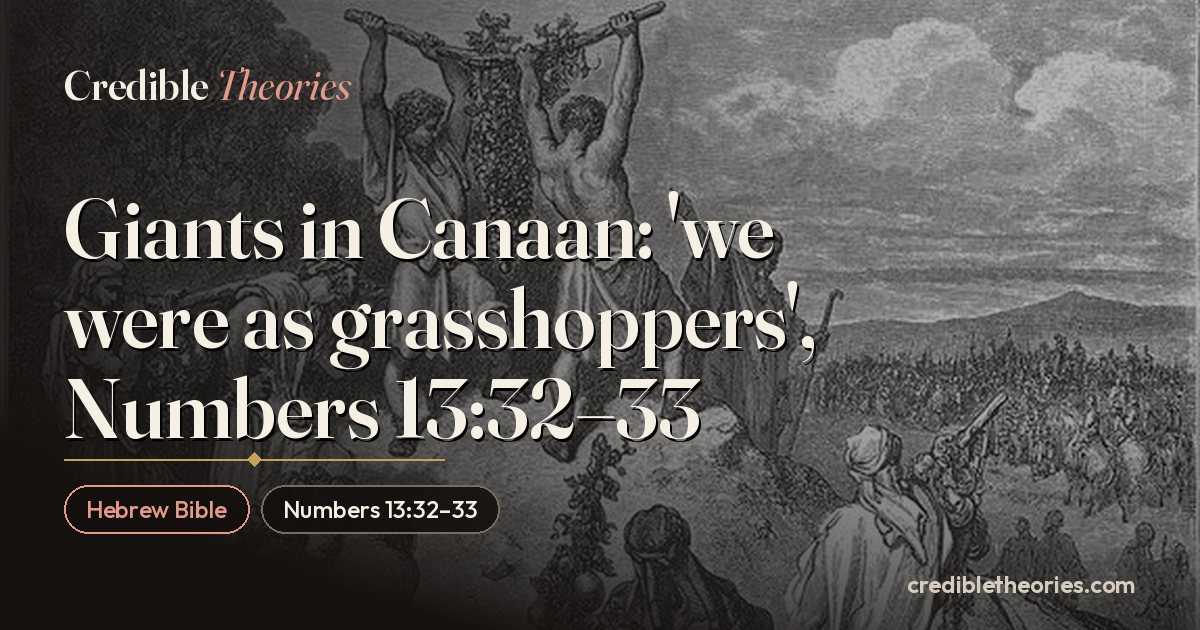
This is a short passage from Numbers, the fourth book of the Bible, written roughly 700 to 400 BCE. Spies back from the land of Canaan report seeing giants, the sons of Anak. They say they felt like grasshoppers next to them, and the giants saw them that way too. This is the only other place the Bible uses the word Nephilim, and scholars read it as the spies exaggerating.
ReferenceNumbers 13:32–33
Writtenc. 700–400 BCE
SetThe Exodus
And there we saw the giants, the sons of Anak, which come of the giants: and we were in our own sight as grasshoppers, and so we were in their sight.
Documented · Ancient text, c. 700–400 BCE Translation: KJV
AdvertisementAd space
Read it literally
The spies call it 'a land that eateth up the inhabitants thereof' (13:32).
What scholars say
The only other use of 'Nephilim' in the Bible. Scholars read it as spies exaggerating.
Genesis has the Nephilim, Greece has the Giants, the North has the frost giants, Arabia has the tall people of 'Ad and the Maya have Zipacna, who piled up mountains. Why does almost everyone remember giants?
Numbers 13 (the spies' report) is one telling. The same story is told 7 more times, in 4 parts of the world. Follow it:
The open question: Real bones dug up and explained, a memory of older peoples, or something else that made giants a story almost everywhere? Join the debate
Questions people ask about Numbers 13:32–33
What happens after the spies' report?
The people weep and talk of returning to Egypt. Joshua and Caleb, two of the spies, urge them to trust God and go in. In Numbers 14 God sentences the generation to wander for forty years, one year for each day the spies spent in the land, and the ten spies who spread the fearful report die of a plague.
Who were the twelve spies?
Moses sent one leader from each tribe of Israel. Only two are well remembered: Caleb son of Jephunneh and Joshua son of Nun, whose name Moses changed from Hoshea. The spies brought back a cluster of grapes from the valley of Eshcol, carried on a pole between two men. That image is now the logo of Israel's Ministry of Tourism.
Did Israel ever drive out the sons of Anak?
Joshua 15:14 says Caleb drove the three sons of Anak, Sheshai, Ahiman and Talmai, out of Hebron, and the city was given to him. Judges 1 tells a similar story, crediting the tribe of Judah. Later in the Bible, giants turn up again among the Philistines at Gath, including Goliath.
Used on these files
The Anakim: Who Were the Giant Sons of Anak?Myth or legendAncient spies came back from Canaan saying they felt like grasshoppers next to the sons of Anak. The Bible traces a line from these giants of Hebron to the Philistine city of Gath, home of Goliath. The spies' report is framed as a faithless exaggeration, though. Were the Anakim a real people, or a legend enlarged by fear?
Nephilim: Who Were the Giants of Genesis 6?Myth or legendGenesis says giants walked the earth "also after that," meaning after the Flood that was meant to wipe everything out. The Nephilim get just two verses in the whole Hebrew Bible, and neither explains them. Who were they, and how did they outlast the Flood? Scholars and the text itself disagree.
Where this comes from
EvidenceDocumented
Comes fromThe Book of Numbers, Numbers 13:32–33, read here in the King James Version. The fourth book of the Bible, named for its head counts of the people. It follows the Israelites through 40 years in the desert, including the spies' report of giants in Canaan and the bronze snake Moses made.
What this means
The text exists and is quoted from a published translation. What it describes is a separate question.
Primary records exist: an original document, a published text, an official file or a dated report. We link to them. This level says the record exists and what it says, not that every claim in it is true.
The King James BibleThe English Bible made for King James I and first printed in 1611; the wording most people know comes from a 1769 update. It is out of copyright, which is why we quote it. The 1611 printing also had the Apocrypha, extra books kept in Catholic and Orthodox Bibles.King James Version (1611; standard 1769 text), with ApocryphaPrimary textArchived copy, 2026-10-03
The Book of NumbersThe fourth book of the Bible, named for its head counts of the people. It follows the Israelites through 40 years in the desert, including the spies' report of giants in Canaan and the bronze snake Moses made. Scholars think it reached its final form by roughly 500 to 400 BC.Numbers 13:22–33, King James VersionOnline copyPrimary textArchived copy, 2026-10-03
The Book of GenesisThe first book of the Bible, telling of Creation, Adam and Eve, Noah's Flood and the families of Abraham, Isaac and Jacob. Scholars think it was written and edited over several centuries and finished by roughly 500 to 400 BC. The oldest surviving copies are pieces of the Dead Sea Scrolls.Genesis 6:1–4, King James VersionOnline copyPrimary textArchived copy, 2026-10-03
Scholarly dates are rounded. The wording follows the named public-domain translation.
More from Hebrew Bible
Two more stories, and what each shares with Giants in Canaan: 'we were as grasshoppers'.