How the rabbit hole works. Start with anything that grabs you, say UFOs. Every person, place and document a page mentions links to its own page, so a UFO file leads to a witness, the witness leads to the people who investigated the case, and it keeps going.
The path you take shows in the bar under the top menu on every page, so you can step back any time or climb out and start again.
This is a short passage from Plato's Critias, a Greek dialogue written around 360 BCE that describes Atlantis and its kings. The text says the kings had a divine part in their blood, but it faded as it mixed again and again with human blood. Once their human nature took over, they began to behave badly. Most scholars think Plato invented the story.
ReferencePlato, Critias 109b–121c
Writtenc. 360 BCE
Set9,000 years before Solon
But when the divine portion began to fade away, and became diluted too often and too much with the mortal admixture, and the human nature got the upper hand, they then, being unable to bear their fortune, behaved unseemly.
The gods split the earth by lot, Poseidon fathers kings with a mortal woman, and the bloodline weakens with each generation until the island is destroyed. The Watcher story told in Greek.
What scholars say
Most scholars read Atlantis as Plato's invented parable.
Themes Giants and hybrids Council of gods Strange time
Gold, silver, bronze, iron: Greece, Persia and the Book of Daniel all count the ages of the world in metals, India counts four yugas, and the Norse and Maya see whole worlds destroyed and remade.
Plato, Timaeus (the priest of Sais) is one telling. The same story is told 9 more times, in 6 parts of the world. Follow it:
A rich city, a proud people and one terrible day when the sea comes in and never leaves. Greece, India, Egypt, Wales, Cornwall and Brittany all tell of a land that now lies under the waves.
Plato, Timaeus (Atlantis) is one telling. The same story is told 8 more times, in 4 parts of the world. Follow it:
The open question: Do these stories keep real memories of lost coastlines, or is a drowned city simply a story people tell to warn against pride? Join the debate
Questions people ask about Plato, Critias 109b–121c
How does the Critias connect to Plato's Timaeus?
The Critias picks up where the Timaeus ends. In the Timaeus, Critias first mentions Atlantis as a tale Solon heard from Egyptian priests at Sais. The Critias was meant to describe the war between early Athens and Atlantis in full. Scholars think Plato planned a third dialogue, the Hermocrates, but it was never written.
Where did Plato say Atlantis was?
Plato places Atlantis in the ocean beyond the pillars of Heracles, the Greek name for the Strait of Gibraltar. He says it was larger than Libya and Asia put together, with a capital built as rings of land and water around a temple of Poseidon. Many modern sites have been proposed, from Spain to Santorini, but none is accepted by historians.
Did the Santorini eruption inspire the Atlantis story?
Some researchers link Atlantis to the Bronze Age eruption of Thera, now Santorini, around 1600 BCE. It buried the town of Akrotiri under ash. Most historians stay cautious, because Plato's dates, size and location do not match, and nothing in his writing shows he knew about the eruption. It remains a popular theory, not a proven source.
Used on these files
Atlantis: Is Plato's Sunken Island Real or a Myth?Myth or legendPlato says a great island empire sank in a single day and night, and then his unfinished dialogue stops mid-sentence just as Zeus starts to speak. No Greek writer before him mentions Atlantis. So was it a warning parable, a memory of a real disaster, or something else? The sources point several ways.
The Watchers: Who Were the Fallen Angels of Enoch?Myth or legendThe story says some angels who never sleep came down to a real mountain summit, picked up human wives, and taught people metalworking, spells and astronomy. Their leaders are named, each in charge of ten others. The same word shows up in the Book of Daniel as a heavenly council. So who exactly were the Watchers?
Where this comes from
EvidenceDocumented
Comes fromPlato's Critias, Plato, Critias 109b–121c, read here in the Benjamin Jowett. A dialogue Plato wrote soon after the Timaeus, around 360 BC, describing Atlantis, its ring-shaped harbors and its kings, and the gods' decision to punish it. Plato left it unfinished; every copy breaks off mid-sentence.
What this means
The text exists and is quoted from a published translation. What it describes is a separate question.
Primary records exist: an original document, a published text, an official file or a dated report. We link to them. This level says the record exists and what it says, not that every claim in it is true.
Plato's TimaeusA dialogue written by the Greek philosopher Plato in Athens around 360 BC. It opens with the story of Atlantis, said to come from Egyptian priests by way of the Athenian lawmaker Solon, then explains how the world was made. It is the oldest source for Atlantis; no earlier writer mentions it.Plato, Timaeus 20d–25d, trans. Benjamin Jowett (1871)Primary textArchived copy, 2026-08-17
The Book of Enoch (1 Enoch)Jewish writings about Enoch, Noah's great-grandfather, the oldest parts from about 300 to 200 BC. It tells of angels called Watchers who came down to earth. Full copies survived only in Ethiopia, whose church still counts it as scripture. Pieces in Aramaic were found among the Dead Sea Scrolls in 1952.1 Enoch 6–8, trans. R. H. Charles, The Book of Enoch (1917)Online copyPrimary textArchived copy, 2026-09-03
Scholarly dates are rounded. The wording follows the named public-domain translation.
More from Greece and Rome
The story before and after this one, and what each shares with Atlantis: gods who divided the earth.













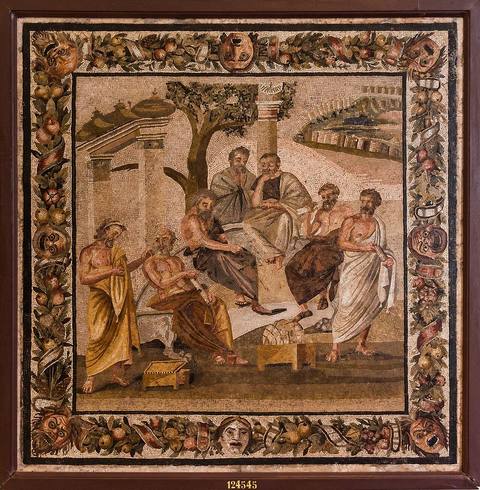 Plato