Credible Theories Sign in
Greece and Rome · Xenophon, Anabasis 4.5.25–26

Villages under the ground, Xenophon, Anabasis 4.5.25–26

Share

In plain words

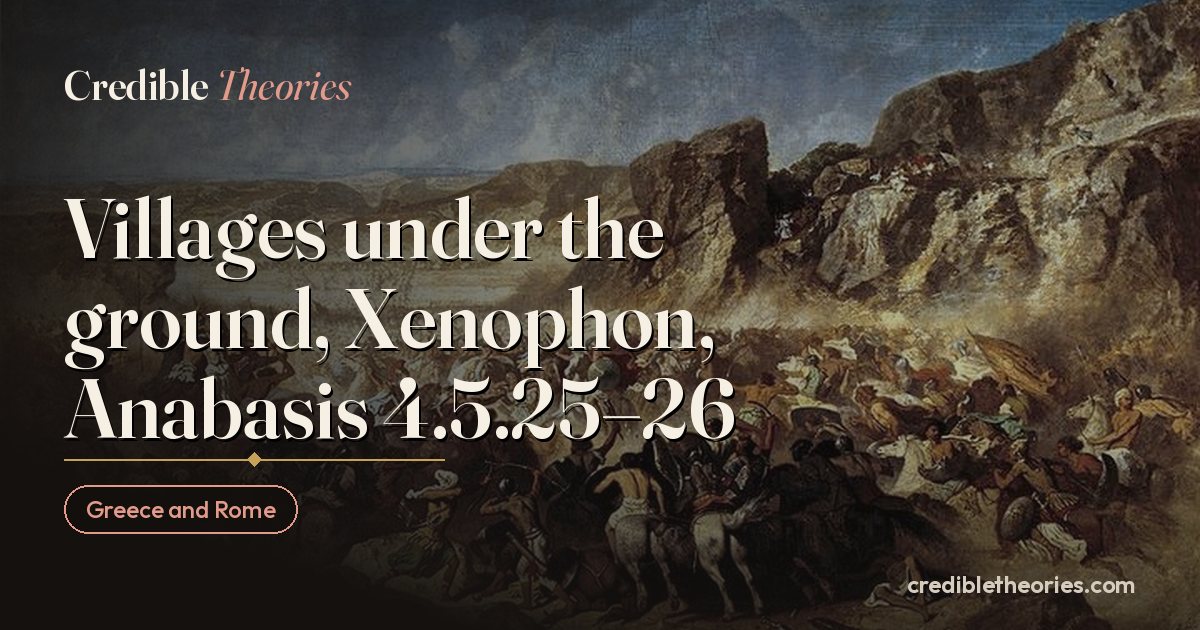
Xenophon was one of the commanders of a Greek army on a march between 401 and 399 BCE, and he later wrote the story down. In Armenia the army reached villages whose houses were dug into the ground, entered through an opening like the mouth of a well. People went down by a ladder, and their goats, sheep, cattle and hens lived below ground with them.

ReferenceXenophon, Anabasis 4.5.25–26
WrittenWritten by Xenophon in the 300s BCE about a march of 401 to 399 BCE
SetArmenian villages in winter, on the Greek army's retreat
The houses were underground structures with an aperture like the mouth of a well by which to enter, but they were broad and spacious below. The entrance for the beasts of burden was dug out, but the human occupants descended by a ladder. In these dwellings were to be found goats and sheep and cattle, and cocks and hens, with their various progeny.

Documented · Ancient text, 300 BCE Translation: H. G. Dakyns

Read it literally

One of the oldest written records of people living below ground with their animals. Xenophon was in Armenia, east of Cappadocia, but the Derinkuyu file sets his words beside Cappadocia's underground cities.

What scholars say

An eyewitness account by one of the march's commanders.

Themes Strange time
People and places hereCappadociaXenophon

Questions people ask about Xenophon, Anabasis 4.5.25–26

Why was a Greek army in Armenia?

Xenophon's Anabasis tells of Greek soldiers hired by Cyrus the Younger to help him take the Persian throne from his brother Artaxerxes. On the march home that followed, between 401 and 399 BCE, Xenophon played a leading role.

What did the villagers drink underground?

Barley wine kept in great bowls, with the malted grains floating up to the brim. Reeds without joints stood in the bowls, and a thirsty person sucked the drink through one. Xenophon calls it very strong when unmixed with water, and a taste that had to be acquired.

Who was Xenophon?

An Athenian born in 431 BCE and a pupil of Socrates. He was later exiled from Athens, lived for years on land Sparta gave him at Scillus, then moved to Corinth, and died in 354 BCE.

Used on these files

  • Derinkuyu underground city DocumentedUnder a town in central Turkey lies a city carved downward into soft rock, about 85 meters deep, with stables, chapels and air shafts. Local people found it by chance in 1963.

Where this comes from

EvidenceDocumented

Comes from H. G. Dakyns, Xenophon, Anabasis 4.5.25–26. Project Gutenberg: The oldest digital library, started in 1971, with more than 70,000 free e-books whose copyright has run out. Volunteers type and check the texts against printed editions.

What this means

The text exists and is quoted from a published translation. What it describes is a separate question.

Primary records exist: an original document, a published text, an official file or a dated report. We link to them. This level says the record exists and what it says, not that every claim in it is true.

See all five labels

Sources

  1. Project GutenbergThe oldest digital library, started in 1971, with more than 70,000 free e-books whose copyright has run out. Volunteers type and check the texts against printed editions.H. G. Dakyns, The Works of Xenophon: Anabasis (Project Gutenberg)Primary text
  2. Turkish Museums (Turkiye Ministry of Culture and Tourism), "Nevsehir Derinkuyu Underground City"

Scholarly dates are rounded. The wording follows the named public-domain translation.

More from Greece and Rome

Two more stories, and what each shares with Villages under the ground.

Photo credits
‹ Before thisThe sun rose where it now setsHerodotus, Histories 2.142

Egyptian priests told him that, over the long past they recorded, the sun had moved from its usual place of rising four times.

Same theme: Strange time
RelatedThe five races of menHesiod, Works and Days 109–201

It tells a myth of five ages of humans.

Same theme: Strange time

Updated

Discussion