How the rabbit hole works. Start with anything that grabs you, say UFOs. Every person, place and document a page mentions links to its own page, so a UFO file leads to a witness, the witness leads to the people who investigated the case, and it keeps going.
The path you take shows in the bar under the top menu on every page, so you can step back any time or climb out and start again.
This is a short passage from a history of Babylon written in Greek by Berossus, a Babylonian priest, around 290 to 278 BCE. The book is lost, and only quotes by later writers survive. In this story, a god named Cronus warns Xisuthrus in a vision that a flood is coming, and tells him to write a history of all things and bury it at Sippara.
ReferenceBerossus, Babyloniaca, via Alexander Polyhistor
Writtenc. 290–278 BCE
SetThe Flood
The Deity, Cronus, appeared to him in a vision, and warned him that upon the fifteenth day of the month Daesius there would be a flood… He therefore enjoined him to write a history of the beginning, procedure, and conclusion of all things; and to bury it in the City of the Sun at Sippara.
A god warns one good man, a boat is built, the world drowns and birds are sent out to find land. The same story turns up from Iraq to India to Greece, with cousins in China, Scandinavia and Guatemala.
Berossus, Babyloniaca (Xisuthrus), via Alexander Polyhistor is one telling. The same story is told 9 more times, in 6 parts of the world. Follow it:
The open question: One real flood remembered by many peoples, or many different floods that each people told in its own way? Join the debate
Questions people ask about Berossus, Babyloniaca, via Alexander Polyhistor
Who was Berossus?
Berossus was a priest of Bel, meaning Marduk, in Babylon in the early Hellenistic period. He wrote a history of Babylonia in Greek and dedicated it to the Seleucid king Antiochus I. The Roman writer Vitruvius says he later moved to the Greek island of Kos and taught astrology there.
Why does Berossus survive only in pieces?
His book, the Babyloniaca, is lost. What remains comes from later writers who quoted it, often second or third hand. Alexander Polyhistor summarized it in the first century BCE, and his summary was used by Josephus, by Eusebius in a Chronicle that survives in Armenian, and by the Byzantine monk George Syncellus.
Berossus: The Babylonian Who Explained His World to the GreeksDocumentedBefore the Flood, ten kings ruled for 432,000 years, according to a Babylonian priest who wrote in Greek around 290 BCE. His flood hero was also ordered to bury written records of all things at Sippar and dig them up afterward; the book itself is lost. So how do we know any of this?
Enki: Who Was the Sumerian God Who Saved Humanity?Myth or legendEnki saves humanity from the Flood without technically breaking his oath: bound to secrecy, he tells the plan to a wall while the hero listens on the other side. The Sumerian god of fresh water also designs the first humans, and in another story gives away civilization while drunk. Who walked off with it?
Where this comes from
EvidenceDocumented
Comes fromBerossus's History of Babylonia (Babyloniaca), Berossus, Babyloniaca, via Alexander Polyhistor, read here in the I. P. Cory. A history of Babylon written in Greek by Berossus, a Babylonian priest, around 290 to 278 BC. It told of Oannes, a fish-man who taught people how to live in cities, and of ten kings before the Flood. The book is lost; only quotations by later writers survive.
What this means
The text exists and is quoted from a published translation. What it describes is a separate question.
Primary records exist: an original document, a published text, an official file or a dated report. We link to them. This level says the record exists and what it says, not that every claim in it is true.
Cory's Ancient FragmentsA book by I. P. Cory, first published in 1826 and revised in 1832, that gathers quotations from lost ancient histories, such as those of Berossus of Babylon and Manetho of Egypt. The original books are gone; these quotes survive mainly through later Christian writers.I. P. Cory, Ancient Fragments (1832; 1876 ed.)Online copyPrimary textArchived copy, 2026-10-03
Berossus's History of Babylonia (Babyloniaca)A history of Babylon written in Greek by Berossus, a Babylonian priest, around 290 to 278 BC. It told of Oannes, a fish-man who taught people how to live in cities, and of ten kings before the Flood. The book is lost; only quotations by later writers survive.Berossus, fragments via Alexander Polyhistor, in I. P. Cory, Ancient Fragments (1832)Online copyPrimary text
Enki and the World OrderA Sumerian poem in which Enki, god of fresh water and wisdom, puts the world in order, giving lands and gods their jobs. It survives on clay tablets copied in about 1900 to 1600 BC. Oxford University's ETCSL project gives it in English.Enki and the World Order, ETCSL t.1.1.3, University of OxfordPrimary textArchived copy, 2026-08-03
Scholarly dates are rounded. The wording follows the named public-domain translation.
More from Sumer and Babylon
The story before and after this one, and what each shares with Xisuthrus buries the writings before the Flood.













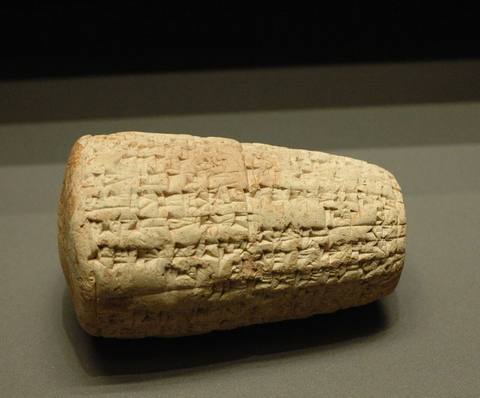 Sippar