Ten Thousand Twenties
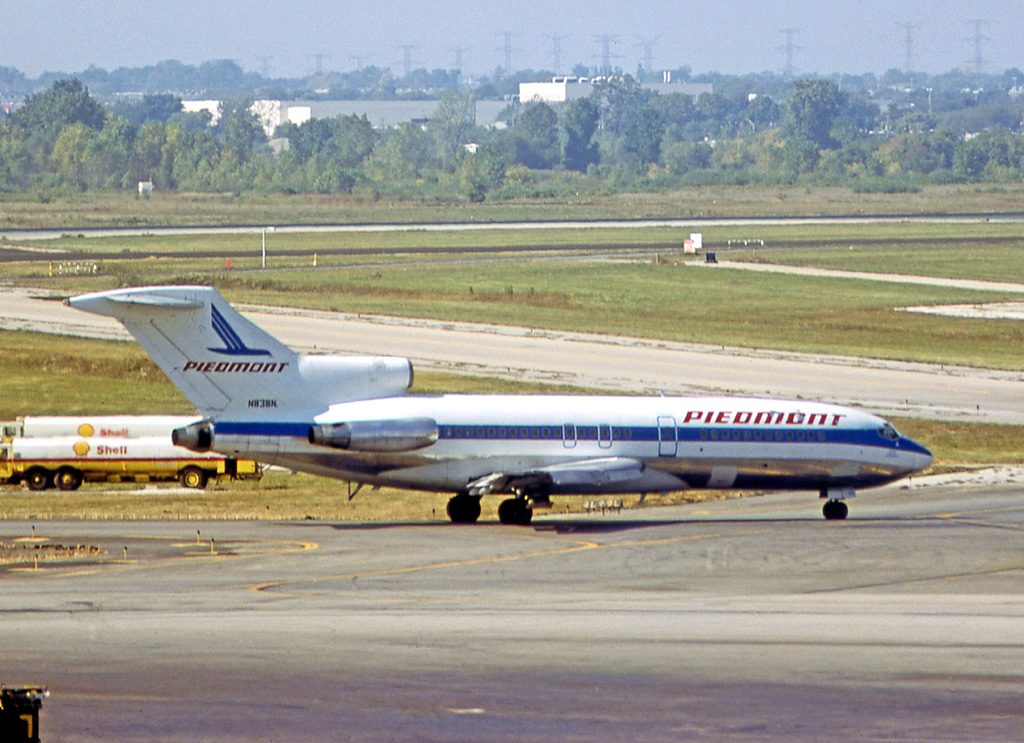
RuthAS. CC BY 3.0. Picture source
The plane circles Seattle while the bank, the police and the airline gather the money and four parachutes, and the passengers are traded for them.
November 24, 1971, about 3:00 to 7:40 pm, over Puget Sound and at Sea-Tac
The story
For about two hours the jet circles over Puget Sound. The passengers are told there is a small mechanical problem. On the ground, people move fast. A Seattle bank bundles ten thousand twenty-dollar bills into a canvas bag. Parachutes are rushed in from a rigger and from a skydiving school.
The plane lands at 5:46 pm and parks away from the terminal. Tina Mucklow walks down the front stairs and comes back with the heavy bag. Only then does he let the 36 passengers go. He even offers her a packet of bills as a tip. She hands it back.
Here is the problem the story has to face. The bank had photographed every serial number before the money left. The man does not know this yet. In this story, he finds out the way everyone else does, from the newspapers, weeks later. It changes everything he does with the money.
He also does not know that one of the two front parachutes is a dummy. It was sewn shut for classroom practice. In this story, that mistake does not matter, because he never planned to use a front parachute at all.
He tells the crew to fly toward Mexico City, slow and low: about 100 knots, no higher than 10,000 feet, landing gear down, flaps at 15 degrees, cabin not pressurized. At about 7:40 pm, Flight 305 takes off again with five people aboard.
What the record says
The non-sequential serial numbers had been recorded on microfiche, part of a routine process the bank had in place to foil a potential robbery.
HistoryLink.org Essay 1997
In the scramble, the jump center inadvertently supplied one dummy parachute that couldn’t open.
HistoryLink.org Essay 1997
the serial numbers that had been supplied the night of the hijacking by Seattle First National Bank (in a bag weighing 19 pounds, with the contents measuring 11 inches by 12 inches by 6.5 inches)
HistoryLink.org Essay 23059, citing FBI Vault Part 11, p. 123
The ransom was 10,000 twenty-dollar bills from Seattle First National Bank, in a bag of about 19 pounds, and the serial numbers had been recorded on microfilm before the hand-over; most began with the letter L, from the Federal Reserve Bank of San Francisco. Two back parachutes came from a local pilot and two front ones from a skydiving school, and one front parachute was a sewn-shut training dummy. The plane landed at Sea-Tac at 5:46 pm, the 36 passengers and two flight attendants were released, and the crew was told to fly at minimum speed below 10,000 feet with gear down and flaps at 15 degrees, refueling in Reno. The story's idea that he only learned of the recorded numbers later is a guess.