The record
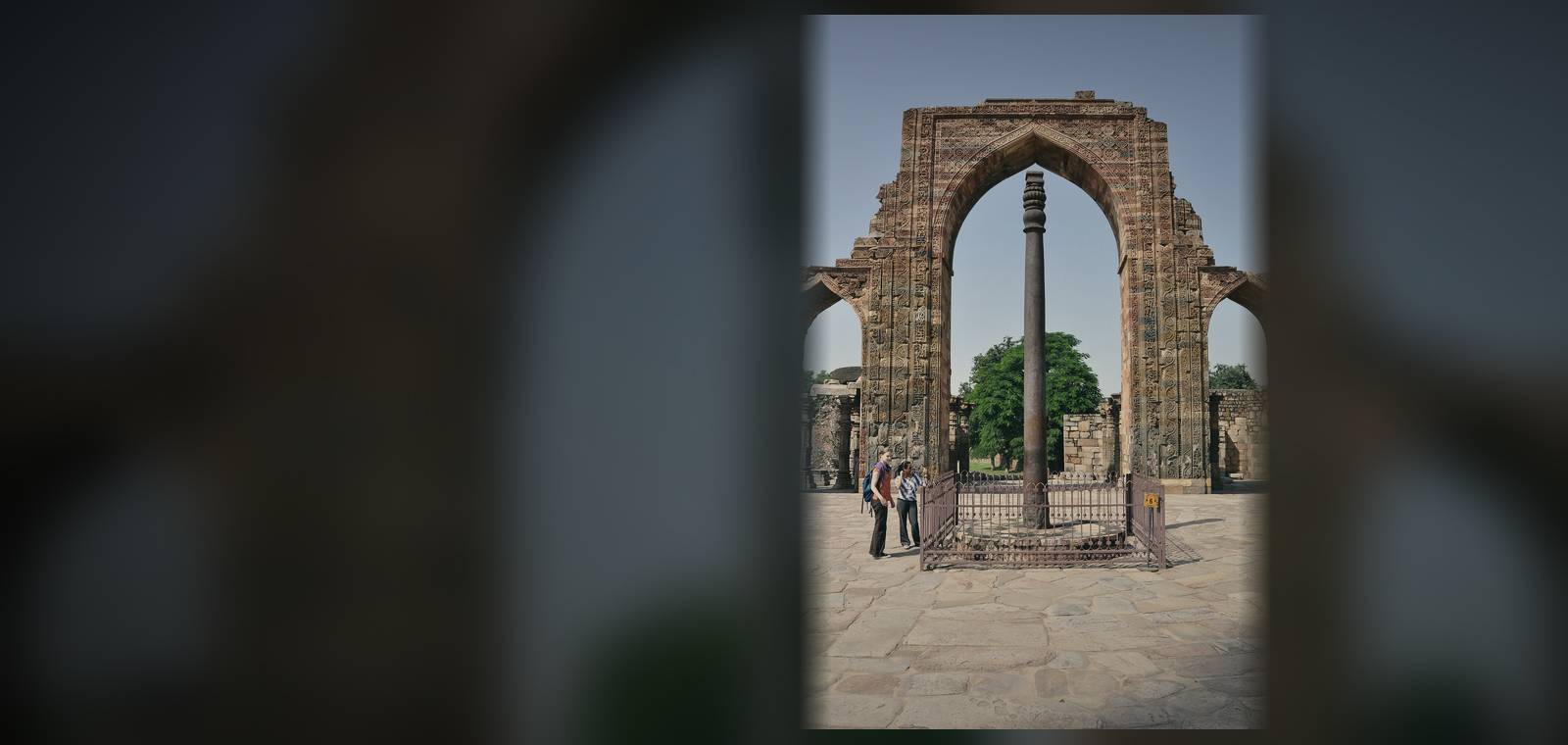
In the courtyard of the great mosque beside the Qutb Minar in Delhi, ringed by cloisters of carved Hindu columns, stands a pillar of iron. Alexander Cunningham, who led the first Archaeological Survey of India, described it in the survey's first reports: a solid shaft of wrought iron upwards of 16 inches in diameter, and upwards of 40 feet in length.
He noted that there are flaws in many parts, which shew that the welding is imperfect,
but added that given the extreme difficulty of manufacturing a pillar of such vast dimensions, our wonder will not be diminished.
He put its weight at upwards of 17 tons.
For a long time even its metal was misunderstood. A Delhi handbook called it a compound metal resembling bronze,
and Cunningham at first repeated that. Then, reasoning that a bronze pillar would never have escaped the rapacity of the Muhammadan conquerors,
he had a chip from the rough lower part analyzed by Dr. Murray Thomson, who reported pure malleable iron.
The pillar carries its own record: The Iron Pillar records its own history in a deeply cut Sanskrit inscription of six lines on its western face,
which praises a Raja, a worshipper of Vishnu, who obtained with his own arm an undivided sovereignty on the earth for a long period.
James Prinsep dated the letters to the third or fourth century; Cunningham agreed they match the Gupta inscriptions. Local tradition, which he also recorded, held that the pillar was driven so deep that it rested on the head of Vasuki, King of the Serpents, and that when a doubting king had it dug up, its foot was found wet with the blood of the serpent king.
What draws scientists is that the pillar has stood in the open for well over a thousand years with very little rust. The metallurgist R. Balasubramaniam made its corrosion resistance the subject of a long study in the journal Corrosion Science in 2000 and of a book, Story of the Delhi Iron Pillar, in 2005.