Credible Theories Sign in

The record

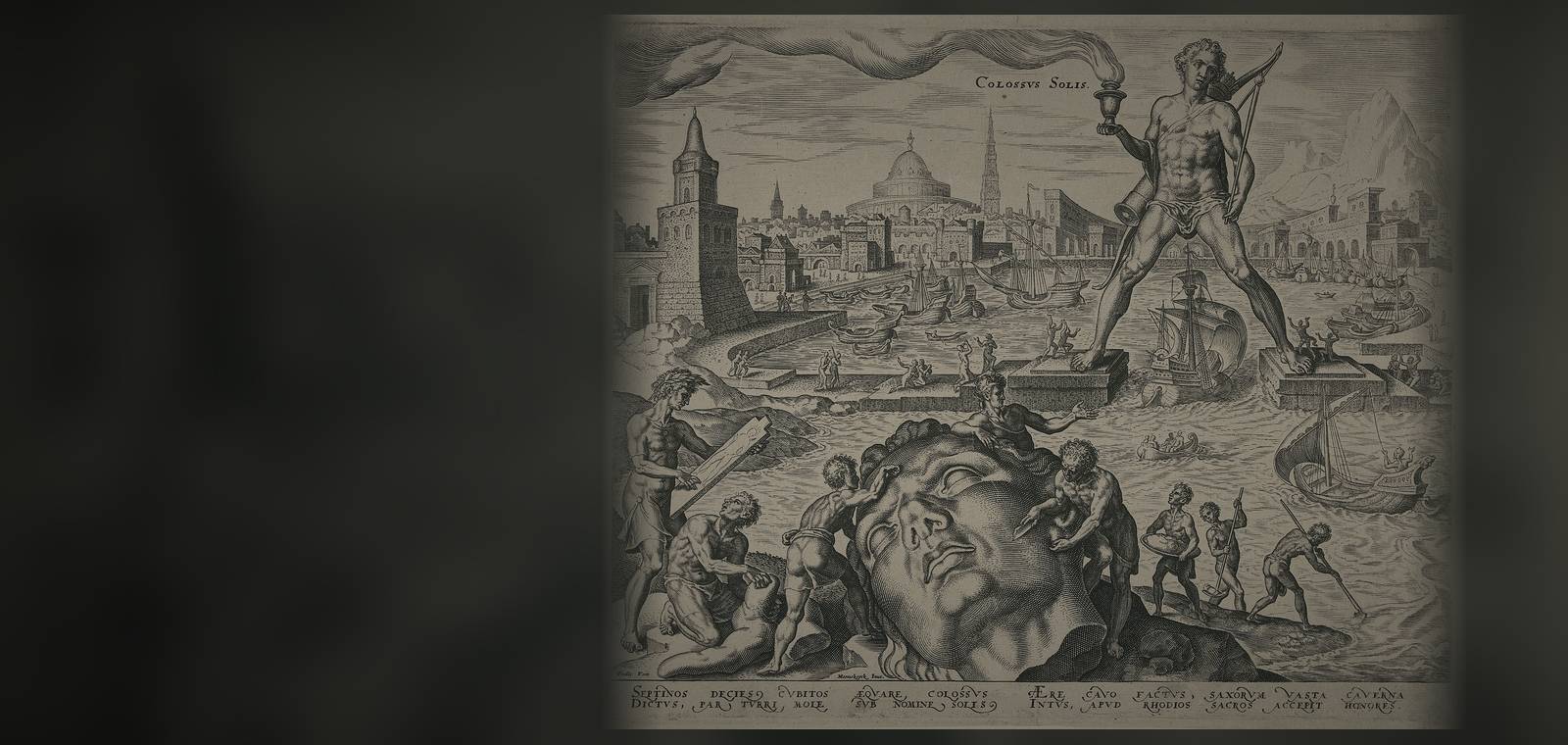
Rhodes set up a giant statue of its sun god, Helios. Strabo calls it the best of the city's offerings and by common agreement one of the Seven Wonders. He quotes a line of verse giving its size: seven times ten cubits in height, the work of Chares the Lindian.

Pliny the Elder says the statue took twelve years to make and cost three hundred talents. The money, he writes, came from the siege engines King Demetrius left behind when he gave up the siege of Rhodes. Fifty-six years after it went up, an earthquake threw it down. Yet even lying on the ground it amazed him: few men could get their arms around the thumb, its fingers were larger than most statues, and the broken limbs showed caverns inside, with big blocks of stone that had steadied it while it was built.

Polybius says the Rhodians made shrewd use of the disaster. Kings sent them gifts, and Ptolemy promised, among much else, three thousand talents of bronze for the restoration of the Colossus. The Colossus was never raised. Strabo says that in his day it lay on the ground, broken at the knees, and gives the reason: in accordance with a certain oracle, the people did not raise it again. None of these writers says where in the city it stood. Pliny adds that Rhodes had a hundred other colossal statues, smaller than this one but any of them enough to make a place famous.
Questions people ask about The Colossus of Rhodes

What paid for the Colossus?

Pliny says the three hundred talents came from selling the war machines King Demetrius abandoned when he grew tired of his long siege of Rhodes.

Who sent aid after the earthquake?

Polybius lists gifts from Hiero and Gelo of Syracuse, Ptolemy, Antigonus and others. Hiero and Gelo gave a hundred talents in all and set up a statue group in the Rhodian market of the People of Rhodes crowned by the People of Syracuse.

Did other giant statues stand at Rhodes?

Pliny counts a hundred more colossal statues in the city, plus five colossal statues of the gods made by the sculptor Bryaxis.

The open question

Still strange: The Wonder left on the ground.

Rhodes was offered bronze to raise it again but left it lying, because of an oracle.

The Lighthouse of Alexandria (Pharos) →
  1. Step 1 of 4 · This fileThe Colossus of Rhodes
  2. Step 2 of 4 · The longer textThe Natural History of Pliny, Volume 1 (of 6)
  3. Step 3 of 4 · Next fileThe Lighthouse of Alexandria (Pharos)
  4. Step 4 of 4 · Next fileThe Hanging Gardens of Babylon
About these videos

Found by a YouTube search for this topic, not checked by us. The player loads from YouTube only when you press play.

Where this comes from

EvidenceDocumented

Comes from Strabo, Geography 14.2.5, trans. H. L. Jones (Loeb Classical Library, 1929), LacusCurtius. Geography, by Strabo: A 17-book description of the lands and peoples of the known world by Strabo, a Greek geographer, finished around AD 20 to 25. It includes an account of the city of Helike sinking in 373 BC.

What this means

Strabo, Pliny and Polybius all describe the statue and its fall; no piece of it is known to survive.

For The Colossus of Rhodes, the original record exists and is linked: Strabo, Geography 14.2.5, trans. H. L. Jones (Loeb Classical Library, 1929), LacusCurtius. That tells you the record is real and what it says. It does not mean every claim in it is true.

Primary records exist: an original document, a published text, an official file or a dated report. We link to them. This level says the record exists and what it says, not that every claim in it is true.

See all five labels

Sources

  1. Geography, by StraboA 17-book description of the lands and peoples of the known world by Strabo, a Greek geographer, finished around AD 20 to 25. It includes an account of the city of Helike sinking in 373 BC.Strabo, Geography 14.2.5, trans. H. L. Jones (Loeb Classical Library, 1929), LacusCurtiusPrimary text
  2. Natural History, by Pliny the ElderA 37-book Roman encyclopedia of everything from stars to animals to art, by Pliny the Elder, published around AD 77. Pliny died in AD 79 near Mount Vesuvius as it erupted. It mixes careful observation with tall tales. Bostock and Riley's English version came out in 1855.Pliny the Elder, Natural History 34.18, trans. John Bostock and H. T. Riley (1855), Perseus Digital Library Online copyPrimary text
  3. LacusCurtiusLacusCurtius, a website of Greek and Roman texts and translations, many from the Loeb Classical Library, put online and carefully proofread by Bill Thayer and hosted on a University of Chicago server.Polybius, Histories 5.88-89, trans. W. R. Paton (Loeb Classical Library, 1922), LacusCurtiusPrimary text

Quotations come from public-domain translations. A book in our Library links to its Library page; other links open the free online copy or the reference page.

Updated

Credible or not?

Tap one to see how other readers voted.

Discussion