The record
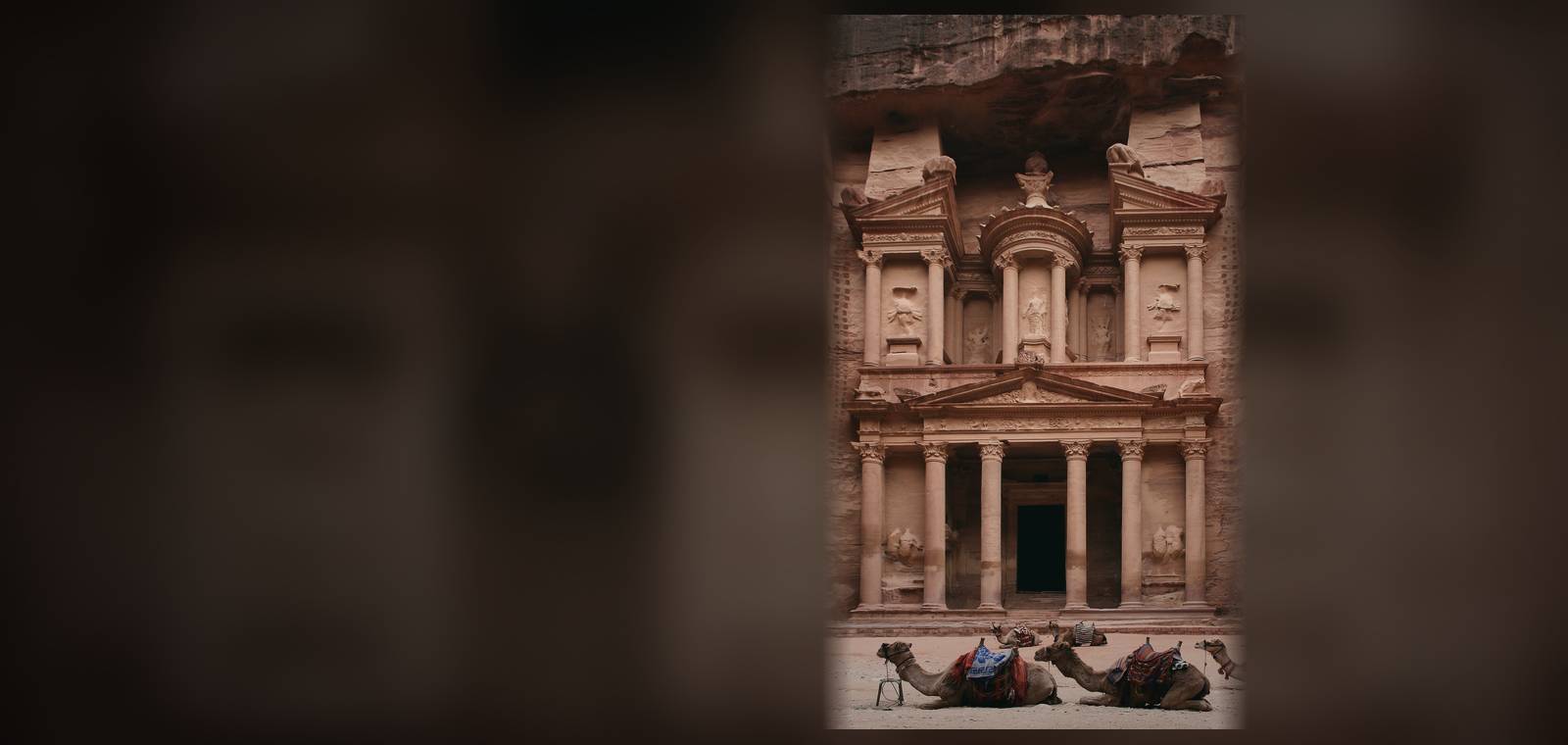
After proceeding for twenty-five minutes between the rocks, we came to a place where the passage opens, and where the bed of another stream coming from the south joins the Syk. On the side of the perpendicular rock, directly opposite to the issue of the main valley, an excavated mausoleum came in view, the situation and beauty of which are calculated to make an extraordinary impression upon the traveller, after having traversed for nearly half an hour such a gloomy and almost subterraneous passage as I have described. It is one of the most elegant remains of antiquity existing in Syria; its state of preservation resembles that of a building recently finished, and on a closer examination I found it to be a work of immense labour.
John Lewis Burckhardt, Travels in Syria and the Holy Land, Wady Mousa (1812) · Other traditions
Translation: John Lewis Burckhardt, Travels in Syria and the Holy Land (London: John Murray, 1822) · Public domain
Petra is a city cut into reddish sandstone cliffs in southern Jordan. UNESCO describes it as the rock-cut capital city of the Nabateans, situated between the Red Sea and the Dead Sea and inhabited since prehistoric times. It notes the serried rows of numerous rock-cut tombs and an ingenious water management system that allowed extensive settlement of an essentially arid area.
The Greek geographer Strabo, writing about two thousand years ago, called Petra the metropolis of the Nabataeans. He said it lay on a level site fortified all round by rock, precipitous and sheer outside, with springs in abundance inside for homes and gardens, while most of the land beyond the rock was desert.
After that, Petra dropped out of European books for centuries. In August 1812 the Swiss traveler Johann Ludwig Burckhardt wanted to see the valley the local people called Wady Mousa, the valley of Moses. Leaving the road would look suspicious to his guides, so he pretended to have made a vow to slaughter a goat in honor of Haroun (Aaron), whose tomb stood at the far end of the valley.
His guide led him into the Syk, a winding gorge between sheer rock walls. After nearly half an hour in that gloomy and almost subterranean passage, a carved tomb front came into view. Burckhardt called it one of the most elegant remains of antiquity existing in Syria; local people knew it as Kaszr Faraoun, Pharaoh's castle. He left the question open: whether he had found the capital of Arabia Petraea, he wrote, he would leave to Greek scholars.