The One That Missed
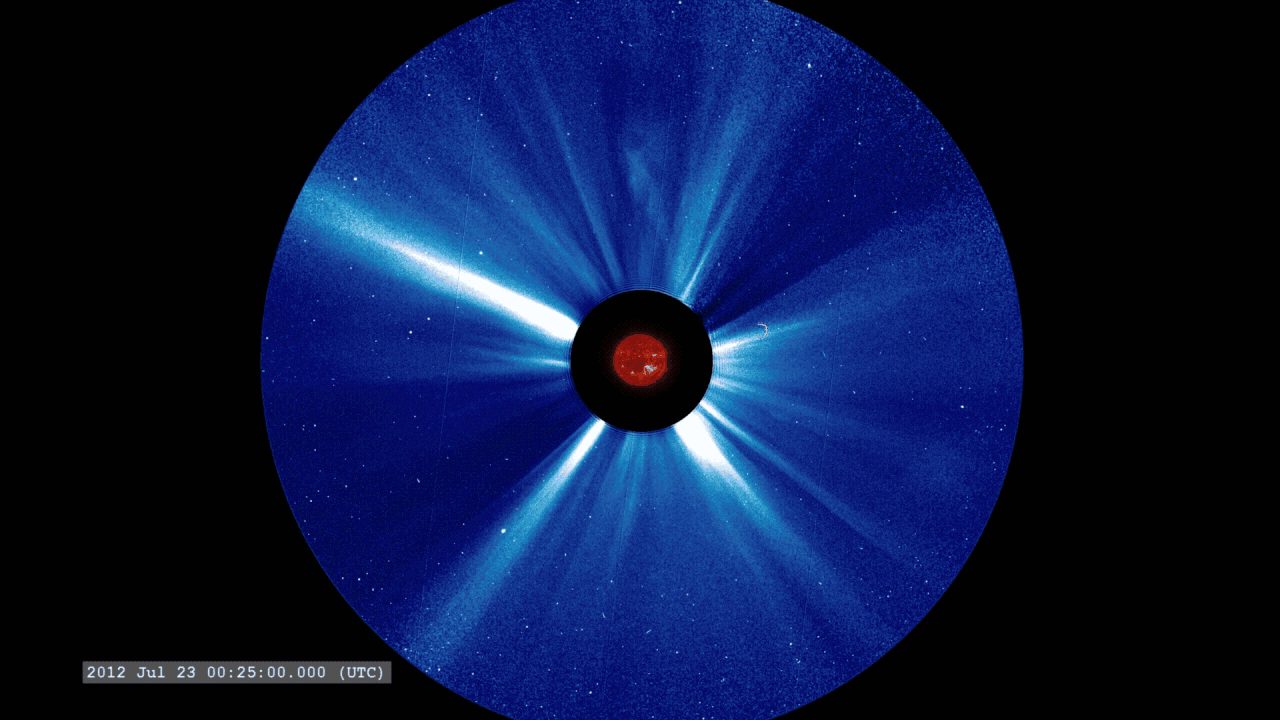
STEREO-A / NASA. Public domain. Picture source
A storm this big is not only history: one crossed Earth's orbit in July 2012 and missed us by about a week.
Record: 23 July 2012, and the G5 storm of 10 May 2024
The story
Everything in the chapters before this one is a what if. This chapter is not.
On 23 July 2012, the Sun threw off a cloud as strong as Carrington's. It crossed the path Earth travels around the Sun. Earth was not there yet. It would have been, if the blast had come about a week earlier.
Instead it hit a NASA spacecraft called STEREO-A, which was built to watch the Sun from far out in space. It rode out the storm and kept sending back data. That is how we know how big the storm was.
Then, in May 2024, a smaller but still extreme storm did hit. At least seven clouds from the Sun arrived over a weekend. NOAA said the northern lights could be seen as far south as Alabama and northern California. The storm reached G5, the top of NOAA's scale.
So the question is not really whether the Sun can do this. The trees say it did in 774. The telegraphs say it did in 1859. The question is what day it picks next, and how ready we are.
What the record says
If it had hit, we would still be picking up the pieces,
Daniel Baker of the University of Colorado, quoted by NASA Science (2014)
If the eruption had occurred only one week earlier, Earth would have been in the line of fire.
Daniel Baker, quoted by NASA Science (2014)
G5 Conditions were first observed at Earth at 6:54 p.m. EDT today.
NOAA Space Weather Prediction Center, May 10, 2024
NASA reports that a coronal mass ejection on 23 July 2012 crossed Earth's orbit and struck the STEREO-A spacecraft instead, and quotes Daniel Baker that it was at least as strong as the 1859 Carrington Event. NASA also reports Pete Riley's 2014 estimate of a 12 percent chance of a Carrington-class storm hitting Earth in a ten-year span. NOAA observed G5 (extreme) conditions on 10 May 2024 after at least seven coronal mass ejections. The 2019 US strategy sets out plans to protect infrastructure, improve forecasts and plan recovery. Neither 2012 nor 2024 matched the particle storm recorded in 774, which Mekhaldi's team found was at least five times stronger than any solar event measured by instruments.