How the rabbit hole works. Start with anything that grabs you, say UFOs. Every person, place and document a page mentions links to its own page, so a UFO file leads to a witness, the witness leads to the people who investigated the case, and it keeps going.
The path you take shows in the bar under the top menu on every page, so you can step back any time or climb out and start again.
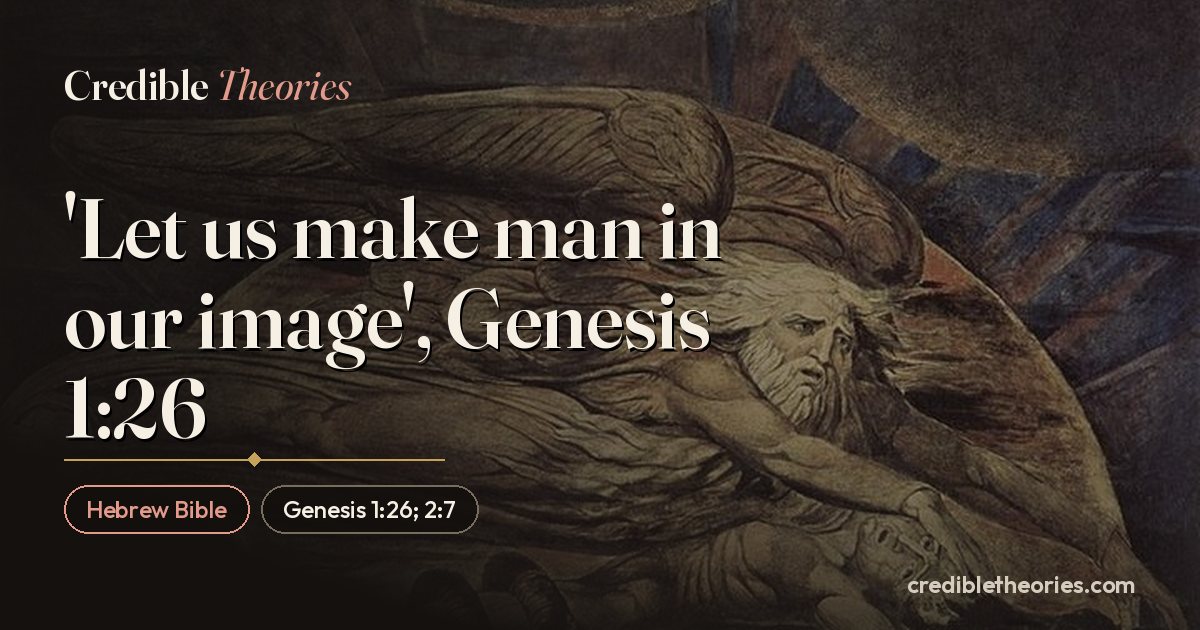
This is a short passage from Genesis, the first book of the Bible, drawn from two sources written around 900 to 450 BCE. God says "Let us make man in our image," and then forms the first man from the dust of the ground and breathes life into his nose. Scholars usually read the "us" as God speaking to his heavenly council.
ReferenceGenesis 1:26; 2:7
Writtenc. 900–450 BCE (two sources)
SetCreation of humans
And God said, Let us make man in our image, after our likeness… And the LORD God formed man of the dust of the ground, and breathed into his nostrils the breath of life.
Documented · Ancient text, c. 900–450 BCE Translation: KJV
AdvertisementAd space
Read it literally
A group designs humans on their own template, from earth material plus something of their own. The same recipe as Atrahasis: clay plus a god's blood.
What scholars say
The plural is usually read as God speaking to his heavenly council.
Before anything existed there was dark water. Or an egg. Babylon, Genesis, the Rig Veda, Egypt, Finland and the Quran all start the world in almost the same place.
Genesis 1 is one telling. The same story is told 9 more times, in 5 parts of the world. Follow it:
The open question: Why would people who never met all start the world in dark water? A shared idea, or the most natural guess anyone would make? Join the debate
A god kneels in the mud, shapes a body with his hands and breathes it into life. That scene is told in Iraq, Israel, Egypt, Greece, China, Arabia, Guatemala, Sudan and New Zealand.
Genesis 2 (the forming of Adam) is one telling. The same story is told 8 more times, in 6 parts of the world. Follow it:
The open question: Did one old story about a potter god travel from people to people, or does anyone who works with clay end up imagining that we were made from it? Join the debate
Questions people ask about Genesis 1:26
Why does Genesis have two creation stories?
Genesis 1 and Genesis 2 tell creation in different ways. In the first, God speaks the world into being over six days and makes humans last, male and female together. In the second, God forms the man first, then plants, animals and finally the woman from his side. Most scholars assign them to two sources, called Priestly and Yahwist.
What does being made in the image of God mean?
The Hebrew words are tselem, image, and demut, likeness. Jewish and Christian thinkers have linked the image to reason, moral choice or the ability to relate to God. Many scholars point out that ancient kings set up statues of themselves to mark their rule, so humans may be pictured as God's representatives over the earth. The idea underlies religious teaching on human dignity.
How does the Quran describe the creation of Adam?
In Surah 2:30, God tells the angels he will place a successor, or khalifa, on earth. The angels ask whether he will put there one who causes bloodshed. God replies that he knows what they do not, then teaches Adam the names of all things. Other passages say Adam was shaped from clay and given life by God's spirit.
Used on these files
Atrahasis: The Epic Where Gods Made Humans, Then Sent the FloodDocumentedAccording to the Babylonian epic Atrahasis, the first humans were made partly from the flesh and blood of a god who was killed because he had intelligence. Overworked junior gods had gone on strike, and humans were the fix; then people grew too noisy, and the Flood followed. What went wrong with the plan?
Where this comes from
EvidenceDocumented
Comes fromThe Book of Genesis, Genesis 1:26; 2:7, read here in the King James Version. The first book of the Bible, telling of Creation, Adam and Eve, Noah's Flood and the families of Abraham, Isaac and Jacob. Scholars think it was written and edited over several centuries and finished by roughly 500 to 400 BC. The oldest surviving copies are pieces of the Dead Sea Scrolls.
What this means
The text exists and is quoted from a published translation. What it describes is a separate question.
Primary records exist: an original document, a published text, an official file or a dated report. We link to them. This level says the record exists and what it says, not that every claim in it is true.
The King James BibleThe English Bible made for King James I and first printed in 1611; the wording most people know comes from a 1769 update. It is out of copyright, which is why we quote it. The 1611 printing also had the Apocrypha, extra books kept in Catholic and Orthodox Bibles.King James Version (1611; standard 1769 text), with ApocryphaPrimary textArchived copy, 2026-10-03
The Atrahasis EpicA Babylonian poem in which the gods make humans to do their work, then try to wipe them out with a great flood; the wise Atrahasis survives in a boat. The best copy was written about 1640 BC. W. G. Lambert and A. R. Millard published the standard English edition in 1969.Atra-hasis, ed. and trans. W. G. Lambert and A. R. Millard, Atra-hasis: The Babylonian Story of the Flood (Oxford, 1969)Primary text
Scholarly dates are rounded. The wording follows the named public-domain translation.
More from Hebrew Bible
Two more stories, and what each shares with 'Let us make man in our image'.