How the rabbit hole works. Start with anything that grabs you, say UFOs. Every person, place and document a page mentions links to its own page, so a UFO file leads to a witness, the witness leads to the people who investigated the case, and it keeps going.
The path you take shows in the bar under the top menu on every page, so you can step back any time or climb out and start again.
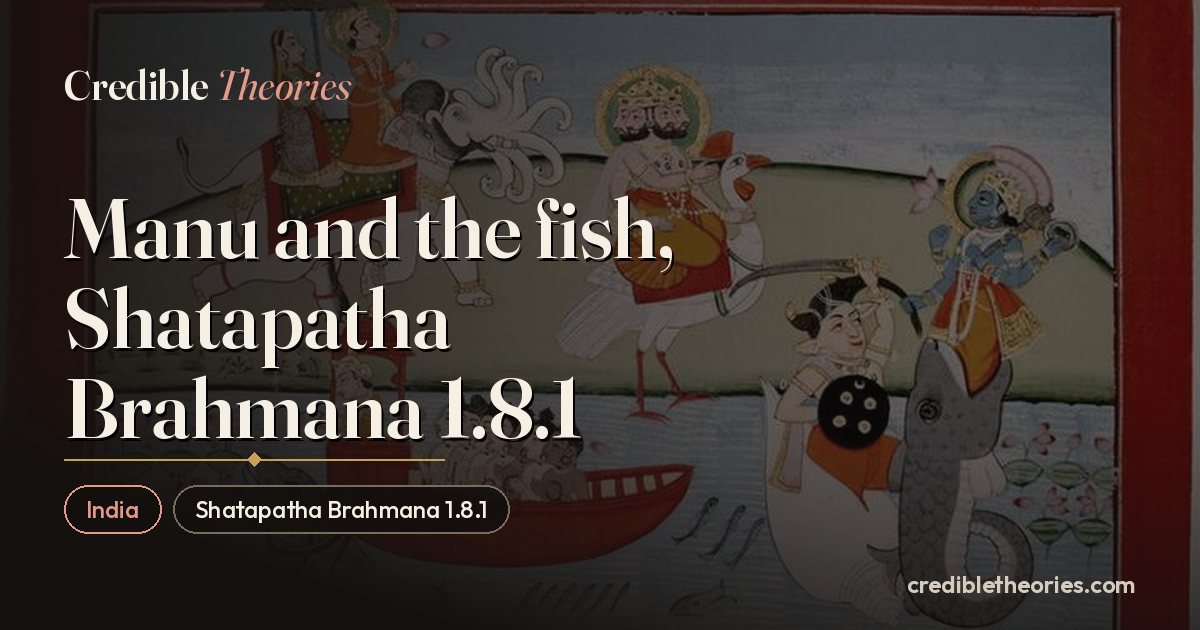
This is a short passage from the Shatapatha Brahmana, a long book from India that explains the rituals of its oldest holy texts, dating to about 800 to 600 BCE. In the story, a man named Manu is washing in the morning when a fish comes into his hands. It asks Manu to raise it and promises to save him. Scholars call it the oldest Indian flood story.
ReferenceShatapatha Brahmana 1.8.1
Writtenc. 800–600 BCE
SetThe Flood
In the morning they brought to Manu water for washing… As he was washing himself, a fish came into his hands. It spake to him the word, 'Rear me, I will save thee!'
A god warns one good man, a boat is built, the world drowns and birds are sent out to find land. The same story turns up from Iraq to India to Greece, with cousins in China, Scandinavia and Guatemala.
Shatapatha Brahmana (Manu and the fish) is one telling. The same story is told 9 more times, in 6 parts of the world. Follow it:
Gold, silver, bronze, iron: Greece, Persia and the Book of Daniel all count the ages of the world in metals, India counts four yugas, and the Norse and Maya see whole worlds destroyed and remade.
Laws of Manu, Book 1 (the four ages) is one telling. The same story is told 9 more times, in 6 parts of the world. Follow it:
The open question: Why do so many traditions believe the past was better and the world is running down? Memory, or human nature? Join the debate
Questions people ask about Shatapatha Brahmana 1.8.1
What is the Shatapatha Brahmana?
It is a long prose text that explains the rituals of the White Yajurveda, one of the four Vedas. Its name means the Brahmana of a hundred paths, after its hundred lessons. Much of it is credited to the sage Yajnavalkya. Julius Eggeling translated it into English in five volumes for the Sacred Books of the East series between 1882 and 1900.
What happens to Manu after the flood?
Manu is the only human left. Wanting children, he offers clarified butter, sour milk, whey and curds into the waters. After a year, a woman rises from them, named Ida in this text. Through her, Manu becomes the ancestor of the human race. The text says the northern mountain where his ship landed is called Manu's Descent.
Which later Hindu texts retell the fish story?
The Mahabharata and several Puranas, including the Matsya Purana and the Bhagavata Purana, retell it. In these versions the fish is Matsya, the first avatar of the god Vishnu. In the Bhagavata Purana the hero is King Satyavrata, and the fish also rescues the Vedas, which a demon named Hayagriva had stolen.
Where this comes from
EvidenceDocumented
Comes fromThe Shatapatha Brahmana, Shatapatha Brahmana 1.8.1, read here in the Julius Eggeling. A long Sanskrit prose book explaining the rituals of the Vedas, India's oldest holy texts. It reached its final form by about 300 BC, using older material.
What this means
The text exists and is quoted from a published translation. What it describes is a separate question.
Primary records exist: an original document, a published text, an official file or a dated report. We link to them. This level says the record exists and what it says, not that every claim in it is true.
The Shatapatha BrahmanaA long Sanskrit prose book explaining the rituals of the Vedas, India's oldest holy texts. It reached its final form by about 300 BC, using older material. In it a fish warns the first man, Manu, of a coming flood and tows his boat to safety. Julius Eggeling's English version came out from 1882 to 1900.Julius Eggeling, The Satapatha-Brahmana, Sacred Books of the East 12 (1882)Online copyPrimary textArchived copy, 2026-10-03
Scholarly dates are rounded. The wording follows the named public-domain translation.
More from India
The story before and after this one, and what each shares with Manu and the fish.