How the rabbit hole works. Start with anything that grabs you, say UFOs. Every person, place and document a page mentions links to its own page, so a UFO file leads to a witness, the witness leads to the people who investigated the case, and it keeps going.
The path you take shows in the bar under the top menu on every page, so you can step back any time or climb out and start again.
This is a short passage from the Emerald Tablet, a brief and mysterious text known in Arabic from around 600 to 900 CE, here in Isaac Newton's translation. It is said to be by Hermes Trismegistus, a legendary wise man linked with the Egyptian god Thoth. Its best-known line says that what is below is like what is above.
ReferenceEmerald Tablet (Tabula Smaragdina)
WrittenArabic, c. 600–900 CE; Latin from the 1100s
SetClaimed to be found in Hermes' tomb
Tis true without lying, certain and most true. That which is below is like that which is above, and that which is above is like that which is below, to do the miracles of one only thing.
This is the real Emerald Tablet, and it is short. It is about alchemy, not aliens.
What scholars say
Earliest known in the Arabic 'Book of the Secret of Creation'. Hermes Trismegistus is a Greek merging of the Egyptian god Thoth.
Themes Looks like technology
Questions people ask about Emerald Tablet
Why did Isaac Newton translate the Emerald Tablet?
Newton studied alchemy privately for about thirty years and left a huge mass of notes on it, alongside his work on physics and mathematics. The economist John Maynard Keynes bought many of these papers at auction in 1936 and later called Newton 'the last of the magicians'. Newton's translation is known as Keynes MS 28.
Who wrote the Emerald Tablet?
The text claims Hermes Trismegistus as its author, but no one knows who really wrote it. Its oldest known source, an Arabic book dated to the late 700s or early 800s, credits its discovery to Balinas, a legendary figure based on Apollonius of Tyana, who finds it beneath a statue of Hermes. Latin versions spread in Europe during the 1100s.
What does 'as above, so below' mean?
Medieval and Renaissance alchemists read the line as saying the heavens and the earth mirror each other, so studying one reveals the other. This idea is often called macrocosm and microcosm. The short phrase became a popular motto in the 1900s through occult writers, including the 1908 book The Kybalion.
Used on these files
Emerald Tablet: Where Does "As Above, So Below" Come From?DocumentedIn the oldest telling, the tablet is found in an underground chamber, held in the hands of an old man seated on a throne; its dozen or so lines, credited to Hermes, became the founding charter of European alchemy: "That which is below is like that which is above." The earliest known version is Arabic. Where did it come from?
Hermes Trismegistus: Who Wrote the Hermetic Books?Myth or legendCosimo de' Medici once had his translator set Plato aside because Hermes had to come first. The "thrice-great" sage, part Egyptian Thoth and part Greek Hermes, was credited with books of wisdom, astrology, magic and alchemy; scholars date those books to the Roman era. So who really wrote them?
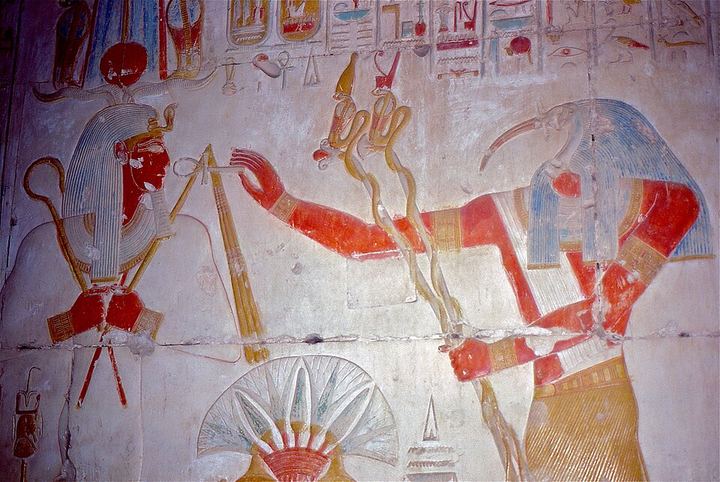
Thoth: Who Was the Egyptian God of Writing and Wisdom?Myth or legendMillions of mummified ibis birds were buried in catacombs as offerings to Thoth, the ibis-headed Egyptian god of writing and the moon. Stories give him hidden writings too, including a Book of Thoth locked in nested boxes at the bottom of the Nile; reading it brought disaster on the man who took it. What did it say?
Where this comes from
EvidenceDocumented
Comes fromThe Emerald Tablet, Emerald Tablet (Tabula Smaragdina), read here in the Isaac Newton. A short, mysterious text, known for the idea that what is below is like what is above. It is said to be by Hermes Trismegistus, a legendary wise man linked with the Egyptian god Thoth.
What this means
The text exists and is quoted from a published translation. What it describes is a separate question.
Primary records exist: an original document, a published text, an official file or a dated report. We link to them. This level says the record exists and what it says, not that every claim in it is true.
The Emerald TabletA short, mysterious text, known for the idea that what is below is like what is above. It is said to be by Hermes Trismegistus, a legendary wise man linked with the Egyptian god Thoth. The oldest known versions are in Arabic, from the early Middle Ages. Isaac Newton made his own translation around 1680.Isaac Newton, English translation of the Emerald Tablet (c. 1680; Keynes MS 28)Primary textArchived copy, 2026-09-22
The Corpus HermeticumA set of Greek religious and philosophical writings credited to Hermes Trismegistus, written in Roman Egypt around AD 100 to 300. When Marsilio Ficino put them into Latin in 1463, many thought they were older than Moses; in 1614 Isaac Casaubon showed they were much later.Corpus Hermeticum I–XIII, trans. G. R. S. Mead (sacred-texts.com)Primary textArchived copy, 2026-10-03
Plato's PhaedrusA dialogue Plato wrote in Athens around 370 BC about love and good speaking. In it Socrates tells how the Egyptian god Thoth offered writing to a king, who warned that it would weaken people's memory.Plato, Phaedrus 274c–275b, trans. Benjamin JowettPrimary textArchived copy, 2026-09-27
Scholarly dates are rounded. The wording follows the named public-domain translation.
More from Egypt and Hermes
Two more stories, and what each shares with The Emerald Tablet of Hermes.
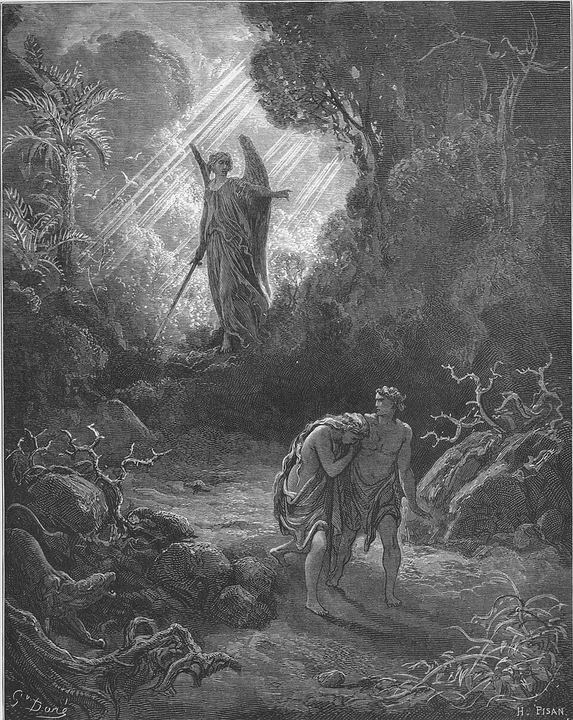
After God drives the first man out of the garden of Eden, the text says he places cherubim at its east side, along with a flaming sword that turns every way.