












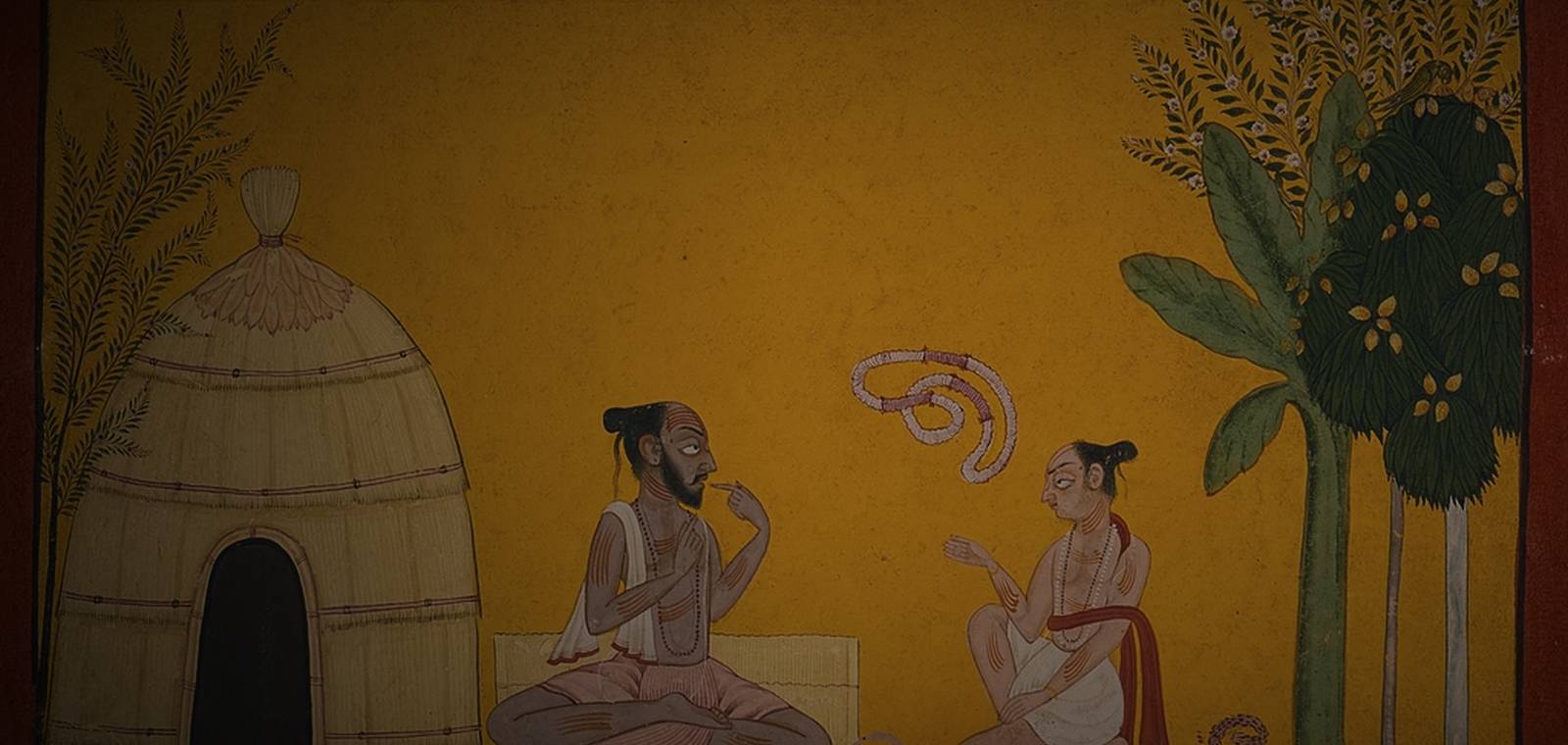
What is Valmiki known for?
Valmiki is the sage traditionally credited with composing the Ramayana in Sanskrit. Tradition calls him the Adi Kavi, the first poet: a well-known story says the first shloka verse came to him in grief after seeing a hunter kill one of a pair of mating cranes. A later legend says he had been a robber before becoming a sage.
Valmiki also appears inside his own epic. In its final book, he shelters the exiled Sita in his hermitage and teaches the poem to her twin sons, Lava and Kusha.
Nothing is known of Valmiki as a historical person. Scholars see the Ramayana as a work that grew over centuries; Britannica dates its composition to probably not before 300 BCE, with the first and last books generally regarded as later layers. The text runs to about 24,000 couplets in seven books.
Titles and honors
- Titles
- Adi Kavi (First Poet) and Maharishi (Great Sage)
Mentioned on these pages
- FilePushpaka Vimana
- PassagePushpaka, the flying car (Ramayana, Book VI)
- PersonLakshmana
- PersonRalph T. H. Griffith
- PersonRama
- PersonRavana
- PersonSita
Where this comes from
Comes from Valmiki, Ramayana, trans. Ralph T. H. Griffith, sacred-texts.com. The Ramayana: One of the two great Sanskrit epics of India, credited to the poet Valmiki. Prince Rama rescues his wife Sita from Ravana, demon king of Lanka, and they fly home in the Pushpaka, a flying chariot.
What this means
A story or tradition. It is documented as a story; nothing independent shows it happened.
Valmiki is known from stories, scripture or tradition. The texts are real and we quote them (for example Valmiki, Ramayana, trans. Ralph T. H. Griffith, sacred-texts.com), but nothing outside those texts shows that Valmiki was real as described.
The page covers something known from myths, scripture or tradition. The texts are real and we quote them, but no independent record shows the events or beings were real.
Sources
- The RamayanaOne of the two great Sanskrit epics of India, credited to the poet Valmiki. Prince Rama rescues his wife Sita from Ravana, demon king of Lanka, and they fly home in the Pushpaka, a flying chariot. Its core is often dated to the 500s to 300s BC. Ralph Griffith's English version came out from 1870 to 1874.Valmiki, Ramayana, trans. Ralph T. H. Griffith, sacred-texts.com Online copyPrimary text Archived copy, 2026-10-03
- Encyclopaedia BritannicaAn encyclopedia first published in Scotland in 1768 and now online. Its articles are written and checked by named experts and editors, which makes it a reliable source for basic facts.Encyclopaedia Britannica, 'Valmiki'Reference Archived copy, 2026-09-25
- Encyclopaedia BritannicaEncyclopaedia Britannica, 'Ramayana'Reference Archived copy, 2026-09-29
No public-domain picture of this person yet. We do not show drawn or generated likenesses.