How the rabbit hole works. Start with anything that grabs you, say UFOs. Every person, place and document a page mentions links to its own page, so a UFO file leads to a witness, the witness leads to the people who investigated the case, and it keeps going.
The path you take shows in the bar under the top menu on every page, so you can step back any time or climb out and start again.
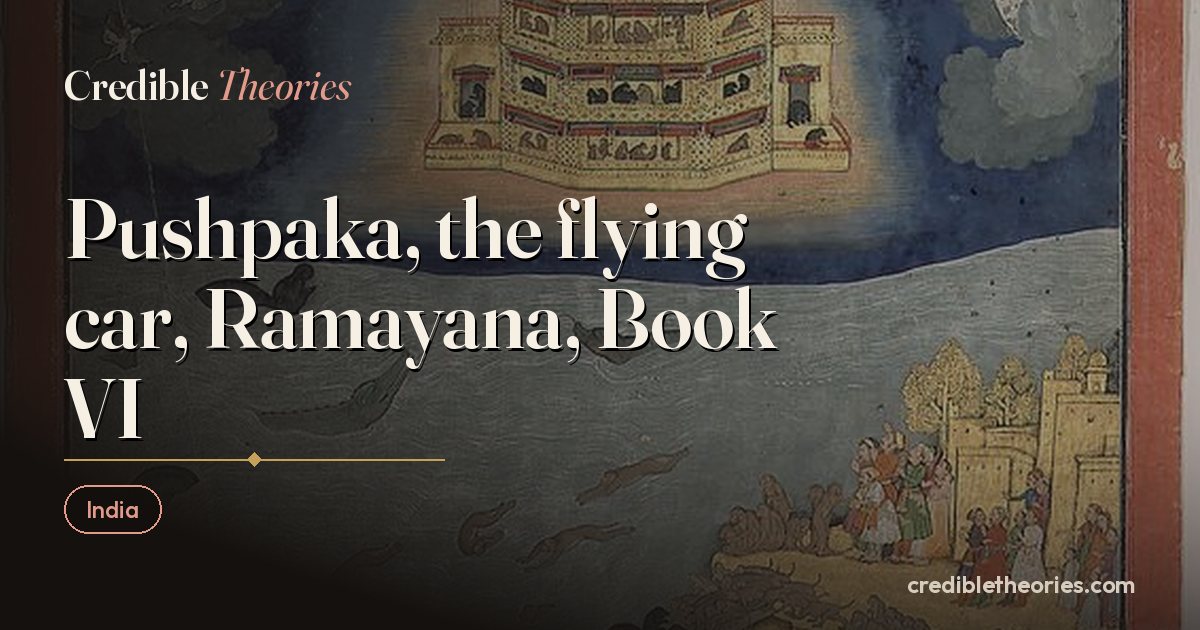
This is a summary from the Ramayana, one of the two great Sanskrit epics of India, written down around 500 BCE to 300 CE. The Pushpaka is a flying car built by a divine architect and stolen by the demon king Ravana. After winning the war, Prince Rama flies home in it with his army, and it moves as he wishes.
ReferenceRamayana, Book VI (Yuddha Kanda)
Writtenc. 500 BCE–300 CE, core older
SetTreta Yuga, the second age
Ravana stole the Pushpaka, a flying car built by the divine architect Vishvakarma for Kubera. After winning the war, Rama flies home to Ayodhya in it with his army, and it moves by his wish.
Where can I read the Ramayana in English for free?
Ralph T. H. Griffith's verse translation, The Rámáyan of Válmíki, is in the public domain and can be read free online, for example on Project Gutenberg and sacred-texts.com. Griffith was an English Sanskrit scholar who headed Benares College in India. The flight home appears in the Yuddha Kanda, the sixth of the epic's seven books.
Who wrote the Ramayana?
Hindu tradition names the sage Valmiki as its author and calls him the adi kavi, or 'first poet'. The Sanskrit epic runs to about 24,000 verses. Scholars think it was shaped over several centuries, and many regard the first and seventh books as later additions to an older core made up of books two to six.
Who first owned the Pushpaka, and what happens to it after Rama gets home?
Kubera, the god of wealth, was Ravana's half-brother; both were sons of the sage Vishrava. Ravana drove Kubera out of Lanka and took the vehicle. In Valmiki's telling, once Rama reaches Ayodhya he sends the Pushpaka back to serve Kubera, so it returns to its rightful owner.
Used on these files
Pushpaka Vimana: Ravana's Flying Palace in the RamayanaMyth or legendOn the flight home, Rama gives Sita an aerial tour of their own adventure, naming each place they fly over. The Ramayana's Pushpaka is a flying palace-car built by the gods' architect, stolen from the god of wealth by Ravana, and able to go wherever its owner wishes. Who steers it, and where does it land?
Where this comes from
EvidenceDocumented
Comes fromThe Ramayana, Ramayana, Book VI (Yuddha Kanda), read here in the Ralph T. H. Griffith. One of the two great Sanskrit epics of India, credited to the poet Valmiki. Prince Rama rescues his wife Sita from Ravana, demon king of Lanka, and they fly home in the Pushpaka, a flying chariot.
What this means
The text exists and is quoted from a published translation. What it describes is a separate question.
Primary records exist: an original document, a published text, an official file or a dated report. We link to them. This level says the record exists and what it says, not that every claim in it is true.
The RamayanaOne of the two great Sanskrit epics of India, credited to the poet Valmiki. Prince Rama rescues his wife Sita from Ravana, demon king of Lanka, and they fly home in the Pushpaka, a flying chariot. Its core is often dated to the 500s to 300s BC. Ralph Griffith's English version came out from 1870 to 1874.Ralph T. H. Griffith, The Rámáyan of Válmíki (1870–74)Primary textArchived copy, 2026-10-03