Credible Theories Sign in
Other traditions · Benjamin of Tudela, Itinerary, on Baalbek

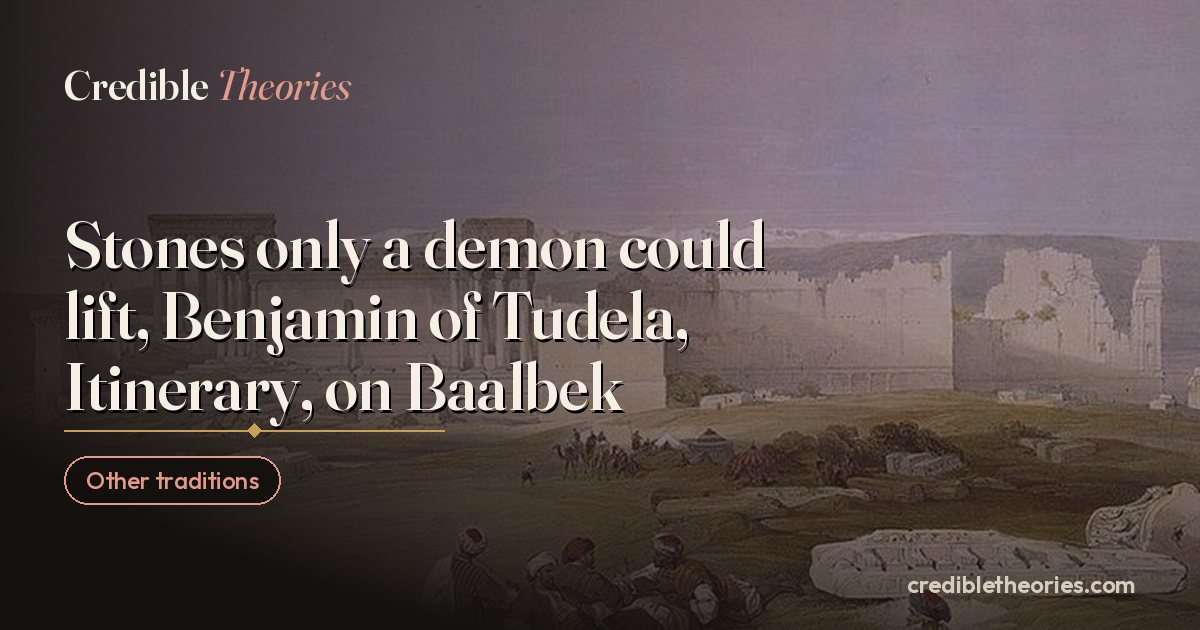
Stones only a demon could lift, Benjamin of Tudela, Itinerary, on Baalbek

Share

In plain words

Benjamin of Tudela, a traveler of the 1100s, passed through Baalbek. He linked it with a town in the Bible that Solomon built for Pharaoh's daughter. Its palace, he wrote, was made of huge stones fitted with no mortar, and people said only the demon king Ashmedai could have built it.

ReferenceBenjamin of Tudela, Itinerary, on Baalbek
WrittenWritten by Benjamin of Tudela about his travels in the 1100s
SetBaalbek, in the valley of Lebanon
This is the city, which is mentioned in scripture as Ba'alath in the valley of Lebanon, which Sh'lomo built for the daughter of Pharao. The palace is constructed of stones of enormous size, measuring twenty spans in length and twelve in breadth; no binding material holds these stones together and people pretend, that the building could have been erected only by the help of Ashmedai.

Documented · Medieval text, 1100 Translation: A. Asher, 1840

Read it literally

A Jewish traveler from Spain passes through Baalbek and records what local people said about its giant stones: that only Ashmedai, the king of the demons, could have set them. The Baalbek file sets his words beside the 1,650-ton block found in its quarry in 2014.

What scholars say

A traveler's account written from his own journey.

Themes Giants and hybrids Spirits and jinn
Questions people ask about Benjamin of Tudela, Itinerary, on Baalbek

Who was Ashmedai?

In Jewish tradition Ashmedai, called Asmodeus in Greek, is the king of the demons. Benjamin does not say he believed the story: he writes that people "pretend" it, in the old sense of claim.

How big is a span?

A span is the width of a spread hand, from thumb tip to little finger, roughly 9 inches. Twenty spans by twelve would be about 15 by 9 feet, far smaller than the largest blocks known today.

Used on these files

  • Baalbek and its giant stones DocumentedIn a Lebanese quarry lie the largest stone blocks known to have been cut in the ancient world, one of them about 1,650 tons. A traveler in the 1100s heard that only the demon king could have built the temple.

Where this comes from

EvidenceDocumented

Comes from A. Asher, Benjamin of Tudela, Itinerary, on Baalbek. Internet Archive: A nonprofit digital library in San Francisco, founded in 1996, that holds millions of scanned books, papers and recordings. A scan there shows the pages of a real printed book or document.

What this means

The text exists and is quoted from a published translation. What it describes is a separate question.

Primary records exist: an original document, a published text, an official file or a dated report. We link to them. This level says the record exists and what it says, not that every claim in it is true.

See all five labels

Sources

  1. Internet ArchiveA nonprofit digital library in San Francisco, founded in 1996, that holds millions of scanned books, papers and recordings. A scan there shows the pages of a real printed book or document.A. Asher, The Itinerary of Rabbi Benjamin of Tudela, vol. 1 (London and Berlin, 1840)Primary text
  2. Internet ArchiveBenjamin of Tudela, The Itinerary of Rabbi Benjamin of Tudela, trans. A. Asher, vol. 1 (London and Berlin, 1840), pp. 86-87Primary text

Scholarly dates are rounded. The wording follows the named public-domain translation.

More from Other traditions

Two more stories, and what each shares with Stones only a demon could lift.

Photo credits
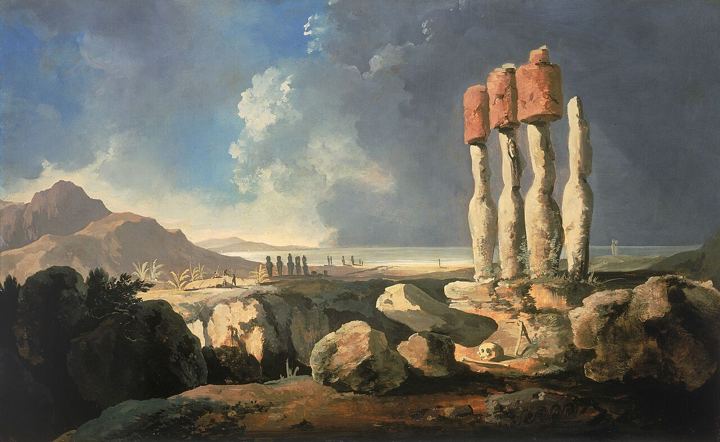
‹ Before thisStone figures too tall for the timberJacob Roggeveen, official log, April 1722

Jacob Roggeveen led a Dutch voyage that reached Easter Island in April 1722.

Same theme: Giants and hybrids
Photo credits
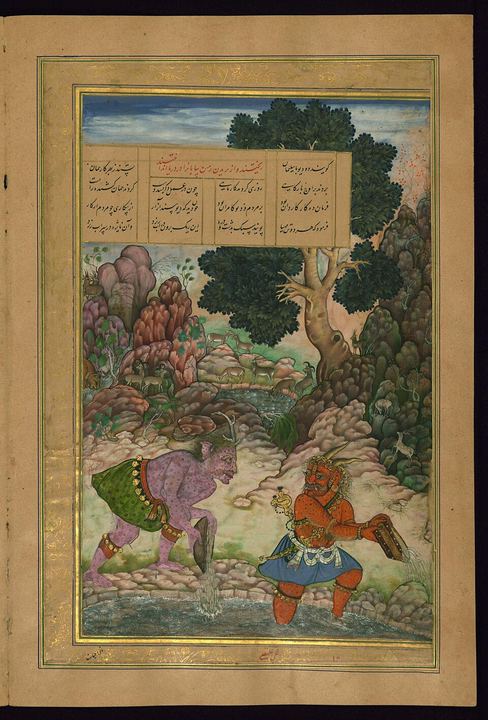
RelatedSolomon's ring and the demons who buildTestament of Solomon 1–26

The archangel Michael brings King Solomon a ring with a seal.

Also about SolomonSame theme: Spirits and jinn

Updated

Discussion