How the rabbit hole works. Start with anything that grabs you, say UFOs. Every person, place and document a page mentions links to its own page, so a UFO file leads to a witness, the witness leads to the people who investigated the case, and it keeps going.
The path you take shows in the bar under the top menu on every page, so you can step back any time or climb out and start again.
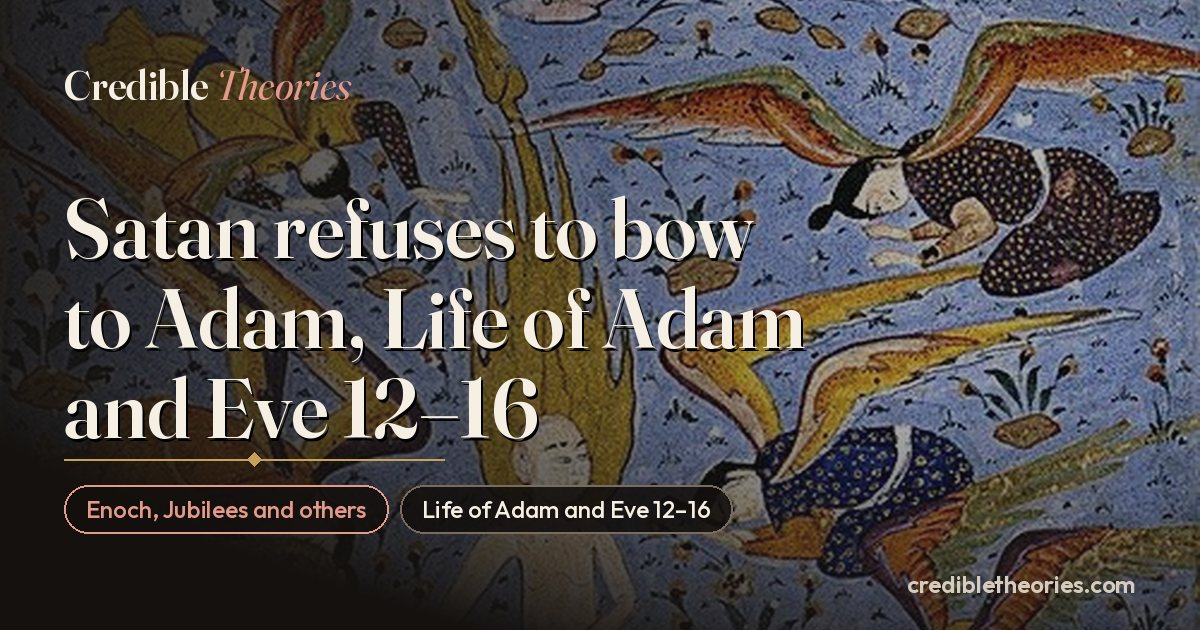
This is a summary of a passage from the Life of Adam and Eve, a Jewish or early Christian story about Adam and Eve's life after Eden, which many scholars place in the first centuries AD. Satan tells Adam he was thrown out of heaven for refusing to worship Adam, since Satan was older. Other angels under him refused too and were cast down.
ReferenceLife of Adam and Eve 12–16
Writtenc. 100–300 CE
SetCreation
Satan tells Adam he was thrown out of heaven because he would not worship Adam, the image of God. 'I am older than he; he ought to worship me.' Other angels under him refused too, and they were cast down.
Documented · Retold in English, c. 100–300 CE Summary by the editors. Translation: Summary in my own words
AdvertisementAd space
Read it literally
The fall starts with jealousy toward humans, the new creation. The visitors resented us.
What scholars say
Latin and Greek versions; the same scene is in Quran 7 and 15.
Questions people ask about Life of Adam and Eve 12–16
When was the Life of Adam and Eve written?
Scholars usually date it to roughly the first to third centuries CE, but they disagree on whether it began as a Jewish or a Christian work. It survives in several forms: a Latin version called Vita Adae et Evae, a Greek version misleadingly titled the Apocalypse of Moses, and Armenian, Georgian and Slavonic versions.
What is going on when Satan tells this story?
After leaving Eden, Adam and Eve do penance by standing in rivers, Adam in the Jordan for forty days and Eve in the Tigris. Satan, disguised as a bright angel, tricks Eve into leaving the water early. When Adam asks why he hates them, Satan explains his grudge. Adam then prays to God, and the devil vanishes.
How does the Quran tell the story of Iblis refusing to bow?
The scene appears several times, including Surahs 2, 7, 15, 17, 18, 20 and 38. Iblis argues he is better than Adam because he was made from fire and Adam from clay. Surah 18:50 says he was one of the jinn. God grants him a delay until the Day of Judgment, and he vows to lead humans astray.
Where this comes from
EvidenceDocumented
Comes fromThe Life of Adam and Eve, Life of Adam and Eve 12–16. A Jewish or early Christian story about Adam and Eve's life after Eden, including the tale that Satan fell because he refused to bow to Adam. Scholars disagree on its date; many place it in the first centuries AD. It survives in Latin, Greek and other versions.
What this means
The text exists and is quoted from a published translation. What it describes is a separate question.
Primary records exist: an original document, a published text, an official file or a dated report. We link to them. This level says the record exists and what it says, not that every claim in it is true.