How the rabbit hole works. Start with anything that grabs you, say UFOs. Every person, place and document a page mentions links to its own page, so a UFO file leads to a witness, the witness leads to the people who investigated the case, and it keeps going.
The path you take shows in the bar under the top menu on every page, so you can step back any time or climb out and start again.
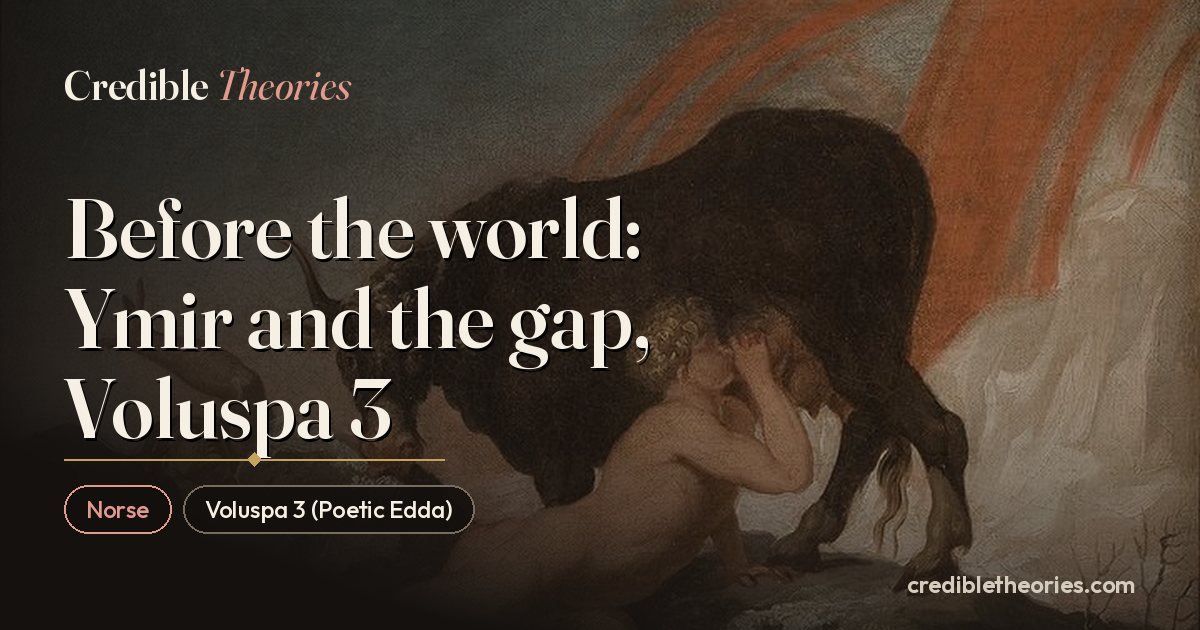
This is a short passage from the Poetic Edda, a collection of Old Norse poems about the gods and the world's beginning and end, composed around 900 to 1100 CE. These lines describe the time before creation, when a being named Ymir lived. There was no sea, sand, earth or sky yet, only a huge empty gap.
ReferenceVoluspa 3 (Poetic Edda)
WrittenPoems c. 900–1100 CE; written down c. 1270
SetBefore creation
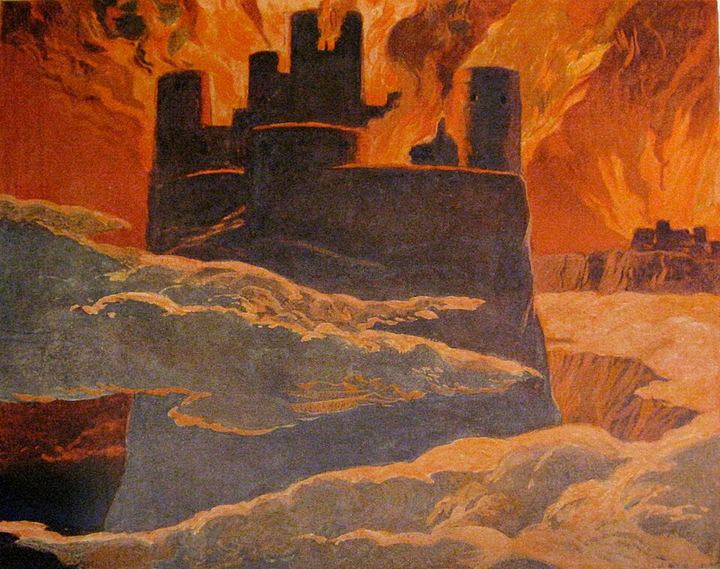
Of old was the age when Ymir lived; Sea nor cool waves nor sand there were; Earth had not been, nor heaven above, But a yawning gap, and grass nowhere.
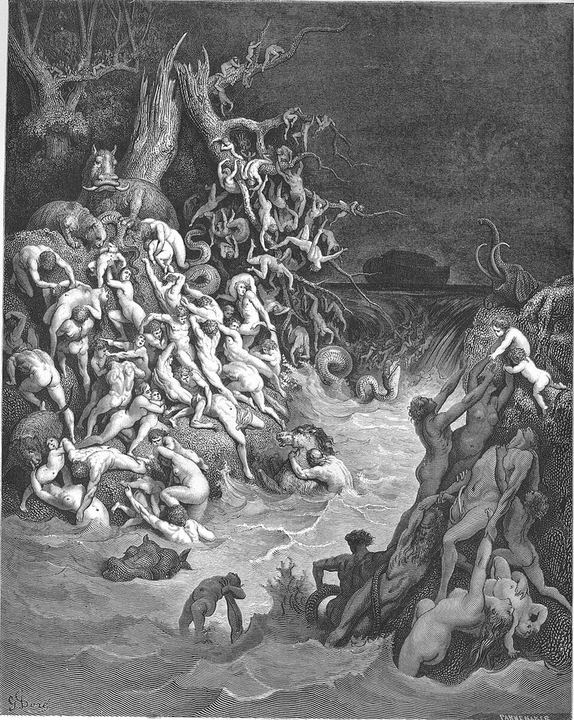
A god warns one good man, a boat is built, the world drowns and birds are sent out to find land. The same story turns up from Iraq to India to Greece, with cousins in China, Scandinavia and Guatemala.
Prose Edda, Gylfaginning (Bergelmer) is one telling. The same story is told 9 more times, in 6 parts of the world. Follow it:
Before anything existed there was dark water. Or an egg. Babylon, Genesis, the Rig Veda, Egypt, Finland and the Quran all start the world in almost the same place.
Poetic Edda, Voluspa is one telling. The same story is told 9 more times, in 5 parts of the world. Follow it:
The open question: Why would people who never met all start the world in dark water? A shared idea, or the most natural guess anyone would make? Join the debate
Genesis has the Nephilim, Greece has the Giants, the North has the frost giants, Arabia has the tall people of 'Ad and the Maya have Zipacna, who piled up mountains. Why does almost everyone remember giants?
Prose Edda, Gylfaginning (Ymir and the frost giants) is one telling. The same story is told 7 more times, in 4 parts of the world. Follow it:
The open question: Real bones dug up and explained, a memory of older peoples, or something else that made giants a story almost everywhere? Join the debate
Questions people ask about Voluspa 3
What is the Voluspa?
The name means Prophecy of the Seeress. It is the opening poem of the Codex Regius, a collection of Old Norse poems. A wise woman tells Odin the history of the world, from its making through Ragnarok to a new green earth. The manuscript was given to the Danish king in 1662 and returned to Iceland in 1971.
How was the world made from Ymir?
In Norse myth, Ymir formed where the ice of Niflheim met the heat of Muspelheim inside the empty gap called Ginnungagap. Odin and his brothers Vili and Ve killed him and built the world from his body: soil from the flesh, seas from the blood, mountains from the bones and the sky from the skull. Snorri Sturluson tells this in his Prose Edda.
Is there more than one version of the Voluspa?
Yes. Besides the Codex Regius, a second copy appears in Hauksbok, an Icelandic manuscript from the early 1300s, with some stanzas missing or placed in a different order. Snorri Sturluson also quoted many of its verses in his Prose Edda around 1220. Modern editions combine these sources, so stanza numbers can differ between translations.
Used on these files
Tiamat: The Primeval Sea Whose Body Became the WorldMyth or legendIn the Babylonian creation epic, the Tigris and Euphrates flow out of the eyes of a dead goddess; Tiamat is the primeval salt sea and mother of the first gods. She prepares for war, gives birth to eleven kinds of monsters, and then her split body becomes the sky and the earth. Who won?
Ymir: The First Giant and the Body That Became the WorldMyth or legendIn Norse myth, the world was built from a butchered giant: his flesh became earth, his blood the sea, his skull the sky. The story says the gods themselves descend from giants. How did a cow, a flood of blood and a lone survivor get the cosmos started? Read what the old poems and Snorri tell.
Where this comes from
EvidenceDocumented
Comes fromThe Poetic Edda, Voluspa 3 (Poetic Edda), read here in the Henry Adams Bellows. A collection of Old Norse poems about gods such as Odin and Thor and about the world's beginning and end. The poems are older, but they survive mainly in one Icelandic manuscript of about 1270, found in 1643 and now in Reykjavik.
What this means
The text exists and is quoted from a published translation. What it describes is a separate question.
Primary records exist: an original document, a published text, an official file or a dated report. We link to them. This level says the record exists and what it says, not that every claim in it is true.
The Poetic EddaA collection of Old Norse poems about gods such as Odin and Thor and about the world's beginning and end. The poems are older, but they survive mainly in one Icelandic manuscript of about 1270, found in 1643 and now in Reykjavik. Henry Adams Bellows's English version came out in 1923.Henry Adams Bellows, The Poetic Edda (1923)Online copyPrimary textArchived copy, 2026-08-20