How the rabbit hole works. Start with anything that grabs you, say UFOs. Every person, place and document a page mentions links to its own page, so a UFO file leads to a witness, the witness leads to the people who investigated the case, and it keeps going.
The path you take shows in the bar under the top menu on every page, so you can step back any time or climb out and start again.
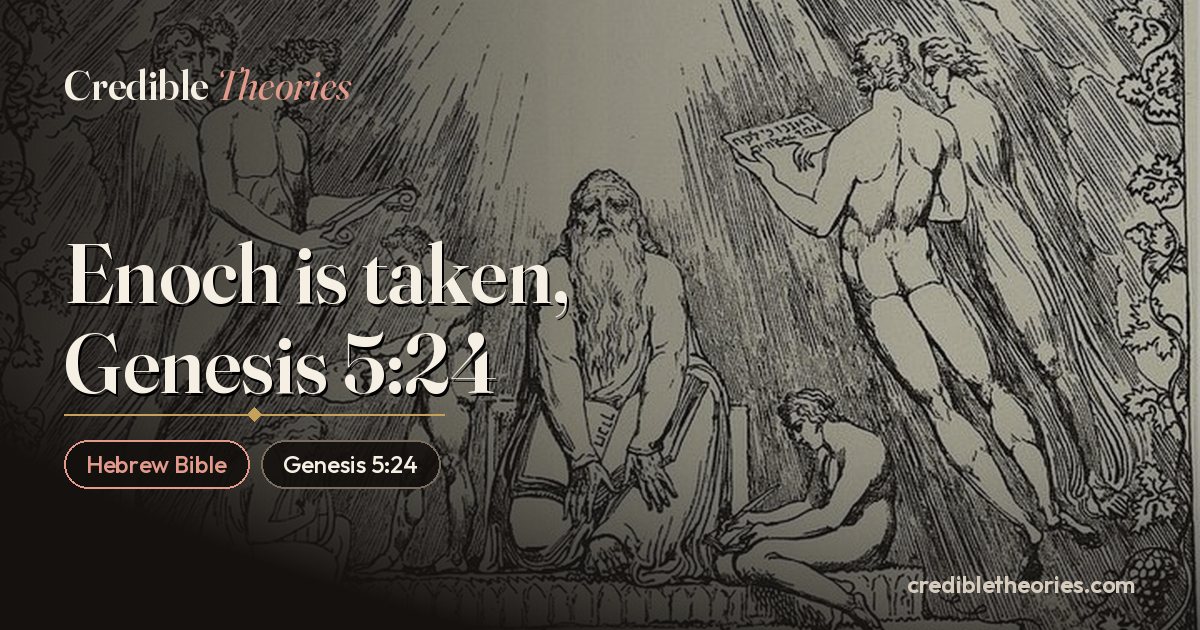
This is a single line from Genesis, the first book of the Bible, written around 600 to 400 BCE. It is about Enoch, a man from the seventh generation after Adam. Instead of saying he died, the text says Enoch "walked with God" and then "was not; for God took him." Later Jewish writers turned this one line into whole books.
ReferenceGenesis 5:24
Writtenc. 600–400 BCE (priestly source)
SetSeventh generation from Adam
And Enoch walked with God: and he was not; for God took him.
Documented · Ancient text, c. 600–400 BCE Translation: KJV
AdvertisementAd space
Read it literally
He did not die. He left. Enoch lived 365 years, the number of days in a solar year, which fits a man who was taught astronomy by the visitors.
What scholars say
One line in Genesis that later Jewish writers expanded into whole books.
Enoch, Elijah, Romulus, Heracles, Krishna and Jesus all leave the earth by going up: in a whirlwind, a cloud, a storm or a blaze of light. The stories quoted side by side.
Genesis 5:24 (Enoch) is one telling. The same story is told 6 more times, in 3 parts of the world. Follow it:
The open question: Why do so many stories end with a great figure leaving the earth alive instead of dying like everyone else? Join the debate
Questions people ask about Genesis 5:24
Who were Enoch's father and son?
Genesis 5 names his father as Jared and his son as Methuselah, born when Enoch was 65. Methuselah's son was Lamech, the father of Noah, so Enoch was Noah's great-grandfather. A different Enoch appears in Genesis 4, a son of Cain, after whom Cain names the first city.
What does the New Testament say about Enoch?
Hebrews 11:5 says that by faith Enoch was translated so he would not see death, and that he pleased God. Luke 3:37 includes him in the family line of Jesus. The Letter of Jude quotes a prophecy credited to him, which comes from the Book of Enoch.
How do Jewish interpreters read Genesis 5:24?
Opinions differ. Some early rabbis, in the midrash Genesis Rabbah, argued that God took Enoch early because he wavered between good and evil, so the phrase meant he died. Other Jewish traditions, such as the books of Enoch and later mystical texts, saw him taken up to heaven alive. Muslims widely identify him with the prophet Idris.
Used on these files
Enoch: The Man Who Walked With God and Was NotMyth or legendGenesis spends only a few lines on Enoch, and then breaks its own pattern. Everyone else in his family line dies, but of him it says only that God took him. He lived 365 years, the same number as days in a solar year. That odd ending sparked a whole library of visions, still being read today.
Where this comes from
EvidenceDocumented
Comes fromThe Book of Genesis, Genesis 5:24, read here in the King James Version. The first book of the Bible, telling of Creation, Adam and Eve, Noah's Flood and the families of Abraham, Isaac and Jacob. Scholars think it was written and edited over several centuries and finished by roughly 500 to 400 BC. The oldest surviving copies are pieces of the Dead Sea Scrolls.
What this means
The text exists and is quoted from a published translation. What it describes is a separate question.
Primary records exist: an original document, a published text, an official file or a dated report. We link to them. This level says the record exists and what it says, not that every claim in it is true.
The King James BibleThe English Bible made for King James I and first printed in 1611; the wording most people know comes from a 1769 update. It is out of copyright, which is why we quote it. The 1611 printing also had the Apocrypha, extra books kept in Catholic and Orthodox Bibles.King James Version (1611; standard 1769 text), with ApocryphaPrimary textArchived copy, 2026-10-03
The Book of GenesisThe first book of the Bible, telling of Creation, Adam and Eve, Noah's Flood and the families of Abraham, Isaac and Jacob. Scholars think it was written and edited over several centuries and finished by roughly 500 to 400 BC. The oldest surviving copies are pieces of the Dead Sea Scrolls.Genesis 5:18–24, King James VersionOnline copyPrimary textArchived copy, 2026-10-03
Scholarly dates are rounded. The wording follows the named public-domain translation.
More from Hebrew Bible
The story before and after this one, and what each shares with Enoch is taken.
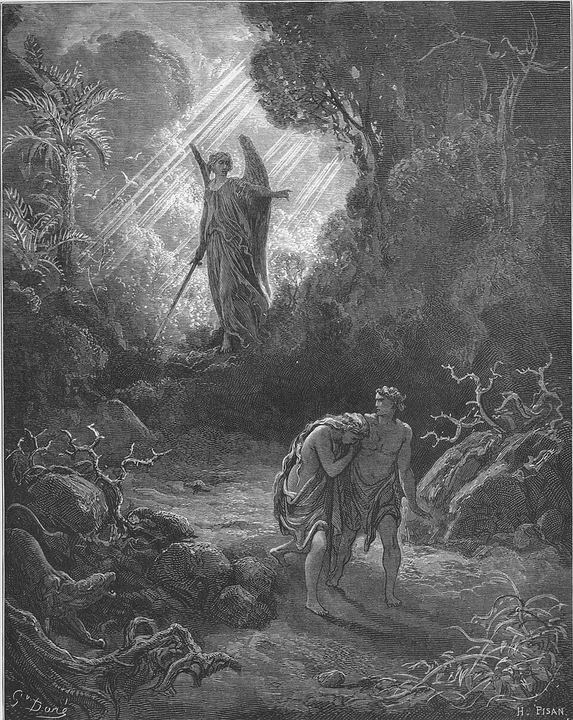
After God drives the first man out of the garden of Eden, the text says he places cherubim at its east side, along with a flaming sword that turns every way.